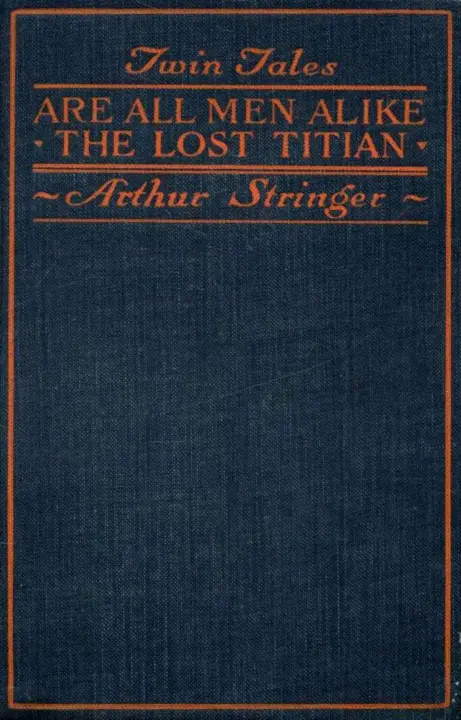
Twin Tales: Are All Men Alike, and, The Lost Titian
Arthur Stringer
THE CLASSIC COLLECTION · 1913
"The Shadow" by Arthur Stringer is a novel written in the early 20th century. The story introduces the readers to Jim Blake, the Second Deputy Commissioner of Police, who is deeply embroiled in the investigation of a notorious criminal named Connie Binhart. The novel explores themes of law, morality, and the complexities of human relationships, particularly through the dynamic between Blake and a woman named Elsie. At the start of the book, Jim Blake receives a visit from Elsie Verriner, a woman with a mysterious past, who has been linked to various crimes. Their conversation reveals both tension and a complicated past, marked by instances where Blake has had to confront her involvement in criminal activities. As he navigates his duties within the police force and his complex feelings for Elsie, Blake learns about Connie Binhart's whereabouts, leading to a tense negotiation of trust and manipulation. The opening sets the stage for an intriguing interplay of crime and personal relationships, hinting at Blake's determination to capture Binhart and his complicated feelings for Elsie, who may still be entangled with the criminal world.
Introduction adapted from the source catalogue; source summaries may be automatically generated.
Free to read · English · 50,449 words · No account needed
MAKE TIME FOR A GOOD BOOK
On by default. Untick to stop anonymous reading totals. Each page counts after 10 seconds in view. How this works.
Anonymous counting is on unless you have switched it off.
He had thrown his head up, at the sound of the opening door, and he still sat, leaning forward in the low chair in an attitude of startled expectancy. There was no outward and apparent change on his face as his eyes fell on Blake’s figure. He showed neither fear nor bewilderment. His career had equipped him with histrionic powers that were exceptional. As a bank-sneak and confidence-man he had long since learned perfect control of his features, perfect composure even under the most discomforting circumstances.
“Hello, Connie!” said the detective facing him. He spoke quietly, and his attitude seemed one of unconcern. Yet a careful observer might have noticed that the pulse of his beefy neck was beating faster than usual. And over that great body, under its clothing, were rippling tremors strangely like those that shake the body of a leashed bulldog at the sight of a street cat.
“Hello, Jim!” answered Binhart, with equal composure. He had aged since Blake had last seen him, aged incredibly. His face was thin now, with plum-colored circles under the faded eyes.
He made a move as though to lift down the valise that rested on his knees. But Blake stopped him with a sharp movement of his right hand.
“That’s all right,” he said. “Don’t get up!”
Binhart eyed him. During that few seconds of silent tableau each man was appraising, weighing, estimating the strength of the other.
“What do you want, Jim?” asked Binhart, almost querulously.
“I want that gun you’ve got up there under your liver pad,” was Blake’s impassive answer.
“Is that all?” asked Binhart. But he made no move to produce the gun.
“Then I want you,” calmly announced Blake.
A look of gentle expostulation crept over Binhart’s gaunt face.
“You can’t do it, Jim,” he announced. “You can’t take me away from here.”
“But I’m going to,” retorted Blake.
“How?”
“I’m just going to take you.”
He crossed the room as he spoke.
“Give me the gun,” he commanded.
Binhart still sat in the low reed chair. He made no movement in response
to Blake’s command.
“What’s the good of getting rough-house,” he complained.
“Gi’ me the gun,” repeated Blake.
“Jim, I hate to see you act this way,” but as Binhart spoke he slowly drew the revolver from its flapped pocket. Blake’s revolver barrel was touching the white shirt-front as the movement was made. It remained there until he had possession of Binhart’s gun. Then he backed away, putting his own revolver back in his pocket.
“Now, get your clothes on,” commanded Blake.
“What for?” temporized Binhart.
Your reading position is saved on this browser. Take it to another device with a library code. Reading pages adapt to text, rather than matching a printed edition.
Arthur Stringer
Arthur Stringer
Arthur Stringer
Arthur Stringer
BEHIND THE BOOK
This eBook is for the use of anyone anywhere in the United States and most other parts of the world at no cost and with almost no restrictions whatsoever. You may copy it, give it away or re-use it under the terms of the Project Gutenberg License included with this eBook or online at www.gutenberg.org. If you are not located in the United States, you will have to check the laws of the country where you are located before using this eBook. Read the source licence.
The original source file, including credits and licence, is retained by this library. Request an original-format copy at no charge. Please include the book title and Project Gutenberg identifier #44336.
KEEP YOUR CURIOSITY GOING
Coulson Kernahan

Maurice Baring
Frances Wright
Cécile Tormay

Frederic Jesup Stimson

W. H. P. (William Henry Pope) Jarvis