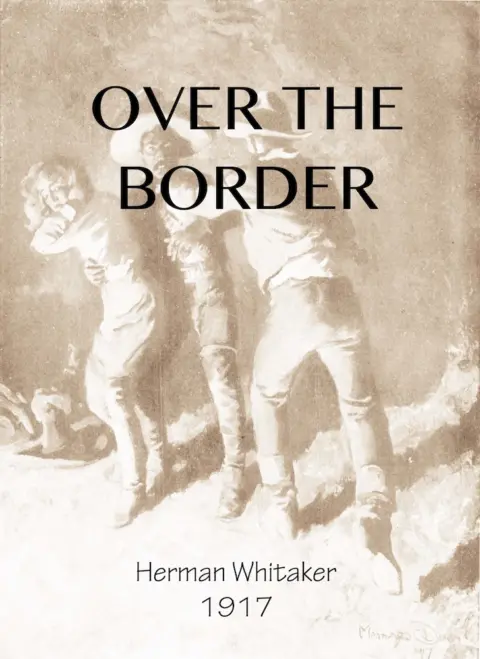
Over the Border: A Novel
Herman Whitaker
THE CLASSIC COLLECTION · 1906
"The Settler" by Herman Whitaker is a novel written in the early 20th century. It explores the lives of settlers in the Canadian prairie, focusing on their struggles and triumphs in establishing a home amidst the challenges of a harsh landscape. The story revolves around characters such as Carter, a strong and capable settler, and Morrill, who faces illness while trying to support his sister Helen, highlighting themes of resilience, community conflict, and the complexities of frontier life. At the start of the novel, readers are introduced to the rich but contentious landscape of the Canadian prairie, where settlers navigate both the physical challenges of farming and the social dynamics of their community. The narrative opens with a vivid description of the setting, showcasing the beauty and harshness of the land through the eyes of Carter, a dedicated worker who is concerned about the welfare of his sick neighbor, Morrill. As Morrill prepares for the arrival of his sister, Helen, who is coming to help him, we see the brewing tensions as neighbors begin to encroach on each other's resources. The scene is set for conflicts and relationships that will unfold as the characters strive to build their lives in a new and often unforgiving environment.
Introduction adapted from the source catalogue; source summaries may be automatically generated.
Free to read · English · 104,969 words · No account needed
MAKE TIME FOR A GOOD BOOK
On by default. Untick to stop anonymous reading totals. Each page counts after 10 seconds in view. How this works.
Anonymous counting is on unless you have switched it off.
"Come ye! Come ye to the Lord!" The preacher pleaded, but, haughty and coldly constrained, the remittance-men ignored the invitation; and so, for the space of a thunderous hymn of praise, gnostic civilization and the fervid frontier faced each other across the middle benches. From that dramatic setting anything might come. Moment, feeling, atmosphere, all pointed to the event that came to pass as the hymn died.
Leaping upon a bench, and so adding its height to unusual tallness, a woman pointed a warning hand at the unbelievers. Thin, family-worn, and naturally cadaverously yellow, she was now flushed with the fever of delirium. "In that day," she screeched, "the Tares shall be separated from the Wheat and cast with the grass into the oven!" Then, while her finger indicated man after man, she raised the grewsome hymn:
"'I heard the Sinners Wailing, Wailing, Wailing, I heard the Sinners Wailing on that Great Day!'"
Travelling around the benches, her skinny finger finally fastened on Helen, and, as the lugubrious refrain came to an end, she burst forth in tremendous paraphrase: "Beware ye of the Scarlet Woman! Avoid ye, for her portals lead down to Death; her feet take hold of Hell!"
The silence of paralysis followed. So still it was that a mosquito's thin whine sounded through the tent, the tinkle of a cow-bell came in from far pastures, a dog could be heard barking a long way off. Swinging from the tent-pole, a circle of lanterns lit dark, flushed faces, and thus, for the space of a long breath, Helen faced the virago, the one glowering, malignant, the other pale with astonishment, mutely indignant. She was not confused. On the contrary, thought and vision were surprisingly clear; she noted Mrs. Glaves's shocked look, the vindictive settler faces, the Englishmen's blank expressions.
"We had better go. May I drive home, Mrs. Carter?" Danvers, the witless, the foolish, rose to the situation.
Low-pitched, his voice yet carried to every ear, as did her clear reply:
"After the service is over."
It was defiance as well as answer, and as she threw it in the lowering face of the congregation, her glance fixed on the evangelist who, till then, had stood, mouth open, hand arrested midway of a gesture, a bearded, spectacled effigy of ridiculous surprise. Starting under her pale scorn, he flushed, looked for a second through shining, bewildered glasses, then strode forward and seized the virago's arm.
"Sister, sister! Judge not that ye be not judged!" Then, himself again, he swept a pudgy hand over the benches. "Sit down, all! Brother Cummings will lead in prayer."
Your reading position is saved on this browser. Take it to another device with a library code. Reading pages adapt to text, rather than matching a printed edition.
BEHIND THE BOOK
This eBook is for the use of anyone anywhere in the United States and most other parts of the world at no cost and with almost no restrictions whatsoever. You may copy it, give it away or re-use it under the terms of the Project Gutenberg License included with this eBook or online at www.gutenberg.org. If you are not located in the United States, you will have to check the laws of the country where you are located before using this eBook. Read the source licence.
The original source file, including credits and licence, is retained by this library. Request an original-format copy at no charge. Please include the book title and Project Gutenberg identifier #43450.
KEEP YOUR CURIOSITY GOING
Coulson Kernahan

Maurice Baring
Frances Wright
Cécile Tormay

Frederic Jesup Stimson

W. H. P. (William Henry Pope) Jarvis