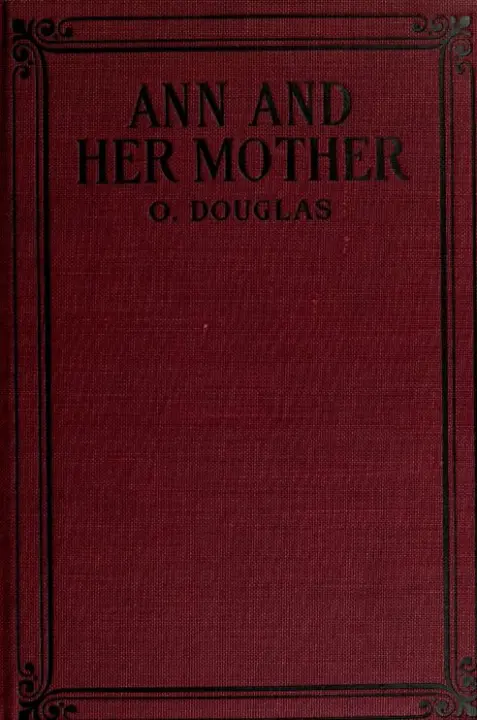
Ann and Her Mother
O. Douglas
THE CLASSIC COLLECTION · 1900
"The Setons" by O. Douglas is a novel written in the early 20th century. Set in Glasgow, the story unfolds the everyday lives of the Thomson family, particularly focusing on their evening party and various interactions with friends and neighbors. The narrative follows characters such as Mr. and Mrs. Thomson, their children Jessie and Alick, along with guests like the endearing yet comical Mr. Taylor. The book captures themes of social class, familial bonds, and the importance of community. At the start of the novel, we are introduced to the Thomson family as they prepare for an evening party, revealing their dynamics and personalities. Mr. Thomson arrives home with a pineapple for the occasion, sparking lively conversations among family members about food, social status, and the guests who are invited. As the guests arrive, a mix of excitement and anxiety unfolds, particularly for Jessie, who is conscious of the way her family's social standing is perceived by others. The atmosphere is filled with a blend of warmth, humor, and underlying tensions characteristic of a gathering where people from varying backgrounds come together. The opening chapters paint a vivid picture of family life and societal expectations at the time, setting the stage for further developments in the social interactions and character arcs throughout the novel.
Introduction adapted from the source catalogue; source summaries may be automatically generated.
Free to read · English · 76,223 words · No account needed
MAKE TIME FOR A GOOD BOOK
On by default. Untick to stop anonymous reading totals. Each page counts after 10 seconds in view. How this works.
Anonymous counting is on unless you have switched it off.
"Me? Naw!" He looked up with an impudent grin. "A'm what ye ca' a Jew."
Elizabeth smiled down at the little snub-nosed face. "No, my son. Whatever you are, you're not that. Listen--d'you know the church just round the corner?"
"Seton's kirk?"
"Yes. Seton's kirk. I have a class there every Sunday afternoon at five o'clock--six boys just about your age. Will you come?"
"A hevna claes nor naething."
"Never mind; neither have the others. What's your name?"
"Bob Scott."
"Well, Bob, I do wish you'd promise. We have such good times."
Bob looked sceptical.
"A whiles gang to Sabbath schules," he said, "juist till the swuree comes aff, and then A leave." His tone suggested that in his opinion Sabbath schools and good times were things far apart.
"I see. Well, we're having a Christmas-tree quite soon. You might try the class till then. You'll come some Sunday? That's good. Now, if I were you I would go home out of the rain."
Bob had resumed his whittling, and he looked carefully at his work as
he said:
"I canna gang hame for ma faither: he's drunk, and he'll no' let's in."
"Have you had any dinner?"
"Uch, no. A'm no heedin' for't," with a fine carelessness.
Elizabeth tilted her umbrella over her shoulder the better to survey the situation. There was certainly little prospect of refreshment in this grey street which seemed to contain nothing but rain, but the sharp ting-ting of an electric tram passing in the street above brought her an idea, and she caught the boy's arm.
"Come on, Bob, and we'll see what we can get."
Two minutes brought them to a baker's shop, with very good-looking things in the window and a fat, comfortable woman behind the counter.
"Isn't this a horrible day, Mrs. Russel?" said Elizabeth. "And here's a friend of mine who wants warming up. What could you give him to eat, I wonder?"
Mrs. Russel beamed as if feeding little dirty ragged boys was just the thing she liked best to do.
"It's an awful day, as you say, Miss Seton, an' the boy's wet through. Whit would ye say to a hot tupp'ny pie an' a cup-o'-tea? The kettle's juist on the boil; I've been havin' a cup masel'--a body wants something to cheer them this weather." She laughed cheerily. "He could take it in at the back--there's a rare wee fire."
"That'll be splendid," said Elizabeth; "won't it Bob?"
"Ay," said Bob stolidly, but his little impudent starved face had an
eager look.
Elizabeth saw him seated before the "rare wee fire" wolfing "tupp'ny pies," then she gathered up her collecting papers and prepared to go.
Your reading position is saved on this browser. Take it to another device with a library code. Reading pages adapt to text, rather than matching a printed edition.
BEHIND THE BOOK
This eBook is for the use of anyone anywhere in the United States and most other parts of the world at no cost and with almost no restrictions whatsoever. You may copy it, give it away or re-use it under the terms of the Project Gutenberg License included with this eBook or online at www.gutenberg.org. If you are not located in the United States, you will have to check the laws of the country where you are located before using this eBook. Read the source licence.
The original source file, including credits and licence, is retained by this library. Request an original-format copy at no charge. Please include the book title and Project Gutenberg identifier #35218.
KEEP YOUR CURIOSITY GOING
Coulson Kernahan

Maurice Baring
Frances Wright
Cécile Tormay

Frederic Jesup Stimson

W. H. P. (William Henry Pope) Jarvis