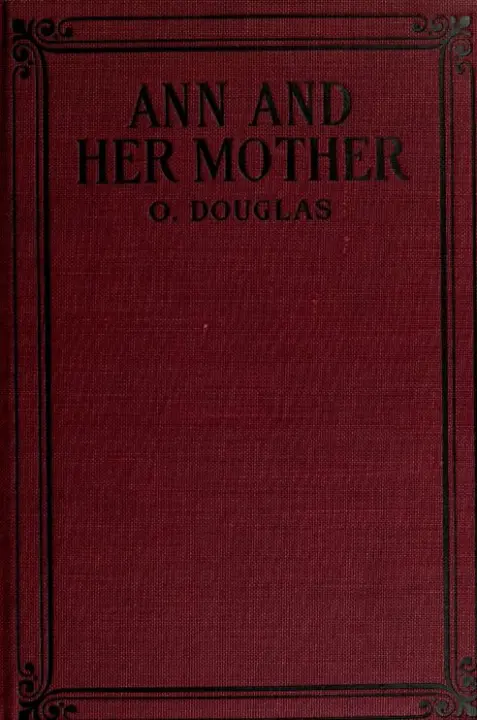
Ann and Her Mother
O. Douglas
THE CLASSIC COLLECTION · 1900
"The Setons" by O. Douglas is a novel written in the early 20th century. Set in Glasgow, the story unfolds the everyday lives of the Thomson family, particularly focusing on their evening party and various interactions with friends and neighbors. The narrative follows characters such as Mr. and Mrs. Thomson, their children Jessie and Alick, along with guests like the endearing yet comical Mr. Taylor. The book captures themes of social class, familial bonds, and the importance of community. At the start of the novel, we are introduced to the Thomson family as they prepare for an evening party, revealing their dynamics and personalities. Mr. Thomson arrives home with a pineapple for the occasion, sparking lively conversations among family members about food, social status, and the guests who are invited. As the guests arrive, a mix of excitement and anxiety unfolds, particularly for Jessie, who is conscious of the way her family's social standing is perceived by others. The atmosphere is filled with a blend of warmth, humor, and underlying tensions characteristic of a gathering where people from varying backgrounds come together. The opening chapters paint a vivid picture of family life and societal expectations at the time, setting the stage for further developments in the social interactions and character arcs throughout the novel.
Introduction adapted from the source catalogue; source summaries may be automatically generated.
Free to read · English · 76,223 words · No account needed
MAKE TIME FOR A GOOD BOOK
On by default. Untick to stop anonymous reading totals. Each page counts after 10 seconds in view. How this works.
Anonymous counting is on unless you have switched it off.
"Is that so?" said Mr. Stevenson, accepting a cup of tea and eyeing the serpent in his Eden (he had not known it was his Eden until he realized the presence of the serpent) with disfavour.
The serpent's smile, however, as he handed him some scones was very disarming, and he seemed to see no reason why he should not be popular with the new-comer. "My great desire," he confided to him over the table, "is to know what a 'U.P.' is?"
"Dear sir," said Elizabeth, "'tis a foolish ambition. Unless you are born knowing what a U.P. is you can never hope to learn. Besides, there aren't any U.P.'s now."
"Extinct?" asked Arthur.
"Well--merged," said Elizabeth.
"It's very obscure," complained Arthur. "But it is absurd to pretend
that I know nothing of Scotland. I once stayed nearly three weeks in
Skye."
"And," put in Mr. Seton, "the man who knows his Scott knows much of Scotland. I only wish Elizabeth knew him as you do. I believe that girl has never read one novel of Sir Walter's to the end."
"Dear Father," said Elizabeth, "I adore Sir Walter, but he shouldn't have written in such small print. Besides, thanks to you, I know heaps of quotations, so I can always make quite a fair show of knowledge."
Mr. Seton groaned.
"You're a frivolous creature," he said, "and extraordinarily ignorant."
"Yes," said his daughter, "I'm just, as someone said, 'a little brightly-lit stall in Vanity Fair'--all my goods in the shop-window. I suppose," turning to Mr. Stevenson, "you have read all Scott?"
"Not quite all, perhaps, but a lot," said that gentleman.
"Yes, I had no real hope that you hadn't. But I maintain that the knowledge you gain about people from books is a very queer knowledge. In books and in plays about Scotland you get the idea that we 'pech' and we 'hoast,' and talk constantly about ministers, and hoard our pennies. Now we are not hard as a nation----"
"Pardon me," broke in Arthur, "the one Scots story known to all Englishmen seems to point to a certain carefulness----"
"You mean," cried Elizabeth, interrupting in her turn, "that stupid tale, 'Bang gaed sixpence'? But you know the end of the tale? I thought not. 'Bang gaed sixpence, maistly on wines and cigars.' The honest fellow was treating his friends."
Arthur shouted with laughter, but presently returned to the charge. "But you can't deny your fondness for ministers, or at least for theological discussion, Elizabeth?"
"Lizbeth!" said her father, "fond of ministers? This is surely a sign
of grace."
Your reading position is saved on this browser. Take it to another device with a library code. Reading pages adapt to text, rather than matching a printed edition.
BEHIND THE BOOK
This eBook is for the use of anyone anywhere in the United States and most other parts of the world at no cost and with almost no restrictions whatsoever. You may copy it, give it away or re-use it under the terms of the Project Gutenberg License included with this eBook or online at www.gutenberg.org. If you are not located in the United States, you will have to check the laws of the country where you are located before using this eBook. Read the source licence.
The original source file, including credits and licence, is retained by this library. Request an original-format copy at no charge. Please include the book title and Project Gutenberg identifier #35218.
KEEP YOUR CURIOSITY GOING
Coulson Kernahan

Maurice Baring
Frances Wright
Cécile Tormay

Frederic Jesup Stimson

W. H. P. (William Henry Pope) Jarvis