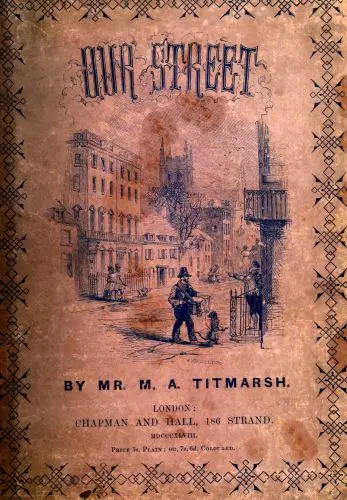
“Our Street”
William Makepeace Thackeray
THE CLASSIC COLLECTION · 1841
"The Second Funeral of Napoleon" by William Makepeace Thackeray is a historical narrative composed during the mid-19th century. This work captures the sentiments and events surrounding the disinterment of Napoleon Bonaparte’s remains from St. Helena and their journey back to France, emphasizing the pomp and pageantry associated with his second funeral. The narrative unfolds with a mix of personal observations, reflections on history, and commentary on the role of individuals in shaping historical events. At the start of this engaging narrative, Thackeray adopts an epistolary style, addressing a character named Amelia while philosophizing about the nature of history and the various interpretations of historical figures. He contrasts the grandiose portrayal of great men in history with the mundane realities of their lives and actions. The opening portion recounts the initial arrangements and decisions surrounding Napoleon’s disinterment at St. Helena, the preparations for transporting his remains back to France, and the significant figures and debates that shaped the ceremony. Through a combination of humor, social critique, and historical detail, Thackeray provides readers with a vivid backdrop to Napoleon's legacy and the reverence with which the French nation regarded him, all while maintaining a candid and often irreverent tone.
Introduction adapted from the source catalogue; source summaries may be automatically generated.
Free to read · English · 17,336 words · No account needed
MAKE TIME FOR A GOOD BOOK
On by default. Untick to stop anonymous reading totals. Each page counts after 10 seconds in view. How this works.
Anonymous counting is on unless you have switched it off.
Is it possible? can the Emperor forget? We don't like to break it to him, but has he forgotten all about the farm at Pizzo, and the garden of the Observatory? Yes, truly: there he lies on his golden shield, never stirring, never so much as lifting his eyelids, or opening his lips any wider.
O vanitas vanitatum! Here is our Sovereign in all his glory, and they fired a thousand guns at Cherbourg and never woke him!
However, we are advancing matters by several hours, and you must give just as much credence as you please to the subjoined remarks concerning the Procession, seeing that your humble servant could not possibly be present at it, being bound for the church elsewhere.
Programmes, however, have been published of the affair, and your vivid fancy will not fail to give life to them, and the whole magnificent train will pass before you.
Fancy then, that the guns are fired at Neuilly: the body landed at daybreak from the funereal barge, and transferred to the car; and fancy the car, a huge Juggernaut of a machine, rolling on four wheels of an antique shape, which supported a basement adorned with golden eagles, banners, laurels, and velvet hangings. Above the hangings stand twelve golden statues with raised arms supporting a huge shield, on which the coffin lay. On the coffin was the imperial crown, covered with violet velvet crape, and the whole vast machine was drawn by horses in superb housings, led by valets in the imperial livery.
Fancy at the head of the procession first of all--
The Gendarmerie of the Seine, with their trumpets and Colonel.
The Municipal Guard (horse), with their trumpets, standard, and Colonel.
Two squadrons of the 7th Lancers, with Colonel, standard, and music.
The Commandant of Paris and his Staff.
A battalion of Infantry of the Line, with their flag, sappers, drums,
music, and Colonel.
The Municipal Guard (foot), with flag, drums, and Colonel.
The Sapper-pumpers, with ditto.
Then picture to yourself more squadrons of Lancers and Cuirassiers. The General of the Division and his Staff; all officers of all arms employed at Paris, and unattached; the Military School of Saint Cyr, the Polytechnic School, the School of the Etat-Major; and the Professors and Staff of each. Go on imagining more battalions of Infantry, of Artillery, companies of Engineers, squadrons of Cuirassiers, ditto of the Cavalry, of the National Guard, and the first and second legions of ditto.
Fancy a carriage, containing the Chaplain of the St. Helena expedition, the only clerical gentleman that formed a part of the procession.
Fancy you hear the funereal music, and then figure in your mind's eye--
Your reading position is saved on this browser. Take it to another device with a library code. Reading pages adapt to text, rather than matching a printed edition.
William Makepeace Thackeray
William Makepeace Thackeray
Charles Dickens & William Makepeace Thackeray
William Makepeace Thackeray
BEHIND THE BOOK
This eBook is for the use of anyone anywhere in the United States and most other parts of the world at no cost and with almost no restrictions whatsoever. You may copy it, give it away or re-use it under the terms of the Project Gutenberg License included with this eBook or online at www.gutenberg.org. If you are not located in the United States, you will have to check the laws of the country where you are located before using this eBook. Read the source licence.
The original source file, including credits and licence, is retained by this library. Request an original-format copy at no charge. Please include the book title and Project Gutenberg identifier #2645.
KEEP YOUR CURIOSITY GOING
Cécile Tormay

Moritz Busch
John L. Ransom
Frances Wright
Cécile Tormay

Mabel Potter Daggett