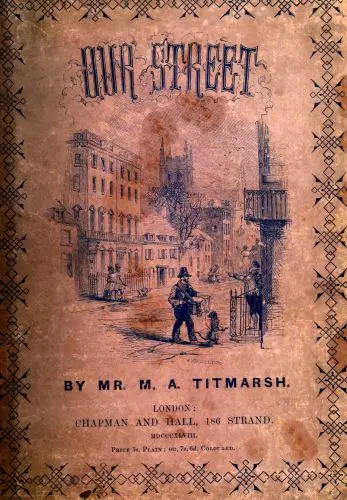
“Our Street”
William Makepeace Thackeray
THE CLASSIC COLLECTION · 1841
"The Second Funeral of Napoleon" by William Makepeace Thackeray is a historical narrative composed during the mid-19th century. This work captures the sentiments and events surrounding the disinterment of Napoleon Bonaparte’s remains from St. Helena and their journey back to France, emphasizing the pomp and pageantry associated with his second funeral. The narrative unfolds with a mix of personal observations, reflections on history, and commentary on the role of individuals in shaping historical events. At the start of this engaging narrative, Thackeray adopts an epistolary style, addressing a character named Amelia while philosophizing about the nature of history and the various interpretations of historical figures. He contrasts the grandiose portrayal of great men in history with the mundane realities of their lives and actions. The opening portion recounts the initial arrangements and decisions surrounding Napoleon’s disinterment at St. Helena, the preparations for transporting his remains back to France, and the significant figures and debates that shaped the ceremony. Through a combination of humor, social critique, and historical detail, Thackeray provides readers with a vivid backdrop to Napoleon's legacy and the reverence with which the French nation regarded him, all while maintaining a candid and often irreverent tone.
Introduction adapted from the source catalogue; source summaries may be automatically generated.
Free to read · English · 17,336 words · No account needed
MAKE TIME FOR A GOOD BOOK
On by default. Untick to stop anonymous reading totals. Each page counts after 10 seconds in view. How this works.
Anonymous counting is on unless you have switched it off.
In the same house where I live (but about five stories nearer the ground) lodges an English family, consisting of--1. A great-grandmother, a hale, handsome old lady of seventy, the very best-dressed and neatest old lady in Paris. 2. A grandfather and grandmother, tolerably young to bear that title. 3. A daughter. And 4. Two little great-grand, or grandchildren, that may be of the age of three and one, and belong to a son and daughter who are in India. The grandfather, who is as proud of his wife as he was thirty years ago when he married, and pays her compliments still twice or thrice in a day, and when he leads her into a room looks round at the persons assembled, and says in his heart, "Here, gentlemen, here is my wife--show me such another woman in England,"--this gentleman had hired a room on the Champs Elysees, for he would not have his wife catch cold by exposing her to the balconies in the open air.
When I came to the street, I found the family assembled in the following
order of march:--
--No. 1, the great-grandmother walking daintily along, supported by No.
3, her granddaughter.
--A nurse carrying No. 4 junior, who was sound asleep: and a huge basket containing saucepans, bottles of milk, parcels of infants' food, certain dimity napkins, a child's coral, and a little horse belonging to No. 4 senior.
--A servant bearing a basket of condiments.
--No. 2, grandfather, spick and span, clean shaved, hat brushed, white buckskin gloves, bamboo cane, brown great-coat, walking as upright and solemn as may be, having his lady on his arm.
--No. 4, senior, with mottled legs and a tartan costume, who was
frisking about between his grandpapa's legs, who heartily wished him at
home.
"My dear," his face seemed to say to his lady, "I think you might have left the little things in the nursery, for we shall have to squeeze through a terrible crowd in the Champs Elysees."
The lady was going out for a day's pleasure, and her face was full of care: she had to look first after her old mother who was walking ahead, then after No. 4 junior with the nurse--he might fall into all sorts of danger, wake up, cry, catch cold; nurse might slip down, or heaven knows what. Then she had to look her husband in the face, who had gone to such expense and been so kind for her sake, and make that gentleman believe she was thoroughly happy; and, finally, she had to keep an eye upon No. 4 senior, who, as she was perfectly certain, was about in two minutes to be lost for ever, or trampled to pieces in the crowd.
Your reading position is saved on this browser. Take it to another device with a library code. Reading pages adapt to text, rather than matching a printed edition.
William Makepeace Thackeray
William Makepeace Thackeray
Charles Dickens & William Makepeace Thackeray
William Makepeace Thackeray
BEHIND THE BOOK
This eBook is for the use of anyone anywhere in the United States and most other parts of the world at no cost and with almost no restrictions whatsoever. You may copy it, give it away or re-use it under the terms of the Project Gutenberg License included with this eBook or online at www.gutenberg.org. If you are not located in the United States, you will have to check the laws of the country where you are located before using this eBook. Read the source licence.
The original source file, including credits and licence, is retained by this library. Request an original-format copy at no charge. Please include the book title and Project Gutenberg identifier #2645.
KEEP YOUR CURIOSITY GOING
Cécile Tormay

Moritz Busch
John L. Ransom
Frances Wright
Cécile Tormay

Mabel Potter Daggett