THE CLASSIC COLLECTION✦The Boys of ’61 or, Four Years of Fighting, Personal Observations with the Army and NavyCLASSIC FREE BOOKS
The Boys of ’61 or, Four Years of Fighting, Personal Observations with the Army and Navy
Charles Carleton Coffin
THE CLASSIC COLLECTION · 1870
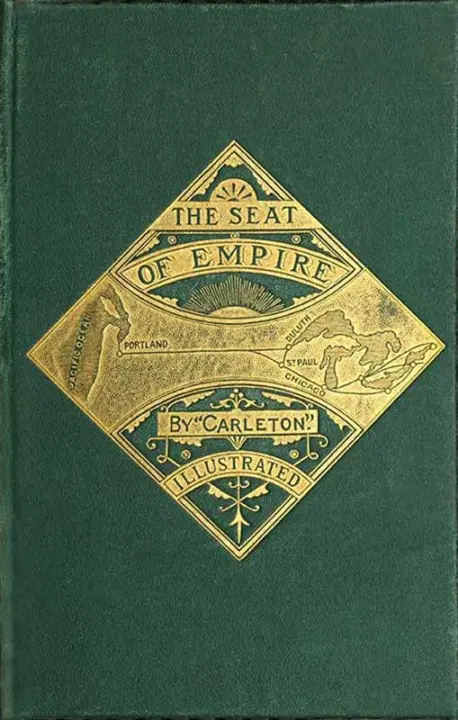
"The Seat of Empire" by Charles Carleton Coffin is a historical account written in the late 19th century. In this work, Coffin explores the vast and evolving landscape of the American Northwest, providing insights and observations about the region's geography, resources, and the lives of its inhabitants during a time of significant westward expansion. The narrative unfolds through a series of expeditions and personal experiences that highlight the potential of the land for settlement and development. At the start of the text, the author recounts a summer journey he undertook with a group of gentlemen from Chicago to Minneapolis, filled with camaraderie and celebration on the Fourth of July. He provides vivid descriptions of the landscape, from the beauty along the Mississippi River to the bustling towns they encounter. Coffin shares anecdotes about the emigrants he meets, particularly the Norwegian immigrants setting out for new futures, emphasizing the hope and determination that drive many individuals toward this uncharted frontier. This introduction sets the stage for exploring the opportunities and challenges faced by those settling in the Northwest.
Introduction adapted from the source catalogue; source summaries may be automatically generated.
Free to read · English · 55,126 words · No account needed
MAKE TIME FOR A GOOD BOOK
On by default. Untick to stop anonymous reading totals. Each page counts after 10 seconds in view. How this works.
Anonymous counting is on unless you have switched it off.
All trains on the New York Central Hudson River Railroad, and all trains on the Erie Railway, form sure and reliable connections at Buffalo with the
All the great railways in the Northwest and Southwest connect at Chicago, Toledo, or Cleveland with this Line.
Palace, Drawing-Room, Sleeping Coaches daily between New York and Chicago, through WITHOUT CHANGE.
The following lines transport freight between Boston, New York, and principal points in New England to Cleveland, Toledo, Chicago, and principal points in the Southwest and Northwest, without break of bulk or transfer.
RED LINE, WHITE LINE,
SOUTH SHORE LINE, EMPIRE LINE,
COMMERCIAL LINE FROM BALTIMORE.
Passengers or shippers of freight will find it to their interest to call on the Agents of these Lines.
F. E. MORSE,
Gen'l Western Pass'r Ag't,
Chicago, Ill.
CHS. F. HATCH,
Gen'l Superintendent,
Cleveland, O.
J. A. BURCH,
Gen'l Eastern Pass'r Ag't,
Buffalo, N. Y.
VERMONT CENTRAL
R. R. Line.
The =GREAT Northern line= and =most direct= route from =BOSTON= and =ALL POINTS= in =New England= to the =CANADAS, DETROIT, CHICAGO=,
=All points West, Northwest, & Southwest=.
the most elegant from =Boston=, and =SPLENDID DRAWING-ROOM CARS= run on every express train, connecting on the =Grand Trunk Railway= with
=Pullman's Palace, Hotel, and Sleeping Cars=;
this being the =only line= affording such comfort and luxury to the passenger between the East and West.
TIME FREIGHT
VIA
National Despatch Line.
=Freight= taken for =Chicago=, =St. Louis=, and =all points West
without breaking bulk or transfer=, in as =short time= as any other
line.
--> For full information relating to time contracts, Tickets, &c., &c., please address or call at
=No. 65 Washington Street (Sears Building), Boston.
LANSING MILLIS, General Agent.=
(=Montreal Office, No. 30 Great St. James St.=)
(=New York Office, No. 9 Astor House.=)
Lake Superior & Mississippi Railroad.
The line of this road is from St. Paul, the head of navigation on the Mississippi River, to the head of Lake Superior, a distance of 140 miles. It connects at St. Paul with each of the long lines of railroad traversing the vast and fertile regions of Minnesota in all directions, and converging at St. Paul.
It connects the commerce and business of the Mississippi and Minnesota Rivers, the California Central Railroad, and the Northern Pacific Railroad, with Lake Superior and the commercial system of the great lakes, and makes the outlet or commercial track to the lakes, over which must pass the commerce of a region of country second to none on the American continent in capacity for production.
Your reading position is saved on this browser. Take it to another device with a library code. Reading pages adapt to text, rather than matching a printed edition.
Charles Carleton Coffin
Charles Carleton Coffin
Charles Carleton Coffin
Charles Carleton Coffin
BEHIND THE BOOK
This eBook is for the use of anyone anywhere in the United States and most other parts of the world at no cost and with almost no restrictions whatsoever. You may copy it, give it away or re-use it under the terms of the Project Gutenberg License included with this eBook or online at www.gutenberg.org. If you are not located in the United States, you will have to check the laws of the country where you are located before using this eBook. Read the source licence.
The original source file, including credits and licence, is retained by this library. Request an original-format copy at no charge. Please include the book title and Project Gutenberg identifier #44072.
KEEP YOUR CURIOSITY GOING
Wilfrid Scawen Blunt
Wilfrid Scawen Blunt

E. W. (Edgar Watson) Howe
Cécile Tormay

Moritz Busch
John L. Ransom