THE CLASSIC COLLECTION✦The Boys of ’61 or, Four Years of Fighting, Personal Observations with the Army and NavyCLASSIC FREE BOOKS
The Boys of ’61 or, Four Years of Fighting, Personal Observations with the Army and Navy
Charles Carleton Coffin
THE CLASSIC COLLECTION · 1870
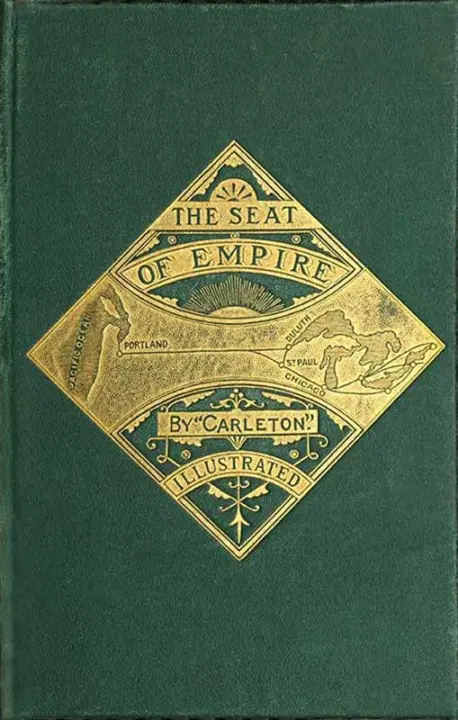
"The Seat of Empire" by Charles Carleton Coffin is a historical account written in the late 19th century. In this work, Coffin explores the vast and evolving landscape of the American Northwest, providing insights and observations about the region's geography, resources, and the lives of its inhabitants during a time of significant westward expansion. The narrative unfolds through a series of expeditions and personal experiences that highlight the potential of the land for settlement and development. At the start of the text, the author recounts a summer journey he undertook with a group of gentlemen from Chicago to Minneapolis, filled with camaraderie and celebration on the Fourth of July. He provides vivid descriptions of the landscape, from the beauty along the Mississippi River to the bustling towns they encounter. Coffin shares anecdotes about the emigrants he meets, particularly the Norwegian immigrants setting out for new futures, emphasizing the hope and determination that drive many individuals toward this uncharted frontier. This introduction sets the stage for exploring the opportunities and challenges faced by those settling in the Northwest.
Introduction adapted from the source catalogue; source summaries may be automatically generated.
Free to read · English · 55,126 words · No account needed
MAKE TIME FOR A GOOD BOOK
On by default. Untick to stop anonymous reading totals. Each page counts after 10 seconds in view. How this works.
Anonymous counting is on unless you have switched it off.
The men who used to frequent this region to trade with the Indians knew as early as 1830 that iron existed in the hills. But it was not till 1845, just a quarter of a century ago, that any attempt was made to test the ore. Dr. Jackson, of Boston, who visited Lake Superior in 1844, pronounced it of excellent quality. He informed Mr. Lyman Pray, of Charlestown, Mass., of its existence, and that the Indians reported a "mountain" of it not far from Marquette. Mr. Pray at once started on an exploring expedition, reached Lake Superior, obtained an Indian guide, penetrated the forest, and found the hills filled with ore.
About the same time a gentleman named Everett obtained half a ton of it, which the Indians and half-breeds carried on their backs to the Carp River, and transported it to the lake in canoes.
It was smelted, but was so different from that of Pennsylvania that the iron-masters shook their heads. Some declared that it was of no particular value, others that it could not be worked.
The Pittsburg iron-men pronounced it worthless. But Mr. Everett persevered, sent a small quantity to the Coldwater forge, where it was smelted and rolled into a bar, from which he made a knife-blade, and was convinced that the metal was superior in quality to any other deposit in the country.
The Jackson Company was at once formed for mining in the iron and copper region. The copper fever was at its height, and the company was organized with a view of working both metals if thought advisable. A forge was erected on the Carp River in 1847, making four blooms a day, each about four feet long and eight inches thick.
Another was built, in 1854, by a company from Worcester, Mass., but so small was the production that in 1856 the shipment only reached five thousand tons. The superior qualities of the metal began to be known. Other companies were formed and improvements made; railroads and docks were constructed, and the production has had a steady increase, till it has reached a high figure.
There are fourteen companies engaged in mining,--two have just commenced, while the others are well developed. The production of the twelve principal mines for the year 1868 will be seen from the following figures:--
Tons.
Jackson, 131,707
Cleveland, 102,213
Marquette, 7,977
Lake Superior, 105,745
New York, 45,665
Lake Angeline, 27,651
Edwards, 17,360
Iron Mountain, 3,836
Washington, 35,757
New England, 8,257
Champion, 6,255
Barnum, 14,380
_______
Total, 506,803
The increase over the previous year is between forty and fifty thousand tons. The yield for 1869 was about 650,000 tons. The entire production of all the mines up to the close of 1868 is 2,300,000 tons.
Your reading position is saved on this browser. Take it to another device with a library code. Reading pages adapt to text, rather than matching a printed edition.
Charles Carleton Coffin
Charles Carleton Coffin
Charles Carleton Coffin
Charles Carleton Coffin
BEHIND THE BOOK
This eBook is for the use of anyone anywhere in the United States and most other parts of the world at no cost and with almost no restrictions whatsoever. You may copy it, give it away or re-use it under the terms of the Project Gutenberg License included with this eBook or online at www.gutenberg.org. If you are not located in the United States, you will have to check the laws of the country where you are located before using this eBook. Read the source licence.
The original source file, including credits and licence, is retained by this library. Request an original-format copy at no charge. Please include the book title and Project Gutenberg identifier #44072.
KEEP YOUR CURIOSITY GOING
Wilfrid Scawen Blunt
Wilfrid Scawen Blunt

E. W. (Edgar Watson) Howe
Cécile Tormay

Moritz Busch
John L. Ransom