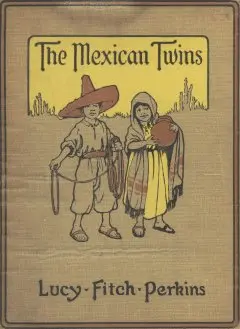
The Mexican Twins
Lucy Fitch Perkins
THE CLASSIC COLLECTION · 1919
"The Scotch Twins" by Lucy Fitch Perkins is a children's novel written in the early 20th century. The book centers on twins Jean and Jock Campbell, who live in a little gray house in the picturesque Scottish Highlands. The story follows their daily adventures and responsibilities as they navigate life in their rural home and face conflicts with the local gamekeeper, Angus Niel, as well as the threat of losing their family home. At the start of the novel, the reader is introduced to Jean's fierce dedication to household duties, as she urgently wakes her brother Jock for their morning chores. Their father, Robin Campbell, the local shepherd, is a central figure who balances work and family life. As the children go about their chores, the dynamic between them provides a charming glimpse into their personalities and their bond as siblings. The narrative hints at broader issues, such as the struggle against Angus Niel and the looming threat of losing their home due to new developments in the region, setting the stage for both personal and communal conflict in their lives.
Introduction adapted from the source catalogue; source summaries may be automatically generated.
Free to read · English · 30,970 words · No account needed
MAKE TIME FOR A GOOD BOOK
On by default. Untick to stop anonymous reading totals. Each page counts after 10 seconds in view. How this works.
Anonymous counting is on unless you have switched it off.
"He is just like Prince Charlie, I'm thinking," said Sandy, and Jock, to ease his feelings, whistled "Charlie is my darling" all the way to the gate of the park.
The evening star was shining brightly over the dark outline of old Ben Vane as the Campbells reached the little gray house on the brae, now safely their home forever, and Tam came bounding down the path to meet them. Jean kissed her hand to the star and murmured to herself,
"Star light, star bright,
I have the wish I wished to-night."
Auld, old.
Aye (pronounced i), yes.
Aye (pronounced a), ever, always.
Bailie, an officer of the law.
Bairn, a child.
Ben. See But and ben.
Besom, a broom.
Bide, stay.
Bittock, a little bit.
Blatherskite, a babbling person, a good-for-nothing.
Blethering, talking nonsense.
Bonny, pretty, beautiful, charming.
Bracken, brake, a species of tall fern.
Brae (pronounced bray), a hillside.
Braw, fine, handsome.
Burn, a brook.
But and ben, outside and in.
But the house means out of the house. But is also applied to the kitchen; going but is going from the best room to the kitchen, and going ben is going into the best room.
Byre, a cow-shed.
Canny, shrewd.
Chap, a knock.
Daft, silly, foolish.
Dandering, wandering.
Dawtie, darling, pet.
Dinna, do not.
Dod, an exclamation.
Doubt, suspect.
Dyke, a low fence or wall of turf or stone.
Fash, disturb.
Fine, finely, well.
Gey, very.
Gin (g as in give), if.
Girdle, a griddle.
Glengarry bonnet, a small cap without visor.
Greet, weep.
Guddling, catching fish with the hands.
Havers (a as in hay), nonsense (an exclamation).
Isna, is not.
Keek, a peep.
Ken, know.
Kilmarnock bonnet, a tam-o'-shanter.
Kirk, church.
Biro, a churn.
Kist, a chest.
Laird, a lord, a landed proprietor.
Laverock, the lark.
Limmer, a mischievous person.
Losh, an exclamation.
Loup, to leap.
Lug, ear.
Mealy pudding, a Scotch dish made of oatmeal and suet, in form
something like a sausage.
Michty (pronounced michty, with the gutteral ch as in the German word ich), mighty, large, powerful.
Michty me, an exclamation.
Na, no, not.
Pawky, sly.
Pewit, the lapwing, a species of plover.
Plaidie (pronounced pladie), diminutive of plaid. Each clan had its own especial pattern which was worn by all members.
Redding up, putting in order.
Sal, an exclamation.
Scone, a flat cake, unsweetened, baked on a griddle.
Skirl, a shrill sound, especially that characteristic of the
bagpipes.
Slippit awa', slipped away, died.
Sousie (both s's as in so), agreeable, attractive, comely,
pleasant.
Spier (pronounced spear), ask.
Sync, afterward, since.
Tarn, a small mountain lake.
Tatties, potatoes.
Tid, a pet name for a child.
Tirley-wirley, a disturbance.
Wasna, was not.
Your reading position is saved on this browser. Take it to another device with a library code. Reading pages adapt to text, rather than matching a printed edition.
Lucy Fitch Perkins
Lucy Fitch Perkins
Lucy Fitch Perkins
Lucy Fitch Perkins
BEHIND THE BOOK
This eBook is for the use of anyone anywhere in the United States and most other parts of the world at no cost and with almost no restrictions whatsoever. You may copy it, give it away or re-use it under the terms of the Project Gutenberg License included with this eBook or online at www.gutenberg.org. If you are not located in the United States, you will have to check the laws of the country where you are located before using this eBook. Read the source licence.
The original source file, including credits and licence, is retained by this library. Request an original-format copy at no charge. Please include the book title and Project Gutenberg identifier #4086.
KEEP YOUR CURIOSITY GOING
Coulson Kernahan

Maurice Baring
Frances Wright
Cécile Tormay

Frederic Jesup Stimson

W. H. P. (William Henry Pope) Jarvis