
Last letters from the living dead man
David Patterson (Spirit) Hatch
THE CLASSIC COLLECTION · 1888
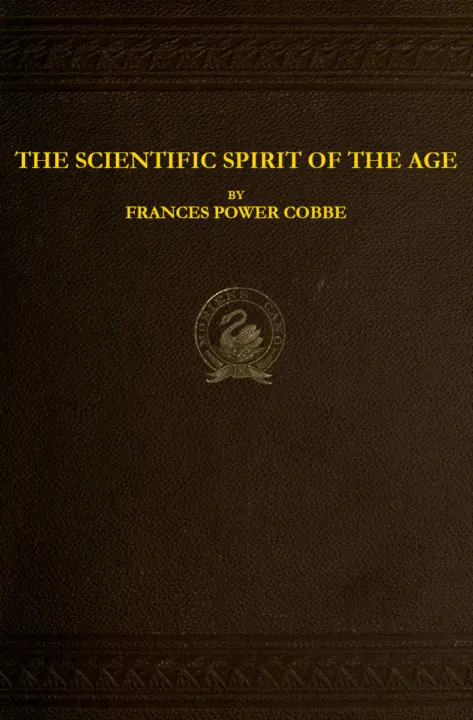
"The Scientific Spirit of the Age, and Other Pleas and Discussions" by Frances Power Cobbe is a collection of essays written in the late 19th century. The essays explore various topics related to the influence of science on society, education, morality, religion, and art. Cobbe critiques the overwhelming dominance of scientific thought and argues for the importance of emotional education, ethical considerations, and aesthetic appreciation in a rapidly changing world. The opening portion of the collection begins with a preface where Cobbe sets the stage for her arguments, distinguishing between essays that present pleas and those that engage in discussions. She expresses concern about the overbearing influence of the scientific spirit on human life, lamenting that while scientific advancements have offered many benefits, they have also led to a loss of appreciation for art, emotion, and morality. Cobbe uses the example of the scientific community's engagement with moral issues to underscore her point, highlighting the potential dangers of a purely factual and analytical perspective that neglects the emotional and ethical dimensions of human experience.
Introduction adapted from the source catalogue; source summaries may be automatically generated.
Free to read · English · 50,126 words · No account needed
MAKE TIME FOR A GOOD BOOK
On by default. Untick to stop anonymous reading totals. Each page counts after 10 seconds in view. How this works.
Anonymous counting is on unless you have switched it off.
“Rarely, rarely comest thou,
Spirit of Delight”;
and we allow it to remain absent from our souls, and grow accustomed to living without it, while all the time we are plodding on, multiplying gratifications and stimulants, while the delicate and evanescent sense they are meant to please is becoming numb and dead. We often, indeed, make religio-philosophical remarks on the beautiful patience and cheerfulness of sufferers from agonizing disease, and we smile at the unfailing hilarity wherewith certain Mark Tapleys of our acquaintance sustain the slings and arrows of outrageous fortune. We quote, with high approval, the poet who sings that
“Stone walls do not a prison make,
Nor iron bars a cage.”
Nevertheless, the singular phenomenon of evident, unmistakable Happiness enjoyed, in despite of circumstances, never seems to teach us how entirely secondary all objective circumstances needs must be to the subjective side of the question, and how much more rational it would be on our part to look first to securing for ourselves the longest and completest tenure of the internal elements of enjoyment before we turn our attention to the attainment of those which are external.
The bearing of this remark on the present subject is, of course, obvious. Is it Life in Town or Life in the Country wherein the springs of happiness flow with perennial freshness, and wherein the Spirit of Delight will burn brightest and longest? To solve this problem, we must turn over in our minds the various conditions of such a state of mind and spirits, the most generally recognized of which is bodily Health.
There is not the smallest danger in these days that any inquirer, however careless, should overlook the vast importance of physical soundness to every desirable mental result. Indeed, on the contrary, we may rather expect shortly to find our teachers treating Disease as the only real delinquency in the world, and all crimes and vices as mere symptoms of disordered nerves or overloaded stomach,—kleptomania, dipsomania, homicidal mania, or something equally pardonable on the part of automata like ourselves. Seriously speaking, a high state of health, such as the “Original” described himself as having attained, or even something a few degrees less perfect, is, undoubtedly, a potent factor in the sum of happiness, causing every separate sensation—sleeping, waking, eating, drinking, exercise, and rest—to be delightful; and the folly of people who seek for Happiness, and yet barter away Health for Wealth or Fame, or any other element thereof, is like that of a man who should sell gold for dross. Admitting this, it would seem to follow that Life in the Country, generally understood to be the most wholesome, must be the most conducive to the state of enjoyment. But there are two points not quite cleared up on the way to this conclusion. First, bodily health seems to be, to some people, anything but the blessing it ought to be, rendering them merely coarse and callous, untouched by those finer impulses and sentiments which pain has taught their feebler companions, and so shutting them out from many of the purest and most spiritual joys of humanity. Paley questioned whether the sum of happiness would not be increased to most of us by one hour of moderate pain in every twenty-four; and, though few would directly ask for the increment of enjoyment so attained, there are perhaps still fewer who would desire to unlearn all the lessons taught in the school of suffering, or find themselves with the gross, oxlike nature of many a farmer or publican, whose rubicund visage bears testimony to his vigorous appetite and to the small amount of pain, sorrow, or anxiety which his own or anybody else’s troubles have ever caused him. Taking it all in all, it seems doubtful, then, whether the most invariably robust people are really much higher than those with more fluctuating health who have taken from the bitter cup the sweet drop which is always to be found at the bottom by those who seek it. For those, unhappiest of all, whom disease has only rendered more selfish and self-centred and rebellious, there is, of course, no comparison possible.
Your reading position is saved on this browser. Take it to another device with a library code. Reading pages adapt to text, rather than matching a printed edition.
BEHIND THE BOOK
This eBook is for the use of anyone anywhere in the United States and most other parts of the world at no cost and with almost no restrictions whatsoever. You may copy it, give it away or re-use it under the terms of the Project Gutenberg License included with this eBook or online at www.gutenberg.org. If you are not located in the United States, you will have to check the laws of the country where you are located before using this eBook. Read the source licence.
The original source file, including credits and licence, is retained by this library. Request an original-format copy at no charge. Please include the book title and Project Gutenberg identifier #64021.
KEEP YOUR CURIOSITY GOING
David Patterson (Spirit) Hatch

David Patterson (Spirit) Hatch

David Patterson (Spirit) Hatch
Coulson Kernahan

Ralph Waldo Emerson

Maurice Baring