
Last letters from the living dead man
David Patterson (Spirit) Hatch
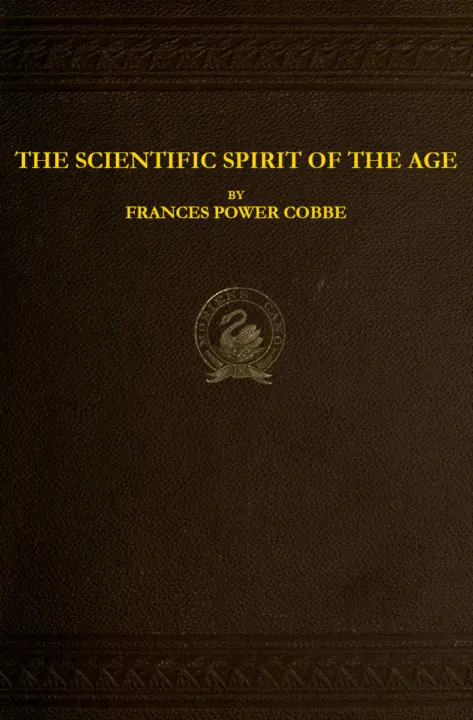
THE CLASSIC COLLECTION · 1888
"The Scientific Spirit of the Age, and Other Pleas and Discussions" by Frances Power Cobbe is a collection of essays written in the late 19th century. The essays explore various topics related to the influence of science on society, education, morality, religion, and art. Cobbe critiques the overwhelming dominance of scientific thought and argues for the importance of emotional education, ethical considerations, and aesthetic appreciation in a rapidly changing world. The opening portion of the collection begins with a preface where Cobbe sets the stage for her arguments, distinguishing between essays that present pleas and those that engage in discussions. She expresses concern about the overbearing influence of the scientific spirit on human life, lamenting that while scientific advancements have offered many benefits, they have also led to a loss of appreciation for art, emotion, and morality. Cobbe uses the example of the scientific community's engagement with moral issues to underscore her point, highlighting the potential dangers of a purely factual and analytical perspective that neglects the emotional and ethical dimensions of human experience.
Introduction adapted from the source catalogue; source summaries may be automatically generated.
Free to read · English · 50,126 words · No account needed
MAKE TIME FOR A GOOD BOOK
On by default. Untick to stop anonymous reading totals. Each page counts after 10 seconds in view. How this works.
Anonymous counting is on unless you have switched it off.
Beyond the alternations of fasting and feasting, still more amazing are the results of narcotics, alcoholic beverages, and of tea and coffee. Every species of wine exercises a perceptibly different influence of its own, from the cheery and social “sparkling grape of Eastern France” to the solemn black wine of Oporto, the fit accompaniment of the blandly dogmatic post-prandial prose of elderly gentlemen of orthodox sentiments. A cup of strong coffee clears the brain and makes the thoughts transparent, while one of green tea drives them fluttering like dead leaves before the wind. Time and learning would fail to describe the yet more marvellous effects of opium, hemlock, henbane, hashish, bromide, and chloral. Every one of these narcotics produces a different hue of the mental window through which we look out on the world; sometimes distorting all objects in the wildest manner (like opium), sometimes (like chloral) acting only perceptibly by removing the sense of disquiet and restoring our thoughts to the white light of commonsense cheerfulness; and again acting quite differently on the thoughts of different persons, and of the same persons at different times.
Only secondary to the effects of inwardly imbibed stimulants or narcotics are those of the outward atmosphere, which in bracing weather makes our thoughts crisp like the frosted grass, and in heavy November causes them to drip chill and slow and dull, like the moisture from the mossy eaves of the Moated Grange. Burning, glaring Southern sunshine dazes our minds as much as our eyes, and a London fog obfuscates them, so that a man might honestly plead that he could no more argue clearly in the fog than the Irishman could spell correctly with a bad pen and muddy ink.
Nor are mouths, eyes, and lungs by any means the only organs through which influences arrive at our brain, modifying the thoughts which proceed from them. The sense of Smelling, when gratified by the odors of woods and gardens and hay-fields, or even of delicately perfumed rooms, lifts all our thoughts into a region wherein the Beautiful, the Tender, and the Sublime may impress us freely; while the same sense, offended by disgusting and noxious odors, as of coarse cookery, open sewers, or close chambers inhabited by vulgar people, thrusts us down into an opposite stratum of feeling, wherein poetry entereth not, and our very thoughts smell of garlic. Needless to add that in a still more transcendent way Music seizes on the thoughts of the musically-minded, and bears them off in its talons over sea and land, and up to Olympus like Ganymede. Two easily distinguishable mental influences seem to belong to music, according as it is heard by those who really appreciate it or by others who are unable to do so. To the former it opens a book of poetry, which they follow word for word after the performer, as if he read it to them, thinking the thoughts of the composer in succession with scarcely greater uncertainty or vagueness than if they were expressed in verbal language of a slightly mystical description. To the latter the book is closed; but though the listener’s own thoughts unroll themselves uninterrupted by the composer’s ideas, they are very considerably colored thereby. “I delight in music,” said once Sir Charles Lyell to me: “I am always able to think out my work better while it is going on!” As a matter of fact, he resumed at the moment a disquisition concerning the date of the Glacial Period at the precise point at which it had been interrupted by the performance of a symphony of Beethoven, having evidently mastered in the interval an intricate astronomical knot. To ordinary mortals with similar deficiency of musical sense, harmonious sound seems to spread a halo like that of light, causing every subject of contemplation to seem glorified, as a landscape appears in a dewy sunrise. Memories rise to the mind and seem infinitely more affecting than at other times, affections still living grow doubly tender, new beauties appear in the picture or the landscape before our eyes, and passages of remembered prose or poetry float through our brains in majestic cadence. In a word, the sense of the Beautiful, the Tender, the Sublime, is vividly aroused, and the atmosphere of familiarity and commonplace, wherewith the real beauty and sweetness of life are too often veiled, is lifted for the hour. As in a camera-obscura or mirror, the very trees and grass which we had looked on a thousand times are seen to possess unexpected loveliness. But all this can only happen to the non-musical soul when the harmony to which it listens is really harmonious, and when it comes at an appropriate time, when the surrounding conditions permit and incline the man to surrender himself to its influences; in a word, when there is nothing else demanding his attention. The most barbarous of the practices of royalty and civic magnificence is that of employing music as an accompaniment to feasts. It involves a confusion of the realm of the real and ideal, and of one sense with another, as childish as that of the little girl who took out a peach to eat while bathing in the sea. Next to music during the dinner-time comes music in the midst of a cheerful evening party, where, when every intellect present is strung up to the note of animated conversation and brilliant repartee, there is a sudden douche of solemn chords from the region of the pianoforte, and presently some well-meaning gentleman endeavors to lift up all the lazy people, who are lounging in easy-chairs after a good dinner, into the empyrean of emotion “sublime upon the seraph wings of ecstasy” of Beethoven or Mozart; or some meek damsel, with plaintive note, calls on them, in Schubert’s Addio, to break their hearts at the memory or anticipation of those mortal sorrows which are either behind or before every one of us, and which it is either agony or profanation to think of at such a moment. All this is assuredly intensely barbarous. The same people who like to mix up the ideal pleasure of music with incongruous enjoyments of another kind would be guilty of giving a kiss with their mouths full of bread and cheese. As to what we may term extra-mural music, the hideous noises made by the aid of vile machinery in the street, it is hard to find words of condemnation strong enough for it. Probably the organ-grinders of London have done more in the last twenty years to detract from the quality and quantity of the highest kind of mental work done by the nation than any two or three colleges of Oxford or Cambridge have effected to increase it. One mathematician alone, as he informed the writer, estimated the cost of the increased mental labor they have imposed upon him and his clerks at several thousand pounds’ worth of first-class work, for which the State practically paid in the added length of time needed for his calculations. Not much better are those church bells which now sound a trumpet before the good people who attend “matins” and other daily services at hours when their profane neighbors are wearily sleeping or anxiously laboring at their appointed tasks.
Your reading position is saved on this browser. Take it to another device with a library code. Reading pages adapt to text, rather than matching a printed edition.
BEHIND THE BOOK
This eBook is for the use of anyone anywhere in the United States and most other parts of the world at no cost and with almost no restrictions whatsoever. You may copy it, give it away or re-use it under the terms of the Project Gutenberg License included with this eBook or online at www.gutenberg.org. If you are not located in the United States, you will have to check the laws of the country where you are located before using this eBook. Read the source licence.
The original source file, including credits and licence, is retained by this library. Request an original-format copy at no charge. Please include the book title and Project Gutenberg identifier #64021.
KEEP YOUR CURIOSITY GOING
David Patterson (Spirit) Hatch

David Patterson (Spirit) Hatch

David Patterson (Spirit) Hatch
Coulson Kernahan

Ralph Waldo Emerson

Maurice Baring