Mechanics: The Science of Machinery
A. Russell (Alexander Russell) Bond
THE CLASSIC COLLECTION · 1905
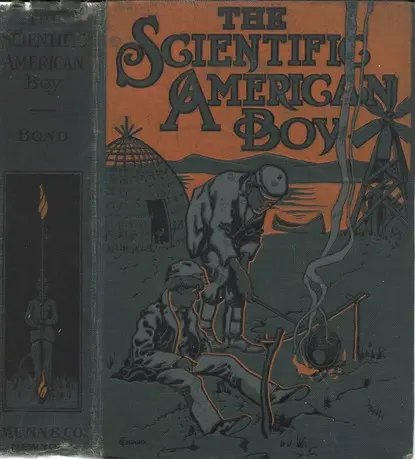
"The Scientific American Boy; Or, The Camp at Willow Clump Island" by A. Russell Bond is a novel written in the early 20th century. This work is a blend of adventure and educational content aimed at young readers, particularly boys, encouraging them to embrace nature while fostering ingenuity. The story revolves around the character Bill, who is depicted as an exceptionally inventive boy guided by his uncle, Uncle Ed, a civil engineer, as they embark on camping adventures. The opening of the novel introduces the protagonist, Bill, and sets the stage for the adventurous spirit of camping and exploration. Bill's curiosity and inventiveness are highlighted as he begins to devise unique contraptions and solutions to problems encountered during their skates on the canal. The narrative hints at the formation of a society dedicated to scientific exploration and adventure, being founded by Bill and his friends as they reminisce and plan future expeditions to Willow Clump Island. The tone is enthusiastic and optimistic, emphasizing camaraderie among boys, the thrill of adventure, and the joy of learning through hands-on experience.
Introduction adapted from the source catalogue; source summaries may be automatically generated.
Free to read · English · 60,138 words · No account needed
MAKE TIME FOR A GOOD BOOK
On by default. Untick to stop anonymous reading totals. Each page counts after 10 seconds in view. How this works.
Anonymous counting is on unless you have switched it off.
W
Wall, how to build, 266
Wall tent, 46
Water wheel, 241
Water wheel buckets, 246
Water wheel, construction of, 245
Water wheel, Mr. Halliday's, 252
Water wheel, mounting the, 249
Water wheel paddles, 246
Water wheel receiving trough, 247
Water wheel, surveying for, 241
Water wheel, towers for, 243
Water wheel towers, setting up, 248
War, council of, 139
Weaving needle, 39
Well, digging the, 274
Wheel, the wind, 276
Wheels for gravity railroad, 285
Wheels, mounting, on car, 286
Wheels, mounting frame on, 219
Wigwag abbreviations, 146
Wigwag alphabet, 145
Wigwag numerals, 145
Wigwag signals, 144
Wigwagging and heliographing, 144
Wigwagging at night, 147
Willow Clump Island, 23
Willow Clump Island, farewell to, 307
Willow Clump Island in winter, 194
Wind wheel, 276
Wind wheel blades, 278
Wind wheel brake, 278
Windmill, 273
Windmill tower, 275
Window hinge, 270
Window sash, log cabin, 270
Wings, bat's, 33
Wire tie, 50
Wood, bending, 39
Wood tie block, 49
Word from Uncle Ed, 45
Y
Yacht, land, 215
Yacht, land, frame of, 216
The Most Popular Scientific Paper in the World
Established 1845
Weekly, $3.00 a Year; $1.50 Six Months
This unrivaled periodical is now in its sixtieth year, and, owing to its ever-increasing popularity, it enjoys the largest circulation ever attained by any scientific publication. Every number contains sixteen large pages, beautifully printed, handsomely illustrated; it presents in popular style a descriptive record of the most novel, interesting and important developments in Science, Arts and Manufactures. It shows the progress of the World in respect to New Discoveries and Improvements, embracing Machinery, Mechanical Works, Engineering in all its branches, Chemistry, Metallurgy, Electricity, Light, Heat, Architecture, Domestic Economy, Agriculture, Natural History, etc. It abounds in fresh and interesting subjects for discussion, thought or study. To the inventor it is invaluable, as every number contains a complete list of all patents and trade-marks issued weekly from the Patent Office. It promotes Industry, Progress, Thrift and Intelligence in every community where it circulates.
The Scientific American should have a place in every Dwelling, Shop, Office, School, or Library. Workmen, Foremen, Engineers, Superintendents, Directors, Presidents, Officials, Merchants, Farmers, Teachers, Lawyers, Physicians, Clergymen--people in every walk and profession in life--will derive satisfaction and benefit from a regular reading of the Scientific American.
If you want to know more about the paper send for "Fifteen Reasons Why You Should Subscribe to the Scientific American," and for "Five Reasons Why Inventors Should Subscribe to the Scientific American." Fifty-two numbers make 832 large pages, equal to 3,328 ordinary magazine pages, and 1,000 illustrations are published each year. Can you and your friends afford to be without this up-to-date periodical, which is read by every class and profession? Remit $3.00 by postal order or check for a year's subscription, or $1.50 for six months.
MUNN & COMPANY, Publishers
No. 361 Broadway, New York City
By GEORGE M. HOPKINS
Author of "Experimental Science"
12mo, 375 Pages, 320 Illustrations. Price, $1.50, Postpaid
Your reading position is saved on this browser. Take it to another device with a library code. Reading pages adapt to text, rather than matching a printed edition.
A. Russell (Alexander Russell) Bond
A. Russell (Alexander Russell) Bond
BEHIND THE BOOK
This eBook is for the use of anyone anywhere in the United States and most other parts of the world at no cost and with almost no restrictions whatsoever. You may copy it, give it away or re-use it under the terms of the Project Gutenberg License included with this eBook or online at www.gutenberg.org. If you are not located in the United States, you will have to check the laws of the country where you are located before using this eBook. Read the source licence.
The original source file, including credits and licence, is retained by this library. Request an original-format copy at no charge. Please include the book title and Project Gutenberg identifier #15831.
KEEP YOUR CURIOSITY GOING
Coulson Kernahan

Maurice Baring
Frances Wright
Cécile Tormay

Frederic Jesup Stimson

W. H. P. (William Henry Pope) Jarvis