
Last letters from the living dead man
David Patterson (Spirit) Hatch
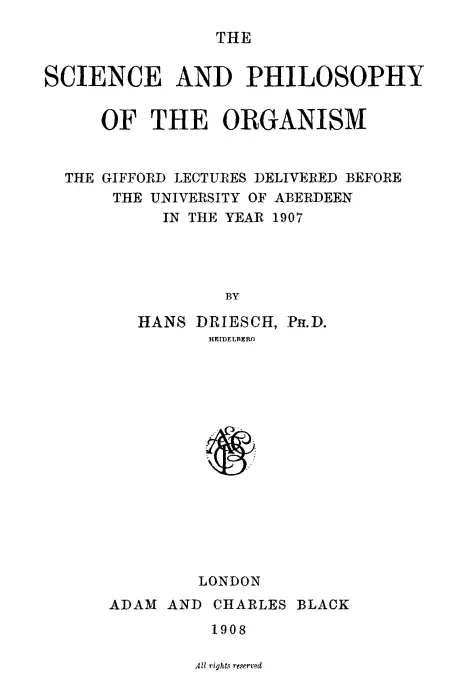
THE CLASSIC COLLECTION · 1908
"The Science and Philosophy of the Organism" by Hans Driesch is a scientific publication written in the early 20th century. The work encompasses a systematic exploration of biological topics relevant to the philosophy of nature, positioning Driesch as a vital contributor to the discourse on organismal biology. The author aims to establish a definitive framework regarding vitalism, the characteristics of biological systems, and the developmental processes of organisms, particularly focusing on how these elements relate to broader philosophical inquiries. The beginning of the book introduces Driesch's motivations and context for delivering the Gifford Lectures at the University of Aberdeen. He outlines his intent to engage with biological phenomena in a way that transcends mere empirical observation, leading into a philosophy that examines natural processes. He emphasizes the importance of understanding the interactive dynamics between scientific discoveries and their philosophical implications, particularly in relation to development and the essence of life itself. The opening portion sets the stage for a thorough investigation into both empirical and theoretical aspects of biology, using specific case studies from embryology, notably that of sea-urchins, providing a rich foundation for future discussions on the organism's nature.
Introduction adapted from the source catalogue; source summaries may be automatically generated.
Free to read · English · 90,776 words · No account needed
MAKE TIME FOR A GOOD BOOK
On by default. Untick to stop anonymous reading totals. Each page counts after 10 seconds in view. How this works.
Anonymous counting is on unless you have switched it off.
Adaptation (definition), 166, 171, 185
to changes from without, 172 ff.
functional, 114, 176 ff.
and Lamarckism, 272, 280
mechanical, 177 f.
morphological, 168 ff.
physiological, 184 ff.
primary and secondary, 188 f.
Adaptedness, 186 f.
*Adiantum*, 279
Adventitious, 55, 74, 111, 221
Albumen, 200
Allelomorphs, 231
Amphibious plants, 172 ff.
Annelids, 65, 70, 221
Answering reaction, 181
Anti-bodies, 206 f.
Antitoxins, 207 f.
*A priori*, 6
Aristotle, 144
*Ascaris*, 93
*Aspergillus*, 195
Assimilation, 17
Atrophy, 178
Autonomy of life, 143, 224 f., 324
Babák, 177
Baer, C. E. v., 48 f. 282
Bateson, 229 ff., 238
Bayliss, 204, 212
*Begonia*, 221
Bergson, 305
Berkeley, 6
Berthold, 91
Biogenetisches Grundgesetz, 248
Biology, 8 ff., 15 f.
Blaringhem, 238, 276
Blastoderm, 39
Blastomeres, 36, 59, 61 f., 79
Blastula, 37, 61, 79
Blumenbach, 26
Boirivant, 174
Bonnet, 26
Boveri, 29, 60, 95, 235 f.
Buckle, 308, 310
Bunge, v., 248
Bütschli, 91
Calcium, 97
Calkins, 33
Cambium, 120, 183, 220
Catalysis, 164, 203
Categories, 6 f.
Cause, 99 ff.
Cell, 27 f.
-division, 28 ff., 53, 94
-lineage, 58, 70
-theory, 27 f.
Chemical theory (of morphogenesis), 134 ff.
Chemistry, systematics of, 244.
Child, C. M., 180
Chromatic regulations, 197
Chromatin, 28 f.
Chromosomes, 30, 237
Chun, 66
Classification, 246 f.
*Clavellina*, 129, 154, 162 f.
Cleavage, 35 ff., 53, 58, 60, 63, 71, 92
Colloids, 187
Compensatory process, 112
Complex potencies, 112, 120
Conic sections, 243
Conjugation, 33
Conklin, 86
Contingency, 218, 284 ff. 304
Continuity of germ-plasm, 215, 227
Cope, 273
Correlation (of masses), 93
(of parts), 247
Correns, 228
Crampton, 70 f.
Crayfish, 105
Ctenophores, 66
Cumulation, 301 ff., 308 ff., 314, 317
Cuvier, 247
Darwin, Ch., 260 ff., 271, 283
Darwinism, 260 ff., 271, 283 ff., 293 ff., 304
Davenport, 191, 206
Delage, 32
Descent, theory of, 250 ff.
Description, 12, 50
Detto, 172
Directive stimuli, 102 ff.
Doncaster, 232
Dreyer, 92
*Echinus*, 27, 33 ff., 60 ff., 68, 81, 85, 87,
98, 104, 108, 111, 154, 232, 235
Ectoderm, 41, 81, 122
Egg, 31, 33 f.
Ehrlich, 207 f.
Eimer, 292
Elementary organs, 46 ff.
processes, 46 ff.
Elements of nature, 9
Embryo, 44
frog’s, 59, 65, 67
half, 59, 61, 66 ff.
whole, 61, 67 f.
Endoderm, 41, 81
Entelechy, 143 f., 224 f., 295
Entwickelungsmechanik, 57, 70, 78, 241
Enumeration, 297, 300
Enzymes, 164, 203
Epigenesis, 26, 45, 54, 72, 144, 301
Equifinality (of restitutions), 159 f.
Equipotential, 83
Eschenhagen, 195
Evolutio, 26, 45 f., 54, 59, 61, 64, 72, 144, 205, 301
Evolution, 8, 21, 46, 250, 301, 305, 311 ff., 317
Experience, 7 f., 12, 212
Experiment, 51, 56 f.
“Explaining,” 51, 309
Explicit potency, 84
Fasting, 199 f.
Ferments, 164, 203 f.
Fertilisation, 32 ff.
Fischer, 278
Foges, 107
Form, closed or open, 49
Form, organic, specific, 16 ff., 25, 92, 293 ff.
Forma accidentalis, 293
essentialis, 294 f.
Formative stimuli, 102 ff., 113, 118, 133
Francé, 158, 239
Frédéricq, 196
Frog, embryo of, 59, 65, 67
Fromm, 205
Function (mathematical), 80
Fungi, metabolism of, 201
Gaidukow, 197 f.
Galls, 101
Galton, 228, 238
Gamble and Keeble, 198
Gastrula, 41, 61, 81
Gautier, 239
Geographical distribution, 251 f.
Geometry, solid, 243
Germ-layers, 41, 44, 61
-lineage, 215
-plasm, 52, 215
Gifford, Lord, 1 ff., 322
Godlewski, 105, 155, 235
Goebel, 116
Goethe, 247
Goette, 48, 56, 214
Goltz, 181
Growth, 30, 93 f.
Gruber, 236
Haeckel, 37, 41
Half-embryo, 59, 61, 66 ff.
Haller, A. v., 26
Harmony, 107 ff., 117, 295
Hausmann, 206
Heat production, 193
Hegel, 307, 311 ff.
Herbst, 96 ff., 102, 104 ff., 172, 177, 200, 232, 236
Heredity, 21, 52
Hering, 216 f.
Hertwig, O., 60, 65
Hertwig, R., 32 f., 60, 107
His, 56, 93
History, 2, 14, 21, 250, 257, 297 ff.
of mankind, 306 ff.
Holmes, 180
Hume, 6
Hypertrophy, 112, 114
Hypertypy, 112
Idealism, 5, 7
Immunity, 204 ff.
Implicit potency, 84
Improvement (of morphogenesis), 212
Indifferent cells, 182
Inflammation, 206
Inheritance, 35, 214 ff.
of acquired characters, 217, 275 ff., 290
Irritability, 190 ff.
Jacoby, 207
Jaeger, 214
Jennings, 218
Kammerer, 176, 280
Kant, 6 f.
Kirchhoff, 50
Klebs, 96, 170, 180, 238, 276
Kölliker, 292
Korshinsky, 239
Krašan, 221, 251
Lamarck, 271 f., 291
Lamarckism, 271 f., 284 ff., 293 ff., 304
Lamprecht, 308, 310
Larva, 41 f., 44
Law of nature, 13, 16
Leibniz, 6
Lens (of eye), 105, 221
Liebmann, 256
Life, 9 f., 16, 21
Lillie, R. S., 236
Limits of regulability, 212
Lithium, 99
“Living,” 9, 16
Localisation, 101, 103, 118 ff.
Locke, 6
Loeb, J., 32, 102, 164, 179, 196, 236
Loeb, L., 208
Lyon, 87
MacDougal, 238 f., 276
Machine (definition), 139
Machine-theory of life, 138 ff., 187, 210
Maillard, 196
Manifoldness, 25 f., 30, 45
intensive, 144
Materialism, 283
Materials, transport of, 194
Matter, theory of, 8
Maturation, 31, 87
Mayenburg, v., 195
Means, of morphogenesis, 89 ff., 101, 113, 118, 228, 234
Memory, 216 f.
Mendel, 229 f.
Merrifield, 198
Mesenchyme, 39, 41, 104, 111, 151 f.
Metabolic regulations, 198 f.
Metabolism, 16, 184
of fungi, 201
Metschnikoff, 206
Micromeres, 36, 60
Miehe, 116
Mill, J. S., 57
*Mimosa*, 191
Minkiewicz, 198
Modification, 277
Molluscs, 70 f., 86
Morgan, T. H., 32, 66 f., 95, 107, 114 f., 162, 230
Morphaesthesia, 157
Morphogenesis, 20, 52, 76, 112, 118 f.
Morphology, 12
Movements, organic, 17
Mutations, 237 f., 276, 291
Nägeli, 266, 292
Nathansohn, 196
Your reading position is saved on this browser. Take it to another device with a library code. Reading pages adapt to text, rather than matching a printed edition.
BEHIND THE BOOK
This eBook is for the use of anyone anywhere in the United States and most other parts of the world at no cost and with almost no restrictions whatsoever. You may copy it, give it away or re-use it under the terms of the Project Gutenberg License included with this eBook or online at www.gutenberg.org. If you are not located in the United States, you will have to check the laws of the country where you are located before using this eBook. Read the source licence.
The original source file, including credits and licence, is retained by this library. Request an original-format copy at no charge. Please include the book title and Project Gutenberg identifier #44388.
KEEP YOUR CURIOSITY GOING
David Patterson (Spirit) Hatch
Coulson Kernahan

Ralph Waldo Emerson
Frances Wright

Edwin Abbott Abbott

Joseph Droz