THE CLASSIC COLLECTION✦An outlaw’s diary: the CommuneCLASSIC FREE BOOKS
An outlaw’s diary: the Commune
Cécile Tormay
THE CLASSIC COLLECTION · 1922
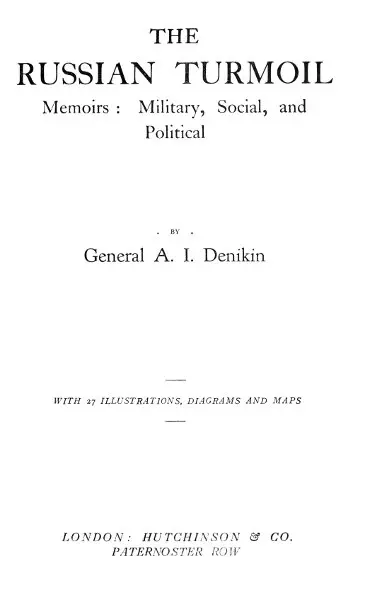
"The Russian Turmoil; Memoirs: Military, Social, and Political" by General A. I. Denikin is a historical account likely written in the early 20th century. The memoirs focus on the tumultuous events surrounding the collapse of the Russian Empire during the early stages of the Russian Revolution. Denikin, an officer closely connected to the military, discusses the disintegration of the army as well as the political and social factors that influenced these profound changes. The opening of the memoir sets the stage for the tumultuous events leading to the Russian Revolution by reflecting on the historical foundations that contributed to the collapse of the Russian state. Denikin outlines the conditions in the Russian army at the onset of the Revolution, emphasizing the soldiers' loyalty to the Czar and their traditional motivations of faith and patriotism. However, he also highlights a significant decline in moral and spiritual fortitude among the ranks, exacerbated by war weariness and the influences of revolutionary ideologies. As Denikin recounts his experiences and observations, he lays a strong foundation for understanding the complex interplay between military loyalty, political upheaval, and social change that characterized this pivotal moment in Russian history.
Introduction adapted from the source catalogue; source summaries may be automatically generated.
Free to read · English · 131,187 words · No account needed
MAKE TIME FOR A GOOD BOOK
On by default. Untick to stop anonymous reading totals. Each page counts after 10 seconds in view. How this works.
Anonymous counting is on unless you have switched it off.
Finally, a certain amount of friction could not fail to arise between the Government and the Stavka, because the latter constantly protested against many Government measures, which exercised a disturbing influence on the Army. There were no other serious reasons for difference of opinion, because neither Alexeiev nor myself, nor the various sections of the Stavka, ever touched upon matters of internal policy. The Stavka was non-political in the fullest sense of the word, and during the first months of the Revolution was a perfectly reliable technical apparatus in the hands of the Provisional Government. The Stavka did but safeguard the highest interests of the Army, and, within the limits of the War and of the Army, demanded that full powers be given to the Supreme Commander-in-Chief. I may even say that the personnel of the Stavka seemed to me to be bureaucratic and too deeply immersed in the sphere of purely technical interests; they were not sufficiently interested in the political and social questions which events had brought to the fore.
In discussing the Russian strategy in the Great War, after August, 1915, one should always bear in mind that it was the personal strategy of General Alexeiev. He alone bears the responsibility before history for its course, its successes and failures. A man of exceptional conscientiousness and self-sacrifice, and devoted to his work, he had one serious failing: all his life he did the work of others as well as his own. So it was when he held the post of Quartermaster-General of the General Staff, of Chief-of-Staff of the Kiev District, and later of the South-Western front and finally of Chief-of-Staff to the Supreme C.-in-C. Nobody influenced strategical decisions, and, as often as not, final instructions, written in Alexeiev's tiny and neat hand-writing, appeared unexpectedly on the desk of the Quartermaster-General, whose duty under the law and whose responsibility in these matters were very grave. If such a procedure was to a certain extent justifiable, when the post of Quartermaster-General was occupied by a nonentity, there was no excuse for it when he was superseded by other Quartermasters-General, such as Lukomski or Josephovitch. These men could not accept such a position. The former, as a rule, protested by sending in memoranda embodying his opinion, which was adverse to the plan of operations. Such protests, of course, were purely academic, but presented a guarantee against the judgment of history. General Klembovski, my predecessor, was compelled to demand non-interference with the rightful sphere of his competence as a condition of his tenure of office. Till then, Alexeiev had directed all the branches of administration. When these branches acquired a still broader scope, this proved practically impossible, and I was given full liberty in my work except ... in respect of strategy. Again, Alexeiev began to send telegrams in his own hand of a strategical nature, orders and directions, the motives of which the Quartermaster-General and myself could not understand. Several times, three of us, the Quartermaster-General, Josephovitch, his assistant, General Markov, and myself, discussed this question. The quick-tempered Josephovitch was greatly excited, and asked to be appointed to a Divisional Command. "I cannot be a clerk," he said. "There is no need for a Quartermaster-General at the Stavka if every clerk can type instructions." The General and myself began to contemplate resignation. Markov said that he would not stay for a single day if we went. I finally decided to have a frank talk with Alexeiev. We were both under the strain of emotion. We parted as friends, but we did not settle the question. Alexeiev said: "Do I not give you a full share of the work? I do not understand you." Alexeiev was quite sincerely surprised because during the war he had grown accustomed to a régime which appeared to him perfectly normal. So we three held another conference. After a lengthy discussion, we decided that the plan of campaign for 1917 had long since been worked out, that preparations for that campaign had reached a stage in which substantial alterations had become impossible, that the details of the concentration and distribution of troops were in the present condition of the Army a difficult matter, allowing for differences of opinion; that we could perhaps manage to effect certain alterations of the plan, and that finally our retirement in corpore might be detrimental to the work, and might undermine the position of the Supreme C.-in-C., which was already by no means stable. We therefore decided to wait and see. We did not have to wait very long, because, at the end of May, Alexeiev left the Stavka, and we followed him very soon afterwards.
Your reading position is saved on this browser. Take it to another device with a library code. Reading pages adapt to text, rather than matching a printed edition.
BEHIND THE BOOK
This eBook is for the use of anyone anywhere in the United States and most other parts of the world at no cost and with almost no restrictions whatsoever. You may copy it, give it away or re-use it under the terms of the Project Gutenberg License included with this eBook or online at www.gutenberg.org. If you are not located in the United States, you will have to check the laws of the country where you are located before using this eBook. Read the source licence.
The original source file, including credits and licence, is retained by this library. Request an original-format copy at no charge. Please include the book title and Project Gutenberg identifier #43680.
KEEP YOUR CURIOSITY GOING
Cécile Tormay

Moritz Busch
John L. Ransom
Frances Wright
Cécile Tormay

Mabel Potter Daggett