THE CLASSIC COLLECTION✦An outlaw’s diary: the CommuneCLASSIC FREE BOOKS
An outlaw’s diary: the Commune
Cécile Tormay
THE CLASSIC COLLECTION · 1922
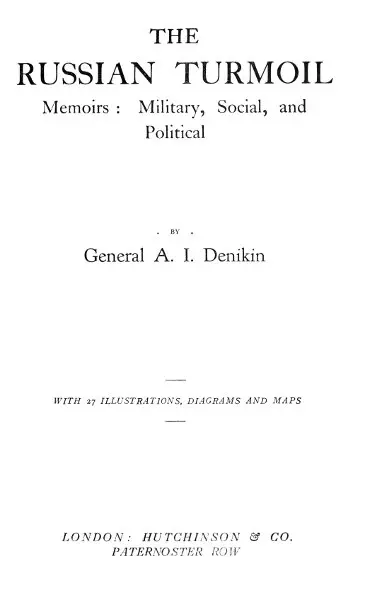
"The Russian Turmoil; Memoirs: Military, Social, and Political" by General A. I. Denikin is a historical account likely written in the early 20th century. The memoirs focus on the tumultuous events surrounding the collapse of the Russian Empire during the early stages of the Russian Revolution. Denikin, an officer closely connected to the military, discusses the disintegration of the army as well as the political and social factors that influenced these profound changes. The opening of the memoir sets the stage for the tumultuous events leading to the Russian Revolution by reflecting on the historical foundations that contributed to the collapse of the Russian state. Denikin outlines the conditions in the Russian army at the onset of the Revolution, emphasizing the soldiers' loyalty to the Czar and their traditional motivations of faith and patriotism. However, he also highlights a significant decline in moral and spiritual fortitude among the ranks, exacerbated by war weariness and the influences of revolutionary ideologies. As Denikin recounts his experiences and observations, he lays a strong foundation for understanding the complex interplay between military loyalty, political upheaval, and social change that characterized this pivotal moment in Russian history.
Introduction adapted from the source catalogue; source summaries may be automatically generated.
Free to read · English · 131,187 words · No account needed
MAKE TIME FOR A GOOD BOOK
On by default. Untick to stop anonymous reading totals. Each page counts after 10 seconds in view. How this works.
Anonymous counting is on unless you have switched it off.
[70] This telegram was not received at Headquarters. Kerensky gives the episode with Lvov thus: "On August 26th General Kornilov sent to me Vv. N. Lvov, member of the State Duma, with a demand that the Provisional Government should cede all its military and civil authority, leaving him to form a Government for the country in accordance with his own personal views."
[71] On the morning of the 29th a telegram from the Quartermaster-General at the Stavka somehow reached us, in which again hopes of a peaceful settlement were held out.
[72] He went through the Kouban campaigns with the Volunteer Army and served in it to the day of his death, from spotted typhus, in 1920.
[73] Official communication.
[74] The members of the Commission were: Col. Raupach and Col. Oukraintsev, military jurists; Kolokolov, examining magistrate; and Lieber and Krochmal, members of the Executive Committee of the Soviet of Workmen's and Soldiers' delegates.
[75] Shablovsky, Kolokolov, Raupach and Oukraintsev.
[76] Shablovsky's interview in the "Retch."
[77] On that same morning we had been taken without any escort, with only one guard accompanying us, to the bath, about two-thirds of a mile from the guard-house, without attracting any attention.
[78] This gallant officer was afterwards one of the first Volunteers, was wounded again in Kornilov's first Kouban campaign in 1918, and died in the spring of 1919 of spotted typhus.
[79] The Kornilov case.
Transcriber's note:
Every effort has been made to replicate this text as faithfully as
possible.
Soviet Order Number 1 is referred to as "Order No. 1." and "Order No. I." in the printed text: this has been standardised to "Order No. 1."
The original contained several unmatched double quotation marks. It was not possible to determine where the matching double quotation marks belonged, and none were added.
The reference to the footnote "Miliukov: History of the Second Russian Revolution" on page 54 was missing in the original.
The following is a list of changes made to the original. The first line is the original line, the second the corrected one.
Shulguin and Miliukov delivered their historical speeches, was Shulgin and Miliukov delivered their historical speeches, was
upon which the Czarist Government could reply. Everybody considered upon which the Czarist Government could rely. Everybody considered
the villages. Government servants of all kinds were impoverishd the villages. Government servants of all kinds were impoverished
the proletariat, the troops, the bourgoisie, even the nobility ... the proletariat, the troops, the bourgeoisie, even the nobility ...
terrorist crimes, military mutinies and aggrarian offences, etc. terrorist crimes, military mutinies and agrarian offences, etc.
At Pskov, on the evening of March 1st, the Czar saw General Rusky, At Pskov, on the evening of March 1st, the Czar saw General Ruzsky,
Your reading position is saved on this browser. Take it to another device with a library code. Reading pages adapt to text, rather than matching a printed edition.
BEHIND THE BOOK
This eBook is for the use of anyone anywhere in the United States and most other parts of the world at no cost and with almost no restrictions whatsoever. You may copy it, give it away or re-use it under the terms of the Project Gutenberg License included with this eBook or online at www.gutenberg.org. If you are not located in the United States, you will have to check the laws of the country where you are located before using this eBook. Read the source licence.
The original source file, including credits and licence, is retained by this library. Request an original-format copy at no charge. Please include the book title and Project Gutenberg identifier #43680.
KEEP YOUR CURIOSITY GOING
Cécile Tormay

Moritz Busch
John L. Ransom
Frances Wright
Cécile Tormay

Mabel Potter Daggett