THE CLASSIC COLLECTION✦An outlaw’s diary: the CommuneCLASSIC FREE BOOKS
An outlaw’s diary: the Commune
Cécile Tormay
THE CLASSIC COLLECTION · 1922
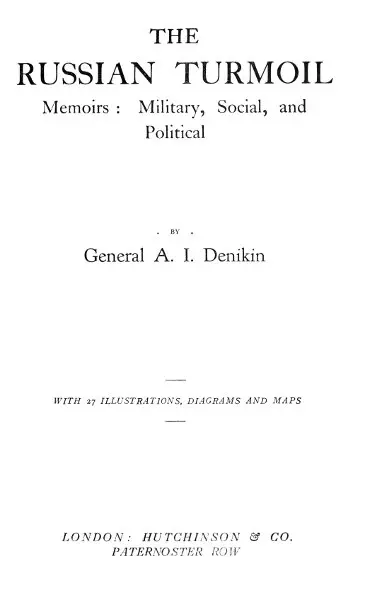
"The Russian Turmoil; Memoirs: Military, Social, and Political" by General A. I. Denikin is a historical account likely written in the early 20th century. The memoirs focus on the tumultuous events surrounding the collapse of the Russian Empire during the early stages of the Russian Revolution. Denikin, an officer closely connected to the military, discusses the disintegration of the army as well as the political and social factors that influenced these profound changes. The opening of the memoir sets the stage for the tumultuous events leading to the Russian Revolution by reflecting on the historical foundations that contributed to the collapse of the Russian state. Denikin outlines the conditions in the Russian army at the onset of the Revolution, emphasizing the soldiers' loyalty to the Czar and their traditional motivations of faith and patriotism. However, he also highlights a significant decline in moral and spiritual fortitude among the ranks, exacerbated by war weariness and the influences of revolutionary ideologies. As Denikin recounts his experiences and observations, he lays a strong foundation for understanding the complex interplay between military loyalty, political upheaval, and social change that characterized this pivotal moment in Russian history.
Introduction adapted from the source catalogue; source summaries may be automatically generated.
Free to read · English · 131,187 words · No account needed
MAKE TIME FOR A GOOD BOOK
On by default. Untick to stop anonymous reading totals. Each page counts after 10 seconds in view. How this works.
Anonymous counting is on unless you have switched it off.
The Army will be regenerated. Of that there can be no doubt.
Shaken in its historical foundations and traditions, like the heroes of the Russian legends, it will stand for no short time at the cross-roads, gazing anxiously into the misty distances, still wrapped in the gloom before the dawn, and listening intently to the vague sounds of the voices calling to it. And among the delusive calls it will seek, straining its hearing to the utmost, for the real voice ... the voice of its own people.
PRINTED BY THE FIELD PRESS LTD., WINDSOR HOUSE, BREAM'S BUILDINGS, LONDON, E.C. 4.
[1] Barin is the Russian word for master. It also means gentleman,
and was used by the peasants and by servants in addressing their
superiors.
[2] The French Deputy, Louis Martin, estimates the losses of the Armies in killed alone as follows:--(In millions) Russia 2½, Germany 2, Austria 1½, France 1.4, Great Britain 0.8, Italy 0.6, etc. Russia's share of the martyrdom of all the Allied forces is 40 per cent.
[3] President of the Duma.
[4] The Grand Duke here refers to the manifesto drafted by Witte, granting various liberties and decreeing the convocation of the Duma.
[5] Miliukov: History of the Second Russian Revolution.
[6] Minister of War.
[7] Chessin: La Révolution Russe.
[8] Quartermaster-General of the Commander-in-Chief of All Fronts.
[9] Chief of Staff of the Northern Front (Com.-in-Ch., General Ruzsky).
[10] Count Fredericks, Narishkine, Ruzsky, Gutchkov, Shulgin.
[11] Shulgin's narrative.
[12] Prince Lvov, Miliukov, Kerensky, Nekrassov, Teresvtchenko, Godnev, Lvov, Gutchkov, and Rodzianko.
[13] Miliukov: History of the Second Russian Revolution.
[14] The murder took place on the night of July 16th, 1918.
[15] Much time, pains and labour were devoted to the task of collecting information about the murdered Imperial family by General Dietrichs.
[16] The term Soviet for brevity will be used in the course of the narrative instead of Soviet of Workmen's and Soldiers' Delegates.
[17] The word Defensists is used as a translation of the newly-coined Russian word oboronetz, which means "He who is in favour of a defensive war."
[18] A "poud" is equal to 40 pounds.
[19] Gustave Le-Bon, The Psychology of Socialism.
[20] The restoration of Poland in her ethnographic frontiers was
intended by Russia also.
[21] Mes Souvenirs de Guerre.
[22] These lists contained the names of those suspected of relations
with the enemy Governments.
[23] Among the members of the Committee were, for instance, Zourabov and Perzitch, who had served under Parvus.
[24] It is curious that Bronstein (Trotsky)--a person sufficiently competent in the matter of secret communications with the Staffs of our antagonists--said in the Izvestia for July 8th, 1917: "In the paper Nashe Slovo I have exposed and pilloried Skoropis-Yoltoukhovsky, Potok and Melenevsky as agents of the Austrian General Staff."
Your reading position is saved on this browser. Take it to another device with a library code. Reading pages adapt to text, rather than matching a printed edition.
BEHIND THE BOOK
This eBook is for the use of anyone anywhere in the United States and most other parts of the world at no cost and with almost no restrictions whatsoever. You may copy it, give it away or re-use it under the terms of the Project Gutenberg License included with this eBook or online at www.gutenberg.org. If you are not located in the United States, you will have to check the laws of the country where you are located before using this eBook. Read the source licence.
The original source file, including credits and licence, is retained by this library. Request an original-format copy at no charge. Please include the book title and Project Gutenberg identifier #43680.
KEEP YOUR CURIOSITY GOING
Cécile Tormay

Moritz Busch
John L. Ransom
Frances Wright
Cécile Tormay

Mabel Potter Daggett