THE CLASSIC COLLECTION✦An outlaw’s diary: the CommuneCLASSIC FREE BOOKS
An outlaw’s diary: the Commune
Cécile Tormay
THE CLASSIC COLLECTION · 1922
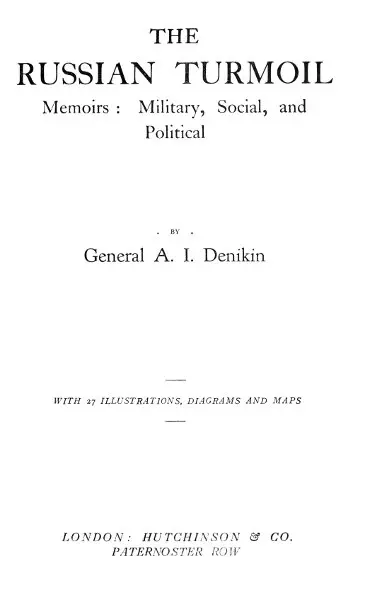
"The Russian Turmoil; Memoirs: Military, Social, and Political" by General A. I. Denikin is a historical account likely written in the early 20th century. The memoirs focus on the tumultuous events surrounding the collapse of the Russian Empire during the early stages of the Russian Revolution. Denikin, an officer closely connected to the military, discusses the disintegration of the army as well as the political and social factors that influenced these profound changes. The opening of the memoir sets the stage for the tumultuous events leading to the Russian Revolution by reflecting on the historical foundations that contributed to the collapse of the Russian state. Denikin outlines the conditions in the Russian army at the onset of the Revolution, emphasizing the soldiers' loyalty to the Czar and their traditional motivations of faith and patriotism. However, he also highlights a significant decline in moral and spiritual fortitude among the ranks, exacerbated by war weariness and the influences of revolutionary ideologies. As Denikin recounts his experiences and observations, he lays a strong foundation for understanding the complex interplay between military loyalty, political upheaval, and social change that characterized this pivotal moment in Russian history.
Introduction adapted from the source catalogue; source summaries may be automatically generated.
Free to read · English · 131,187 words · No account needed
MAKE TIME FOR A GOOD BOOK
On by default. Untick to stop anonymous reading totals. Each page counts after 10 seconds in view. How this works.
Anonymous counting is on unless you have switched it off.
The idea of the advance was finally, however, accepted by the Committee of the Front, which demanded that from itself and from Army Committees "fighting committees of contact" be established which would be entitled to partake in the drafting of plans of operations to control the Commanding Officers and Headquarters of the advancing troops, etc. I naturally refused the request, and a conflict ensued. The War Minister was very much perturbed, and sent to Minsk the Chief of his Chancery, Colonel Baronovsky, a young staff officer who prompted Kerensky in all military matters, and the Commissar Stankevitch, who remained at the Western Front for two days, was removed to the Northern Front and replaced by Kalinin. Baronovsky's friends afterwards told me that the question of my dismissal had been raised in view of "friction with the Committee of the Front." Stankevitch appeased the Committee and "fighting committees of contact" were allowed to take part in the advance, but were denied the right of control over the operations and of assisting in drawing up plans.
Of the three Army Commanders at that Front, two were entirely in the hands of the Committees. As their sectors were inactive, their presence could be temporarily tolerated. The advance was to begin on the Front of the 10th Army, commanded by General Kisselevsky, in the region of Molodetchno. I inspected the troops and the position, interviewed the Commanding Officers and addressed the troops. In the preceding chapters I have recounted impressions, facts, and episodes of the life of the Western front. I will, therefore, mention here only a few details. I saw the troops on parade. Some units had preserved the appearance and the routine of the normal pre-Revolutionary times. These, however, were exceptions, and were to be found chiefly in the Army Corps of General Dovbor-Mussnitzki, who was persistently and sternly maintaining the old discipline. Most of the units, however, were more akin to a devastated ants-nest than to an organised unit, although they had retained a semblance of discipline and drill. After the review I walked down the ranks and spoke to the soldiers. I was deeply depressed by their new mental attitude. Their speeches were nought but endless complaints, suspicions and grievances against everyone and everything. They complained of all the officers, from the Platoon Commander to the Army Corps Commander, complained of the lentil soup, of having to stand at the Front for ever, of the next regiment of the line, and of the Provisional Government for being implacably hostile to the Germans. I witnessed scenes which I shall not forget till my last hour. In one of the Army Corps I asked to be shown the worst unit. I was taken to the 703rd Suram Regiment. We drove up to a huge crowd of unarmed men who were standing, sitting, wandering about the plain behind the village. Having sold their clothes for cash or for drink, they were dressed in rags, bare-footed, ragged, unkempt, and seemed to have reached the utmost limit of physical degradation. I was met by the Divisional Commander, whose lower lip trembled, and by a Regimental Commander who had the face of a condemned man. Nobody gave the order "Attention!" and none of the soldiers rose. The nearest ranks moved towards our motor cars. My first impulse was to curse the regiment and turn back. But that might have been interpreted as cowardice, so I went into the thick of the crowd. I stayed there for about an hour. Good Heavens, what was the matter with these men, with the reasonable creature of God, with the Russian field-labourer? They were like men possessed, their brain dimmed, their speech stubborn and completely lacking logic or common-sense; their shrieks were hysterical, full of abuse and foul swearing. We tried to speak, but the replies were angry and stupid. I remember that my feelings of indignation as an old soldier receded to the background and I merely felt infinitely sorry for these uncouth, illiterate Russians to whom little was given and of whom little will, therefore, be asked. One wished that the leaders of the Revolutionary Democracy had been on that plain and had seen and heard everything. One wished one could have said to them: "It is not the time to find out who is guilty, it doesn't matter whether the guilt is ours, yours, of the bourgeoisie or of autocracy. Give the people education and an 'image of man' first, and then socialise, nationalise, Communise, if the people will then follow you."
Your reading position is saved on this browser. Take it to another device with a library code. Reading pages adapt to text, rather than matching a printed edition.
BEHIND THE BOOK
This eBook is for the use of anyone anywhere in the United States and most other parts of the world at no cost and with almost no restrictions whatsoever. You may copy it, give it away or re-use it under the terms of the Project Gutenberg License included with this eBook or online at www.gutenberg.org. If you are not located in the United States, you will have to check the laws of the country where you are located before using this eBook. Read the source licence.
The original source file, including credits and licence, is retained by this library. Request an original-format copy at no charge. Please include the book title and Project Gutenberg identifier #43680.
KEEP YOUR CURIOSITY GOING
Cécile Tormay

Moritz Busch
John L. Ransom
Frances Wright
Cécile Tormay

Mabel Potter Daggett