THE CLASSIC COLLECTION✦An outlaw’s diary: the CommuneCLASSIC FREE BOOKS
An outlaw’s diary: the Commune
Cécile Tormay
THE CLASSIC COLLECTION · 1922
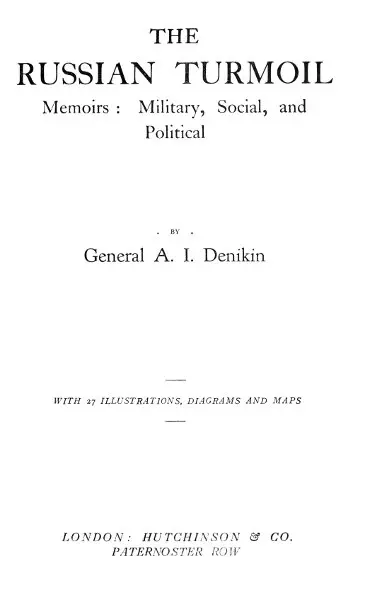
"The Russian Turmoil; Memoirs: Military, Social, and Political" by General A. I. Denikin is a historical account likely written in the early 20th century. The memoirs focus on the tumultuous events surrounding the collapse of the Russian Empire during the early stages of the Russian Revolution. Denikin, an officer closely connected to the military, discusses the disintegration of the army as well as the political and social factors that influenced these profound changes. The opening of the memoir sets the stage for the tumultuous events leading to the Russian Revolution by reflecting on the historical foundations that contributed to the collapse of the Russian state. Denikin outlines the conditions in the Russian army at the onset of the Revolution, emphasizing the soldiers' loyalty to the Czar and their traditional motivations of faith and patriotism. However, he also highlights a significant decline in moral and spiritual fortitude among the ranks, exacerbated by war weariness and the influences of revolutionary ideologies. As Denikin recounts his experiences and observations, he lays a strong foundation for understanding the complex interplay between military loyalty, political upheaval, and social change that characterized this pivotal moment in Russian history.
Introduction adapted from the source catalogue; source summaries may be automatically generated.
Free to read · English · 131,187 words · No account needed
MAKE TIME FOR A GOOD BOOK
On by default. Untick to stop anonymous reading totals. Each page counts after 10 seconds in view. How this works.
Anonymous counting is on unless you have switched it off.
Owing to various political and economic reasons and to the fact that the old Government did not devote sufficient attention to the development of the natural resources of the country, our industries were not placed on a solid basis, and were to a great extent dependent upon foreign markets even for such material as might easily have been found in Russia. Thus in 1912 there was a serious shortage of pig-iron, and in 1913 of fuel. From 1908 to 1913 imports of metals from abroad rose from 29 to 34 per cent. Before the War we imported 48 per cent. of cotton. We needed 2,750,000 pouds[18] of wool from abroad out of a total of the 5,000,000 pouds produced.
The War unquestionably affected industry very deeply. Normal imports came to a standstill. The mines of Dombrovsk were lost. Owing to strategical requirements, transport was weakened, supplies of fuel and of raw materials diminished. Most of the factories had to work for the Army, and their personnel was curtailed by mobilisations. From an economic point of view, the militarisation of industry was a heavy burden for the population, because, according to the estimates made by one of the Ministers, the Army absorbed 40 to 50 per cent. of the total of goods produced by the country. Finally, the War widened the gulf between the employers and the workmen, as the former made immense profits, whereas the latter were impoverished, and their condition was further aggravated by the suspension of certain professional guarantees on account of the War by the fact that certain categories of workmen were drafted by conscription to definite industrial concerns, and by the general burden of inflated prices and inadequate food supplies.
Even in these abnormal circumstances Russian industries to some extent fulfilled the requirements of the moment, but the Revolution dealt them a death blow, which caused their gradual dislocation and ultimate collapse. On the one hand, the Provisional Government was legislating for the establishment of a strict Government control of the industries of the country and for regulating them by heavily taxing profits and excess war profits, as well as by Government distribution of fuel, raw materials and food. The latter measure caused the trading class to be practically eliminated and to be replaced by democratic organisations. Whether excess profits disappeared as a result of this policy, or were merely transferred to another class, it is not easy to decide. On the other hand, the Government were deeply concerned with the protection of labour, and were drafting and passing various laws concerning the freedom of unions, labour exchanges, conciliation boards, social insurance, etc. Unfortunately, the impatience and the desire for "law-making" which had seized the villages were also apparent in the factories. Heads of industrial concerns were dismissed wholesale, as well as the administrative and technical staffs. These dismissals were accompanied by insults and sometimes by violence, out of revenge for past offences, real or imaginary. Some of the members of the staffs resigned of their own accord, because they were unable to endure the humiliating position into which they were forced by the workmen. Given our low level of technical and educational standards, such methods were fraught with grave danger. As in the Army, so in the factories, Committees replaced by elections the dismissed personnel with utterly untrained and ignorant men. Sometimes the workmen completely seized the industrial concerns. Ignorant and unprovided with capital, they led these concerns to ruin, and were themselves driven to unemployment and misery. Labour discipline in the factories completely vanished, and no means was left of exercising moral, material or judicial pressure or compulsion. The "consciousness" alone of the workers proved inadequate. The technical and administrative personnel which remained or was newly elected could no longer direct the industries and enjoyed no authority, as it was thoroughly terrorised by the workmen. Naturally, therefore, the working hours were still further curtailed, work became careless, and production fell to its lowest ebb. The metallurgical industries of Moscow fell 32 per cent. and the productivity of the Petrograd factories 20 to 40 per cent. as early as in the month of April. In June the production of coal and the general production of the Donetz basin fell 30 per cent. The production of oil in Baku and Grozni also suffered. The greatest injury, however, was inflicted upon the industries by the monstrous demands for higher wages, completely out of proportion to the cost of living and to the productivity of labour, as well as to the actual paying capacity of the industries. These demands greatly exceeded all excess profits. The following figures are quoted in a Report to the Provisional Government: In eighteen concerns in the Donetz Basin, with a total profit of 75,000,000 roubles per annum, the workmen demanded a wage increase of 240,000,000 roubles per annum; the total amount of increased wages in all the mining and metallurgical factories of the South was 800,000,000 roubles per annum. In the Urals the total Budget was 200,000,000, while the wages rose to 300,000,000. In the Putilov factory alone, in Petrograd, before the end of 1917, the increase in wages amounted to 90,000,000 roubles. The wages rose from 200 to 300 per cent. The increase in the wages of the textile workers of Moscow rose 500 per cent., as compared to 1914. The burden of these increases naturally fell on the Government, as most of the factories were working for the defence of the country. Owing to the condition of industry described above, and to the psychology of the workmen, industrial concerns collapsed, and the country experienced an acute shortage of necessary commodities, with a corresponding increase in prices. Hence the rise in the price of bread and the reluctance of the villages to supply the towns.
Your reading position is saved on this browser. Take it to another device with a library code. Reading pages adapt to text, rather than matching a printed edition.
BEHIND THE BOOK
This eBook is for the use of anyone anywhere in the United States and most other parts of the world at no cost and with almost no restrictions whatsoever. You may copy it, give it away or re-use it under the terms of the Project Gutenberg License included with this eBook or online at www.gutenberg.org. If you are not located in the United States, you will have to check the laws of the country where you are located before using this eBook. Read the source licence.
The original source file, including credits and licence, is retained by this library. Request an original-format copy at no charge. Please include the book title and Project Gutenberg identifier #43680.
KEEP YOUR CURIOSITY GOING
Cécile Tormay

Moritz Busch
John L. Ransom
Frances Wright
Cécile Tormay

Mabel Potter Daggett