
Neka, the boy conjuror
Edward Stratemeyer
THE CLASSIC COLLECTION · 1912
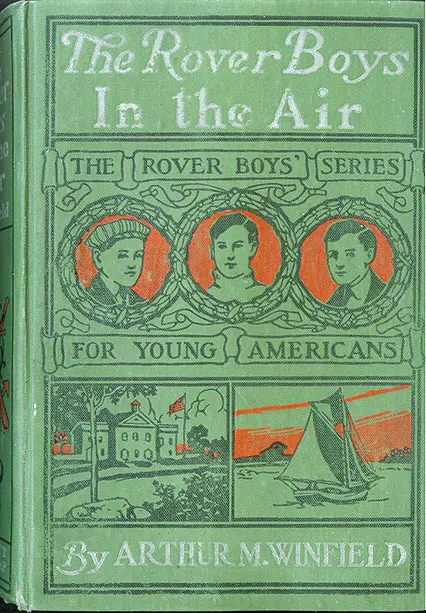
"The Rover Boys in the Air; Or, From College Campus to the Clouds" by Stratemeyer is a juvenile adventure novel published in 1926. Part of the popular Rover Boys series, this installment incorporates modern aviation technology as the adventurous brothers take to the skies. The series follows wealthy young men attending military boarding school, known for their pranks, flirtations, and unchaperoned adventures that frequently lead to both mischief and encounters with criminals, blending action with the technological marvels of the era.
Introduction adapted from the source catalogue; source summaries may be automatically generated.
Free to read · English · 60,118 words · No account needed
MAKE TIME FOR A GOOD BOOK
On by default. Untick to stop anonymous reading totals. Each page counts after 10 seconds in view. How this works.
Anonymous counting is on unless you have switched it off.
"I think we could carry half a dozen folks now," said Sam, after a trial with some bags of sand. "She takes up the extra weight without an effort."
"Perhaps, but there is no use of straining the biplane, or the engine
either," returned Dick.
The morning of the all-important day came and the boys found the wind blowing steadily from the west.
"Rather breezy for a flight," was Dick's comment.
"Do you think it will rain?" queried Sam, anxiously.
"Not with the wind from that quarter, Sam. But we may get more breeze
than we want."
"Oh, we won't mind the wind a bit," declared Tom, who never wanted anything to interfere with his pleasure.
The boys had their regular classes to attend during the morning, and also one recitation after lunch. But by half-past two all were free, and after donning their aviation suits, they hurried to the shed and rolled out the Dartaway.
"Pretty breezy and no mistake," remarked Dick, as he gazed anxiously at the sky. "I don't know about this."
"Oh, don't say we can't go, Dick!" pleaded Sam.
"Maybe the breeze isn't so strong high up," came from Tom, hopefully.
"It may be stronger, Tom. We don't want to go up and get wrecked."
"Oh, the Dartaway won't get wrecked--not with that powerful engine."
Dick hesitated. He did not like that strong breeze in the least. Yet he was just as anxious as his brothers to visit the seminary and meet the girls, and let them see the biplane. And there was something even more important on his mind.
"Oh, come ahead, and take a chance!" cried Tom. "We'll get through
somehow!"
"Just what I say," declared Sam.
"Who is to run the machine?" asked the big brother.
"I'll run her, if you want me to," answered Tom, promptly.
"Oh, I was only thinking of the honor, Tom. I'm not afraid to try it."
"Oh, you go ahead and do it," put in Sam, who knew that his big brother's heart was set on showing Dora what he could do with the flying machine.
"We'll go up and try it," answered Dick, at last. "If she works all right, I'll head her for the seminary; otherwise I'll bring her down again;" and so it was arranged.
Your reading position is saved on this browser. Take it to another device with a library code. Reading pages adapt to text, rather than matching a printed edition.
Edward Stratemeyer

Edward Stratemeyer
Edward Stratemeyer

Edward Stratemeyer
BEHIND THE BOOK
This eBook is for the use of anyone anywhere in the United States and most other parts of the world at no cost and with almost no restrictions whatsoever. You may copy it, give it away or re-use it under the terms of the Project Gutenberg License included with this eBook or online at www.gutenberg.org. If you are not located in the United States, you will have to check the laws of the country where you are located before using this eBook. Read the source licence.
The original source file, including credits and licence, is retained by this library. Request an original-format copy at no charge. Please include the book title and Project Gutenberg identifier #20053.
KEEP YOUR CURIOSITY GOING
Coulson Kernahan

Maurice Baring
Frances Wright
Cécile Tormay

Frederic Jesup Stimson

W. H. P. (William Henry Pope) Jarvis