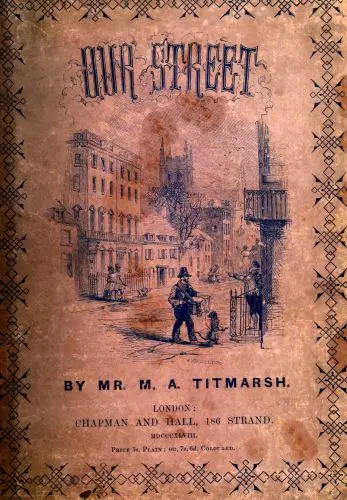
“Our Street”
William Makepeace Thackeray
THE CLASSIC COLLECTION · 1854
"The Rose and the Ring" by William Makepeace Thackeray is a satirical fantasy written in 1854. In the fictional kingdoms of Paflagonia and Crim Tartary, four royal cousins find their fates entwined with two magical gifts from the Fairy Blackstick—a ring and a rose that make their wearers irresistibly beautiful. As stolen thrones, mistaken identities, and enchanted love complicate courtly life, princes and princesses must navigate deception, exile, and even a den of lions before discovering their true destinies.
Introduction adapted from the source catalogue; source summaries may be automatically generated.
Free to read · English · 29,829 words · No account needed
MAKE TIME FOR A GOOD BOOK
On by default. Untick to stop anonymous reading totals. Each page counts after 10 seconds in view. How this works.
Anonymous counting is on unless you have switched it off.
The little girl said, ‘Little lion was my brudder; great big lioness my mudder; neber heard of any udder.’ And she capered away on her one shoe, and everybody was exceedingly diverted.
So Angelica said to the Queen, ‘Mamma, my parrot flew away yesterday out of its cage, and I don’t care any more for any of my toys; and I think this funny little dirty child will amuse me. I will take her home, and give her some of my old frocks.’
‘Oh, the generous darling!’ says Mrs. Gruffanuff.
‘Which I have worn ever so many times, and am quite tired of,’ Angelica went on; ‘and she shall be my little maid. Will you come home with me, little dirty girl?’
The child clapped her hands, and said, ‘Go home with you--yes! You pooty Princess!--Have a nice dinner, and wear a new dress!’
And they all laughed again, and took home the child to the palace, where, when she was washed and combed, and had one of the Princess’s frocks given to her, she looked as handsome as Angelica, almost. Not that Angelica ever thought so; for this little lady never imagined that anybody in the world could be as pretty, as good, or as clever as herself. In order that the little girl should not become too proud and conceited, Mrs. Gruffanuff took her old ragged mantle and one shoe, and put them into a glass box, with a card laid upon them, upon which was written, ‘These were the old clothes in which little BETSINDA was found when the great goodness and admirable kindness of Her Royal Highness the Princess Angelica received this little outcast.’ And the date was added, and the box locked up.
For a while little Betsinda was a great favourite with the Princess, and she danced, and sang, and made her little rhymes, to amuse her mistress. But then the Princess got a monkey, and afterwards a little dog, and afterwards a doll, and did not care for Betsinda any more, who became very melancholy and quiet, and sang no more funny songs, because nobody cared to hear her. And then, as she grew older, she was made a little lady’s-maid to the Princess; and though she had no wages, she worked and mended, and put Angelica’s hair in papers, and was never cross when scolded, and was always eager to please her mistress, and was always up early and to bed late, and at hand when wanted, and in fact became a perfect little maid. So the two girls grew up, and, when the Princess came out, Betsinda was never tired of waiting on her; and made her dresses better than the best milliner, and was useful in a hundred ways. Whilst the Princess was having her masters, Betsinda would sit and watch them; and in this way she picked up a great deal of learn ing; for she was always awake, though her mistress was not, and listened to the wise professors when Angelica was yawning or thinking of the next ball. And when the dancing-master came, Betsinda learned along with Angelica; and when the music-master came, she watched him, and practiced the Princess’s pieces when Angelica was away at balls and parties; and when the drawing-master came, she took note of all he said and did; and the same with French, Italian, and all other languages--she learned them from the teacher who came to Angelica. When the Princess was going out of an evening she would say, ‘My good Betsinda, you may as well finish what I have begun.’ ‘Yes, miss,’ Betsinda would say, and sit down very cheerful, not to FINISH what Angelica began, but to DO it.
Your reading position is saved on this browser. Take it to another device with a library code. Reading pages adapt to text, rather than matching a printed edition.
William Makepeace Thackeray
William Makepeace Thackeray
Charles Dickens & William Makepeace Thackeray
William Makepeace Thackeray
BEHIND THE BOOK
This eBook is for the use of anyone anywhere in the United States and most other parts of the world at no cost and with almost no restrictions whatsoever. You may copy it, give it away or re-use it under the terms of the Project Gutenberg License included with this eBook or online at www.gutenberg.org. If you are not located in the United States, you will have to check the laws of the country where you are located before using this eBook. Read the source licence.
The original source file, including credits and licence, is retained by this library. Request an original-format copy at no charge. Please include the book title and Project Gutenberg identifier #897.
KEEP YOUR CURIOSITY GOING
Coulson Kernahan

Maurice Baring
Frances Wright
Cécile Tormay
Francis Greenleaf Allinson & Anne C. E. (Anne Crosby Emery) Allinson

Frederic Jesup Stimson