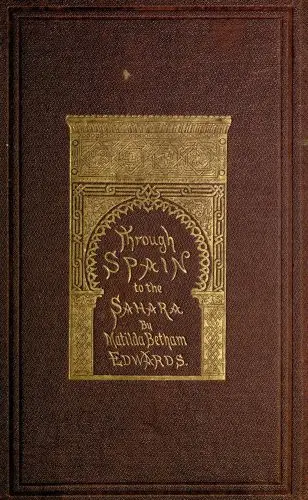
Through Spain to the Sahara
Matilda Betham-Edwards
THE CLASSIC COLLECTION · 1889
"The Roof of France; Or, the Causses of the Lozère" by Matilda Betham-Edwards is a travel narrative written during the late 19th century. This work is the third volume in the author's travels in France, offering readers a vivid exploration of the lesser-known landscapes of Lozère, particularly its striking limestone plateaus, known as the Causses, and their unique geological and cultural features. At the start of the book, the author introduces her readers to the mesmerizing region of the Lozère, detailing its breathtaking contrasts between the barren, rugged Causses and the fertile valleys below. She shares her personal journey, inspired by English acquaintances, to uncover the marvels of this remote area that few travelers have ventured to explore. The opening portion elaborates on her travels from the town of Le Puy to Mende, amidst stunning natural landscapes, as well as her encounters with the region's distinct culture and the resilient peasant communities that inhabit it. The narrative sets a tone of adventure and discovery, inviting readers into a richly descriptive experience of rural France that blends travelogue with insights into local life and traditions.
Introduction adapted from the source catalogue; source summaries may be automatically generated.
Free to read · English · 55,980 words · No account needed
MAKE TIME FOR A GOOD BOOK
On by default. Untick to stop anonymous reading totals. Each page counts after 10 seconds in view. How this works.
Anonymous counting is on unless you have switched it off.
Whereas mademoiselle laughingly counted half a dozen by the milestones between each inquiry. We had fondly looked forward to a fair inn and a good meal at noon--it was nearly two o'clock when our driver triumphantly deposited us before the dirtiest, most repulsive-looking hostelry it was ever my fate to enter.
In the kitchen, with walls blackened by smoke, hens and chickens disported at will; the uneven, floor was innocent of broom or scrubbing-brush as the road; in the salle-à-manger, gendarmes, soldiers, carters, and gamekeepers were smoking, drinking and discussing at the tops of their voices.
The old man whispered a word in the ear of the patrone--a veritable hag to look at--and she immediately begged us to walk upstairs.
'You will find no elegance, but comfort here' ('Vous ne trouvez pas le luxe, mais le confortable ici),' she said.
Then, with evident pride, she threw open the door of what was evidently the public bedchamber of the inn.
Let not the reader take alarm. In these out-of-the-way places such accommodation is often all that is offered the traveller, namely, a spacious room, set round with four posters, each well curtained, so as to form a tiny room in itself. As women never, or very rarely, travel in such regions, the chief patrons being commis-voyageurs and soldiers, the inconvenience is not great. The bedding looked good and clean, and the room was airy.
We opened the window. Madame complacently spread a snowy cloth, then, with the airy aplomb of a head waiter of some famous restaurant, say, the Chapeau Rouge at Bordeaux, asked:
'And what would these ladies like for breakfast?'
There seemed cruel, double-edged irony in the question. What could we expect in such a place but just something to stay the cravings of hunger: that something rendered uneatable by the terribly dirty--no, let me say, smoke-dried--look of the speaker, who seemed to be cook and waitress in one?
'Suppose we have an omelette?' suggested my young friend.
An omelette cooked by those hands! The very notion took away my appetite; however, there were new-laid eggs, and no matter the unwashed condition of the cook, the inside of a boiled egg may always be eaten with impunity. We could have anything we chose by waiting a little, our hostess said--mutton cutlets, roast chicken, partridges, fish, vegetables; the resources of that rustic larder seemed inexhaustible. Then she had choice wine, Burgundy and Bordeaux, besides liqueurs, in the cellar.
We had no time or inclination for a feast, but made an excellent meal--what with the eggs and a tiny leg of cold-boiled mutton, I do honestly believe the very best I ever tasted in my life.
Your reading position is saved on this browser. Take it to another device with a library code. Reading pages adapt to text, rather than matching a printed edition.
Matilda Betham-Edwards
Matilda Betham-Edwards
Matilda Betham-Edwards
Matilda Betham-Edwards
BEHIND THE BOOK
This eBook is for the use of anyone anywhere in the United States and most other parts of the world at no cost and with almost no restrictions whatsoever. You may copy it, give it away or re-use it under the terms of the Project Gutenberg License included with this eBook or online at www.gutenberg.org. If you are not located in the United States, you will have to check the laws of the country where you are located before using this eBook. Read the source licence.
The original source file, including credits and licence, is retained by this library. Request an original-format copy at no charge. Please include the book title and Project Gutenberg identifier #9073.
KEEP YOUR CURIOSITY GOING
Wilfrid Scawen Blunt
Wilfrid Scawen Blunt

E. W. (Edgar Watson) Howe
Francis Greenleaf Allinson & Anne C. E. (Anne Crosby Emery) Allinson
Cyrenus Cole

John Martineau