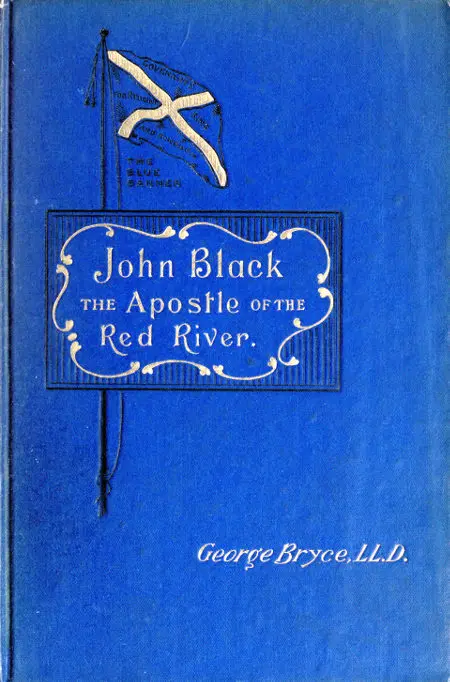
John Black, the Apostle of the Red River Or, How the Blue Banner Was Unfurled on Manitoba Prairies
George Bryce
THE CLASSIC COLLECTION · 1909
"The Romantic Settlement of Lord Selkirk's Colonists" by George Bryce is a historical account written in the early 20th century. The book delves into the narrative of the Scottish and Irish settlers who formed the Red River Colony under the patronage of Lord Selkirk in the early 1800s. Focusing on their struggles and triumphs, Bryce emphasizes the hardships these settlers faced as they attempted to build a new life in the challenging landscape of what is now Manitoba, Canada. At the start of the narrative, readers are introduced to Andrew McDermott, a patriarch of the settlement, who recounts the history of the land before the arrival of the settlers. He speaks of the indigenous peoples, the ancient Mound Builders, and the explorers who ventured into the wilderness, providing context for the looming challenges. The tone shifts as the story moves to the early years of settlement, highlighting themes of perseverance and community amidst adversity. McDermott shares tales of the initial arrival of the Selkirk Colonists in 1812, their encounters with local Indigenous tribes, and the complex dynamics that unfolded as various cultures collided in the Red River region. This opening sets the stage for a deeper exploration of their poignant journey toward establishing a sustainable community against significant odds.
Introduction adapted from the source catalogue; source summaries may be automatically generated.
Free to read · English · 64,235 words · No account needed
MAKE TIME FOR A GOOD BOOK
On by default. Untick to stop anonymous reading totals. Each page counts after 10 seconds in view. How this works.
Anonymous counting is on unless you have switched it off.
Some thirty years before the arrival of the Colonists, the Montreal traders found it useful to form a Company. This was called the North-West Fur Company of Montreal. Having taken large amounts out of the fur trade, they became the leaders among the merchants of Montreal. The Company had an energy and ability that made them about the beginning of the nineteenth century the most influential force in Canadian life. At Fort William and Lachine their convivial meetings did something to make them forget the perils of the rapids and whirlpools of the rivers, and the bitterness of the piercing winds of the northwestern stretches. Familiarly they were known as the "Nor'-Westers." Shortly before the beginning of the century mentioned, a split took place among the "Nor'-Westers," and as the bales of merchandise of the old Company had upon them the initials "N.W.," the new Company, as it was called, marked their packages "XY," these being the following letters of the alphabet.
Besides these mentioned there were a number of independent merchants, or free traders. At one time there were at the junction of the Souris and Assiniboine Rivers, five establishments, two of them being those of free traders or independents. Among all these Companies the commander of a Fort was called, "The Bourgeois" to suit the French tongue of the men. He was naturally a man of no small importance.
But the conditions, in which both the traders and the voyageurs lived, brought a disturbing shadow over the wide plains of the North-West. Now under British rule, the Fur trade from Montreal became a settled industry. From Curry's time (1766) they began to erect posts or depots at important points to carry on their trade. Around these posts the voyageurs built a few cabins and this new centre of trade afforded a spot for the encampment near by of the Indian teepees made of tanned skins. The meeting of the savage and the civilized is ever a contact of peril. Among the traders or officers of the Fur trade a custom grew up--not sanctioned by the decalogue--but somewhat like the German Morganatic marriage. It was called "Marriage of the Country." By this in many cases the trader married the Indian wife; she bore children to him, and afterwards when he retired from the country, she was given in real marriage to some other voyageur, or other employee, or pensioned off. It is worthy of note that many of these Indian women became most true and affectionate spouses. With the voyageurs and laborers the conditions were different. They could not leave the country, they had become a part of it, and their marriages with the Indian women were bona fide. Thus it was that during the space from the time of Curry until the arrival of the Selkirk Colonists upwards of forty years had elapsed, and around the wide spread posts of the Fur Trading Companies, especially around those of the prairie, there had grown up families, which were half French and half Indian, or half English and half Indian. When it could be afforded these children were sent for a time to Montreal, to be educated, and came back to their native wilds. On the plain between the Assiniboine and the Saskatchewan, a half-breed community had sprung up. From their dusky faces they took the name "Bois-Brules," or "Charcoal Faces," or referring to their mixed blood, of "Metis," or as exhibiting their importance, they sought to be called "The New Nation." The blend of French and Indian was in many respects a natural one. Both are stalwart, active, muscular; both are excitable, imaginative, ambitious; both are easily amused and devout. The "Bois-Brules" growing up among the Indians on the plains naturally possessed many of the features of the Indian life. The pursuit of their fur-bearing animals was the only industry of the country. The Bois-Brules from childhood were familiar with the Indian pony, knew all his tricks and habits, began to ride with all the skill of a desert ranger, were familiar with fire-arms, took part in the chase of the buffalo on the plains, and were already trained to make the attack as cavalry on buffalo herds, after the Indian fashion, in the famous half-circle, where they were to be so successful in their later troubles, of which we shall speak. Such men as the Grants, Findlays, Lapointes, Bellegardes, and Falcons were equally skilled in managing the swift canoe, or scouring the plains on the Indian ponies. We shall see the part which this new element were to play in the social life and even in the public concerns of the prairies.
Your reading position is saved on this browser. Take it to another device with a library code. Reading pages adapt to text, rather than matching a printed edition.
George Bryce

George Bryce
George Bryce
George Bryce
BEHIND THE BOOK
This eBook is for the use of anyone anywhere in the United States and most other parts of the world at no cost and with almost no restrictions whatsoever. You may copy it, give it away or re-use it under the terms of the Project Gutenberg License included with this eBook or online at www.gutenberg.org. If you are not located in the United States, you will have to check the laws of the country where you are located before using this eBook. Read the source licence.
The original source file, including credits and licence, is retained by this library. Request an original-format copy at no charge. Please include the book title and Project Gutenberg identifier #17358.
KEEP YOUR CURIOSITY GOING
Cécile Tormay

Moritz Busch
John L. Ransom
Frances Wright
Cécile Tormay

Mabel Potter Daggett