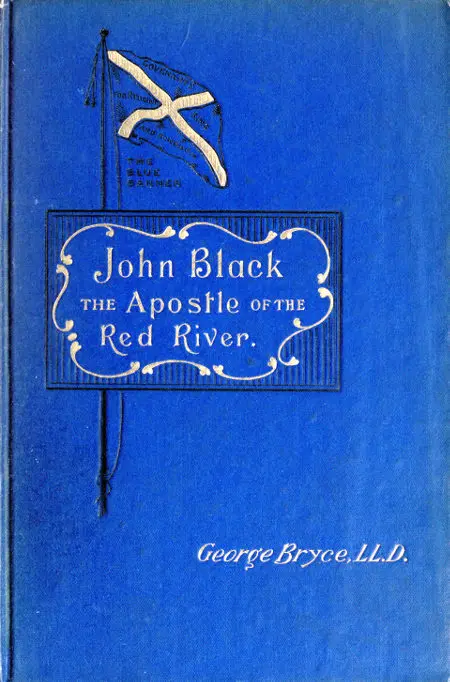
John Black, the Apostle of the Red River Or, How the Blue Banner Was Unfurled on Manitoba Prairies
George Bryce
THE CLASSIC COLLECTION · 1909
"The Romantic Settlement of Lord Selkirk's Colonists" by George Bryce is a historical account written in the early 20th century. The book delves into the narrative of the Scottish and Irish settlers who formed the Red River Colony under the patronage of Lord Selkirk in the early 1800s. Focusing on their struggles and triumphs, Bryce emphasizes the hardships these settlers faced as they attempted to build a new life in the challenging landscape of what is now Manitoba, Canada. At the start of the narrative, readers are introduced to Andrew McDermott, a patriarch of the settlement, who recounts the history of the land before the arrival of the settlers. He speaks of the indigenous peoples, the ancient Mound Builders, and the explorers who ventured into the wilderness, providing context for the looming challenges. The tone shifts as the story moves to the early years of settlement, highlighting themes of perseverance and community amidst adversity. McDermott shares tales of the initial arrival of the Selkirk Colonists in 1812, their encounters with local Indigenous tribes, and the complex dynamics that unfolded as various cultures collided in the Red River region. This opening sets the stage for a deeper exploration of their poignant journey toward establishing a sustainable community against significant odds.
Introduction adapted from the source catalogue; source summaries may be automatically generated.
Free to read · English · 64,235 words · No account needed
MAKE TIME FOR A GOOD BOOK
On by default. Untick to stop anonymous reading totals. Each page counts after 10 seconds in view. How this works.
Anonymous counting is on unless you have switched it off.
But the De Meurons were not only bachelors, but they came from the peasantry of Austria and Italy, they had not fought for home and country, and their life of mercenary soldiering had made them selfish and deceitful. A writer of the time speaks, and evidently with much prejudice, against the De Meurons. "They were," he says, "a medley of almost all nations--Germans, French, Italians, Swiss and others. They were bad farmers and withal very bad subjects; quarrelsome, slothful, famous bottle companions and ready for any enterprise however lawless and tyrannical." A few years later we find it stated that they made free with the cattle of their neighbors, and the chronicler does not hesitate to say that the herds of the De Meurons grew in number in exactly the same ratio as those of the Scottish settlers decreased.
Some four years after the settlement of the De Meurons a sunburst came upon them quite unexpectedly.
Lord Selkirk in the very last years of his life planned to bring a band of Protestant settlers from Switzerland. A Colonel May, late of another of the mercenary regiments, accepted the duty of going to Switzerland, issuing a very attractive invitation to settlers, and succeeded in shipping a considerable number of Swiss families to his so-called Red River paradise.
This band of Colonists, consisting as they did of "watch and clock-makers, pastry cooks and musicians," were quite unfit for the rough work of the Selkirk Colony. In 1821 they were brought by way of Hudson Bay, over the same rocky way as the earlier Colonists came. They were utterly poverty stricken, though honest, and well-behaved. Their only possession of value was a plenty of handsome daughters. The Swiss families on arrival were placed under tents nearby Fort Douglas. As soon as possible many of the Swiss settlers were placed alongside the De Meurons on German Creek. Good Mr. West, who had just been sent out as chaplain by the Hudson's Bay Company, in place of the minister of their own faith promised to the Scottish settlers, did a great stroke of work in marrying the young Swiss girls to the De Meuron bachelors of German Creek. The description of the way in which the De Meurons invited families having young women in them to the wifeless cabins is ludicrous. A modern "Sabine raid" was made upon the young damsels, who were actually carried away to the De Meuron homesteads. The Swiss families which had the misfortune to have no daughters in them were left to languish in their comfortless tents. The afflictions of the earlier Selkirk settlers were increased by the arrival of these settlers. With the Selkirk settlers in their first decade the first consideration was always food. Till that question is settled no Colony can advance. Probably the most alarming and hopeless feature of their new colonial life was the appearance of vast flights of locusts or grasshoppers, which devoured every blade of wheat and grass in the country. To those who have never seen this plague it is inconceivable. Some thirty-five years ago in Manitoba the writer witnessed the utter devastation of the country by these pests. Some thirteen years before the coming of the first Colonists this plague prevailed. About the end of July, 1818, these riders of the air made their attack. In this year the Selkirk Colonists were greatly discouraged by the capture and removal to Canada, by the Nor'-Westers, of Mr. James Sutherland, their spiritual guide. But their labors now seem likely to be rewarded by a good harvest. The oats and barley were in ear, when suddenly the invasion came. The vast clouds of grasshoppers sailing northward from the great Utah desert in the United States, alighted late in the afternoon of one day and in the morning fields of grain, gardens with their promise, and every herb in the Settlement were gone, and a waste like a blasted hearth remained behind. The event was more than a loss of their crops, it seemed a heaven-struck blow upon their community, and it is said they lifted up their eyes to heaven, weeping and despairing. The sole return of their labors for the season was a few ears of half-ripened barley which the women saved and carried home in their aprons. There was no help for it but to retire to Pembina, although there was less fear than formerly for as a writer of the day says: "The settlers had now become good hunters; they could kill the buffalo; walk on snowshoes; had trains of dogs trimmed with ribbons, bells and feathers, in true Indian style; and in other respects were making rapid steps in the arts of a savage life."
Your reading position is saved on this browser. Take it to another device with a library code. Reading pages adapt to text, rather than matching a printed edition.
George Bryce

George Bryce

George Bryce
George Bryce
BEHIND THE BOOK
This eBook is for the use of anyone anywhere in the United States and most other parts of the world at no cost and with almost no restrictions whatsoever. You may copy it, give it away or re-use it under the terms of the Project Gutenberg License included with this eBook or online at www.gutenberg.org. If you are not located in the United States, you will have to check the laws of the country where you are located before using this eBook. Read the source licence.
The original source file, including credits and licence, is retained by this library. Request an original-format copy at no charge. Please include the book title and Project Gutenberg identifier #17358.
KEEP YOUR CURIOSITY GOING
Cécile Tormay

Moritz Busch
John L. Ransom
Frances Wright
Cécile Tormay

Mabel Potter Daggett