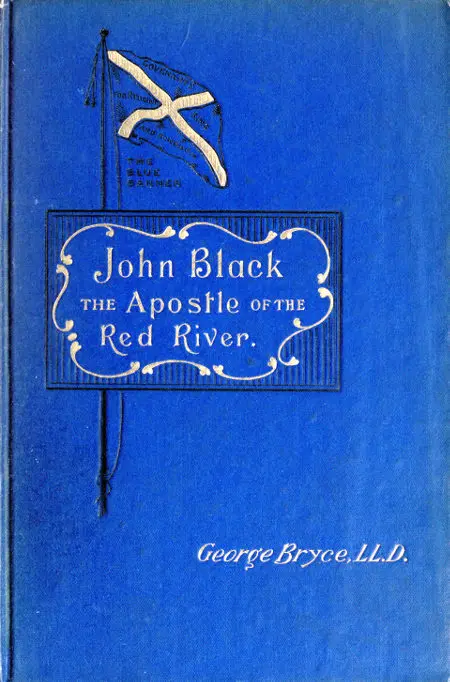
John Black, the Apostle of the Red River Or, How the Blue Banner Was Unfurled on Manitoba Prairies
George Bryce
THE CLASSIC COLLECTION · 1909
"The Romantic Settlement of Lord Selkirk's Colonists" by George Bryce is a historical account written in the early 20th century. The book delves into the narrative of the Scottish and Irish settlers who formed the Red River Colony under the patronage of Lord Selkirk in the early 1800s. Focusing on their struggles and triumphs, Bryce emphasizes the hardships these settlers faced as they attempted to build a new life in the challenging landscape of what is now Manitoba, Canada. At the start of the narrative, readers are introduced to Andrew McDermott, a patriarch of the settlement, who recounts the history of the land before the arrival of the settlers. He speaks of the indigenous peoples, the ancient Mound Builders, and the explorers who ventured into the wilderness, providing context for the looming challenges. The tone shifts as the story moves to the early years of settlement, highlighting themes of perseverance and community amidst adversity. McDermott shares tales of the initial arrival of the Selkirk Colonists in 1812, their encounters with local Indigenous tribes, and the complex dynamics that unfolded as various cultures collided in the Red River region. This opening sets the stage for a deeper exploration of their poignant journey toward establishing a sustainable community against significant odds.
Introduction adapted from the source catalogue; source summaries may be automatically generated.
Free to read · English · 64,235 words · No account needed
MAKE TIME FOR A GOOD BOOK
On by default. Untick to stop anonymous reading totals. Each page counts after 10 seconds in view. How this works.
Anonymous counting is on unless you have switched it off.
In 1808 though inactive he showed his bent by buying up Hudson's Bay Company stock. During this time projects in agriculture, the condition of the poor, the safety of the country, and the spread of civilization constantly occupied his active mind. The Napoleonic war cut off the vast cornfields of America from England, and as a great historian shows was followed by a terrible pauperization of the laboring classes.
There is no trace of a desire for aggrandizement, for engaging in the fur trade, or for going a-field on plans of speculation in the mind of Lord Selkirk. The feuds of the two branches of the Montreal Fur traders--the Old Northwest and the New Northwest--which were apparently healed in the year after the Colonization of Prince Edward Island, were not ended between the two factions of the united company led by McTavish--called the Premier--on the one hand and Sir Alexander Mackenzie on the other.
During these ten years of the century, the Hudson's Bay Company had also established rival posts all over the country. The competition at times reached bloodshed, and financial ruin was staring all branches of the fur trade in the face.
It was the depressed condition of the fur trade and the consequent drop in Hudson's Bay Company shares that appealed to Lord Selkirk, the man of many dreams and imaginations and he saw the opportunity of finding a home under the prairie skies for his hapless countrymen. It requires no detail here of how Lord Selkirk bought a controlling interest in the Hudson's Bay Company's stock, made out his plans of Emigration, and took steps to send out his hoped-for thousands or tens of thousands of Highland crofters, or Irish peasants, whoever they might be, if they sought freedom though bound up with hardship, hope instead of a pauper's grave, the prospect of independence of life and station in the new world instead of penury and misery under impossible conditions of life at home. Nor is it a matter of moment to us, how the struggle began until we have brought before our minds the stalwart figure of Sir Alexander Mackenzie--Lord Selkirk's great protagonist. Like many a distinguished man who has made his mark in the new world, and notably our great Lord Strathcona, who came as a mere lad to Canada, Alexander Mackenzie, a stripling of sixteen, arrived in Montreal to make his fortune. He was born as the Scottish people say of "kenn't" of "well-to-do" folk in Stornoway, in the Hebrides. He received a fair education and as a boy had a liking for the sea. Two partners, Gregory and McLeod, were fighting at Montreal in opposition to the dominant firm of McTavish and Frobisher. Young Alexander Mackenzie joined this opposition. So great was his aptitude, that boy as he was, he was despatched West to lead an expedition to Detroit. Soon he was pushed on to be a bourgeois, and was appointed at the age of twenty-two to go to the far West fur country of Athabasca, the vast Northern country which was to be the area of his discoveries and his fame. His energy and skill were amazing, although like many of his class, he had to battle against the envy of rivals. After completely planning his expedition, he made a dash for the Arctic Sea, by way of Mackenzie River, which he--first of white men--descended, and which bears his name. Finding his astronomical knowledge defective, he took a year off, and in his native land learned the use of the instruments needed in exploration. After his return he ascended the Peace River, crossed the Rocky Mountains, and on a rock on the shore of the Pacific Ocean in British Columbia, inscribed with vermillion and grease, in large letters, "Alexander Mackenzie, from Canada, by land, the Twenty-second of July, One Thousand Seven Hundred and Ninety-three." That was his record as the first white man to cross North America, north of Mexico. A few years afterwards he received the honor of knighthood for his discoveries. He gained much distinction as a leader, though the great McTavish in his Company was never very friendly to him. At length he retired, became a representative in the legislature of Lower Canada, and was for a time a travelling companion of the Duke of Kent. With a desire for loftier station, he settled in his native land, married the beautiful and gifted daughter of the House of Seaforth, and from her enjoyed the property of Avoch, near Inverness.
Your reading position is saved on this browser. Take it to another device with a library code. Reading pages adapt to text, rather than matching a printed edition.
George Bryce

George Bryce
George Bryce
George Bryce
BEHIND THE BOOK
This eBook is for the use of anyone anywhere in the United States and most other parts of the world at no cost and with almost no restrictions whatsoever. You may copy it, give it away or re-use it under the terms of the Project Gutenberg License included with this eBook or online at www.gutenberg.org. If you are not located in the United States, you will have to check the laws of the country where you are located before using this eBook. Read the source licence.
The original source file, including credits and licence, is retained by this library. Request an original-format copy at no charge. Please include the book title and Project Gutenberg identifier #17358.
KEEP YOUR CURIOSITY GOING
Cécile Tormay

Moritz Busch
John L. Ransom
Frances Wright
Cécile Tormay

Mabel Potter Daggett