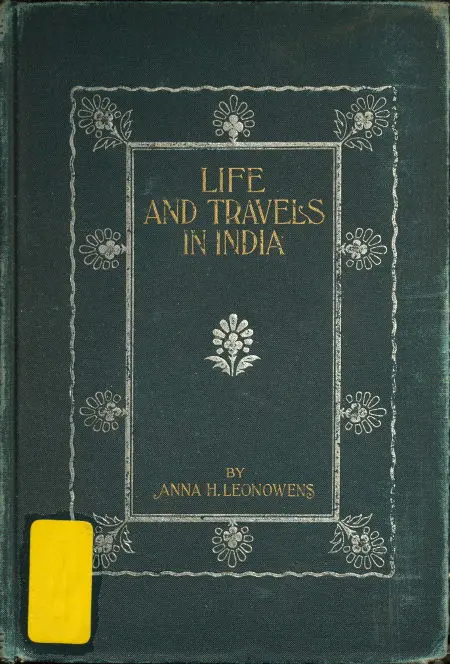
Life and Travel in India Being Recollections of a Journey Before the Days of Railroads
Anna Harriette Leonowens
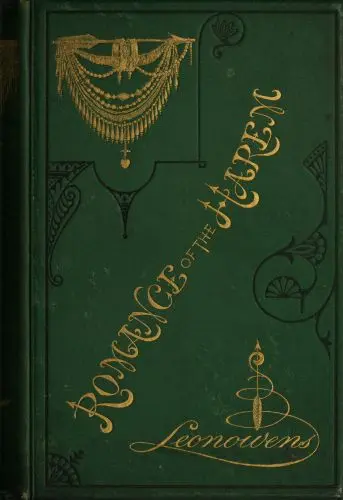
THE CLASSIC COLLECTION · 1873
"The Romance of the Harem" by Anna Harriette Leonowens is a historical account written in the late 19th century. The work provides a vivid portrayal of life in the Siamese royal harem, exploring themes of love, sacrifice, and the complex dynamics of power and gender within a fascinating cultural context. Drawing from her personal experiences and observations, Leonowens sheds light on the lives of the women who navigate their fates under the constraints of the royal court. At the start of the narrative, the foundation is laid with an introduction to Siam, referred to by its people as "Muang Thai," and its rich culture. The opening chapter elaborates on the country's history, its connections to Buddhism and its social structures, while also setting the stage for the personal stories that follow. The focus then shifts to specific characters within the harem, particularly a young girl named Tuptim, who experiences both the allure and the burdens of life in the palace. The chapter establishes a poignant tone, hinting at the trials and tribulations Tuptim will face within the harem's walls, as well as the overarching themes of love, loss, and the quest for freedom that drive the narrative forward.
Introduction adapted from the source catalogue; source summaries may be automatically generated.
Free to read · English · 85,790 words · No account needed
MAKE TIME FOR A GOOD BOOK
On by default. Untick to stop anonymous reading totals. Each page counts after 10 seconds in view. How this works.
Anonymous counting is on unless you have switched it off.
The hall is full of men. The work of branding and enrolling goes briskly on under the orders of a young nobleman, called Nai Dhamaphat, the grandson of Somdetch Ong Yai. Every now and then some persons are brought forward to be admonished, fined, or whipped. Sometimes from among this crowd a boy is dragged out forcibly, and branded.
Through the masses of men, lighted up now by the full blaze of sunlight, Smâyâtee sought one form and one figure only, and he was nowhere to be seen.
Suddenly the Grand Duke was announced; he entered the hall with conscious swagger, followed by a long train of attendants and slaves.
No words could express what there was in the face and figure of this man, as he rolled rather than walked into the centre of the hall.
Work instantly ceased; all around crouched and hid their faces. This did not rouse his huge, drowsy nature into even a look of recognition; he growled rather than spoke the orders for the workers to continue, and turned to his son and said, "Dhamaphat, what is this about Rama Singalee having attacked the captain of the royal guards?"
"My Lord," replied the latter, "the captain, as far as I can learn, is as much to blame as the old soldier, who says he only struck him in defence of his daughter."
"A daughter, eh! I did not know the old fellow had a daughter."
At this point in the conversation Smâyâtee, who had been listening with deep attention, leaned forward, and fearlessly addressed the duke, said, "Do you want that I should tell you how it happened, my lord?"
"Well, speak out!" said the duke, turning savagely upon the girl for having dared to interrupt him unbidden.
He checked himself, however, as his eye fell upon the graceful, veiled figure, and said rather more gently, "Go on, how was it?"
Smâyâtee threw back her covering, sat up, and repeated the story of her long journey, her father's fears to leave her alone at home, their encampment near the royal palace, her fearful alarm, and how it was to save her that her father struck the captain of the king's guard.
The girl never looked so beautiful, so fearless; there was in her look the innocence and the ignorance of a babe. It was not the words she uttered, but the face she presented, the look so sad and yet so full of trust, which served to rouse the drowsy nature of the duke, and to change his repulsiveness into something more hideous still.
Your reading position is saved on this browser. Take it to another device with a library code. Reading pages adapt to text, rather than matching a printed edition.
Anna Harriette Leonowens
Anna Harriette Leonowens
BEHIND THE BOOK
This eBook is for the use of anyone anywhere in the United States and most other parts of the world at no cost and with almost no restrictions whatsoever. You may copy it, give it away or re-use it under the terms of the Project Gutenberg License included with this eBook or online at www.gutenberg.org. If you are not located in the United States, you will have to check the laws of the country where you are located before using this eBook. Read the source licence.
The original source file, including credits and licence, is retained by this library. Request an original-format copy at no charge. Please include the book title and Project Gutenberg identifier #56028.
KEEP YOUR CURIOSITY GOING
Cécile Tormay

Moritz Busch
Coulson Kernahan
John L. Ransom

Maurice Baring
Frances Wright