THE CLASSIC COLLECTION✦An outlaw’s diary: the CommuneCLASSIC FREE BOOKS
An outlaw’s diary: the Commune
Cécile Tormay
THE CLASSIC COLLECTION · 1920
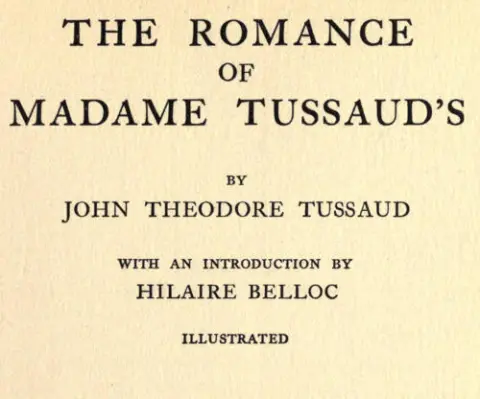
"The Romance of Madame Tussaud's" by John Theodore Tussaud is a historical account written in the early 20th century. This work chronicles the fascinating life and times of Madame Marie Tussaud, the founder of the famous wax museum in London, detailing her experiences from her childhood in Switzerland to her tumultuous life during the French Revolution. The narrative intertwines personal recollections of her family, particularly her uncle Christopher Curtius, a pioneering wax sculptor, inspiring readers to explore the depth of her character and the historical backdrop that shaped her legacy. At the start of the book, the author reflects on his childhood memories in his father's studio, revealing a lineage of wax modeling spanning generations. He recalls beginning his training under his father and notes the significance of figures from history that surrounded him, including Napoleon and Louis XVI. The narrative swiftly transitions to Madame Tussaud's origins in Berne, Switzerland, her eventual move to Paris with Curtius, and the artistic and political tumult of the time. The reader gains a glimpse of her early life, the formation of her identity as an artist, and the increasing involvement in the revolutionary climate of Paris, setting the stage for her future endeavors in the wax modeling industry.
Introduction adapted from the source catalogue; source summaries may be automatically generated.
Free to read · English · 82,147 words · No account needed
MAKE TIME FOR A GOOD BOOK
On by default. Untick to stop anonymous reading totals. Each page counts after 10 seconds in view. How this works.
Anonymous counting is on unless you have switched it off.
The following highly interesting figures and objects, in consequence of the Peculiarity of their appearance, are placed in an adjoining situation, and are well worth the attention of artists and amateurs, taken by order of the National Assembly by Madame Tussaud--The Celebrated John Marat, one of the leaders of the French Revolution, taken immediately after his assassination by Charlotte Corde. The following heads--Robespierre, Carrier, Fouquier de Tinville, and Hébert were taken immediately after execution. The celebrated Count de Lorge, who was confined twenty years in the Bastille, taken from life. Mirabeau. Also, Phrenological Portraits of
Who were executed in Edinburgh on the 13th of August, 1829, having confessed to the murder of Seven Persons by means of Poison, which they familiarly called doctoring.
Casts of CORDER and HOLLOWAY, taken from their faces.
CURIOUS AND INTERESTING RELICS, &c.
The shirt of Henry IV. of France in which he was assassinated by Ravaillac, with various original documents relative to that transaction. A small model of the original French Guillotine, with its apparatus. Model of the Bastille in Paris in its entire state.
Proved by the Hieroglyphics to be the body of the Princess of Memphis, who lived in the time of Sesostris, King of Egypt, a.m. 2528, 1491 years before Christ, being actually 3328 years old.
(Phair, Printer, 67, Great Peter Street, Westminster.)
A further placard is headed as follows:
The Flattering Success with which this Exhibition continues to be honored, (the Promenade being Crowded every Evening), the very general desire expressed by Thousands for it to remain some time longer, (its merits becoming more generally known), being acknowledged to be the most Splendid, and, at the same time, the most Instructive to Youth, (induces the Proprietors to obey the general wish.) It will remain in consequence till further Notice.
The Exhibition is, therefore, located in “The Great Assembly Room of the late Royal London Bazaar, Gray’s Inn Road.” There it remained till early in March, 1835, on the 21st of which month it removed to its quarters in Baker Street.
As for the Assembly Room, it appears that on Tuesday, the 29th of March, directly after Madame Tussaud left, it was put up for sale at the Mart by the famous auctioneer, George Robins.
A lady, on viewing the Exhibition when it was in Gray’s Inn Road, wrote the following excellent verses:
I stand amid a breathless throng,
Though animation’s light is here;
Expression, too, that might belong
To creatures of a nobler sphere;
Where’er I turn my dazzled view,
I marvel what Art’s hand can do!
Your reading position is saved on this browser. Take it to another device with a library code. Reading pages adapt to text, rather than matching a printed edition.
BEHIND THE BOOK
This eBook is for the use of anyone anywhere in the United States and most other parts of the world at no cost and with almost no restrictions whatsoever. You may copy it, give it away or re-use it under the terms of the Project Gutenberg License included with this eBook or online at www.gutenberg.org. If you are not located in the United States, you will have to check the laws of the country where you are located before using this eBook. Read the source licence.
The original source file, including credits and licence, is retained by this library. Request an original-format copy at no charge. Please include the book title and Project Gutenberg identifier #54369.
KEEP YOUR CURIOSITY GOING
Cécile Tormay

Moritz Busch
John L. Ransom
Frances Wright
Cécile Tormay

Mabel Potter Daggett