THE CLASSIC COLLECTION✦An outlaw’s diary: the CommuneCLASSIC FREE BOOKS
An outlaw’s diary: the Commune
Cécile Tormay
THE CLASSIC COLLECTION · 1920
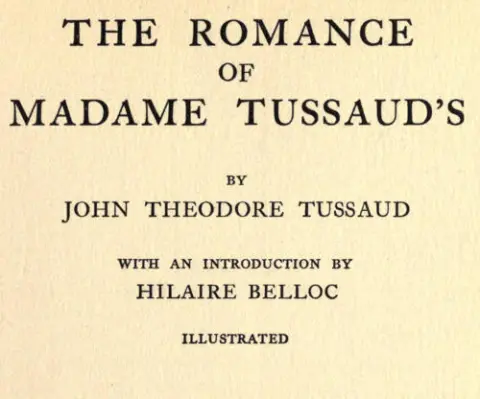
"The Romance of Madame Tussaud's" by John Theodore Tussaud is a historical account written in the early 20th century. This work chronicles the fascinating life and times of Madame Marie Tussaud, the founder of the famous wax museum in London, detailing her experiences from her childhood in Switzerland to her tumultuous life during the French Revolution. The narrative intertwines personal recollections of her family, particularly her uncle Christopher Curtius, a pioneering wax sculptor, inspiring readers to explore the depth of her character and the historical backdrop that shaped her legacy. At the start of the book, the author reflects on his childhood memories in his father's studio, revealing a lineage of wax modeling spanning generations. He recalls beginning his training under his father and notes the significance of figures from history that surrounded him, including Napoleon and Louis XVI. The narrative swiftly transitions to Madame Tussaud's origins in Berne, Switzerland, her eventual move to Paris with Curtius, and the artistic and political tumult of the time. The reader gains a glimpse of her early life, the formation of her identity as an artist, and the increasing involvement in the revolutionary climate of Paris, setting the stage for her future endeavors in the wax modeling industry.
Introduction adapted from the source catalogue; source summaries may be automatically generated.
Free to read · English · 82,147 words · No account needed
MAKE TIME FOR A GOOD BOOK
On by default. Untick to stop anonymous reading totals. Each page counts after 10 seconds in view. How this works.
Anonymous counting is on unless you have switched it off.
A young girl arriving at an institution at Torquay, from London, was asked whether she had ever visited Westminster Abbey. She hesitated, and was then reminded that that historic edifice contained monuments of the Kings and Queens of England. She immediately brightened up, and replied, “Oh, yes, I have been there, but they call it Madame Tussaud’s now.”
A short time after the seated figure of Mr. Rudyard Kipling, which is still to be seen in the Exhibition, had been modelled, the following conversation is reported to have occurred between a young lady and her maid, who had visited Madame Tussaud’s:
Relating her experiences there, the girl remarked:
“They’ve got Mr. Kipling and another murderer there, miss.”
“But Mr. Kipling isn’t a murderer,” said her young mistress.
“No, miss,” was the reply, “but they’ve got him there, miss.”
During those days when the Exhibition was being removed from one town to another the figures of criminals originally stood together in the same room with all the other models; but as it was suggested that it was indecorous to have the effigies of criminals in such close proximity with those of illustrious personages, Madame Tussaud had the former removed to a separate room, and the Chamber of Horrors was formed as it now exists.
The relatives and friends of criminals frequently visit the Chamber.
At a drawing-room meeting held at the residence of Lady Esther Smith, in Grosvenor Place, in aid of the Social Institutes’ Union, which exists to provide facilities for establishing clubs on temperance lines, Mrs. (now Lady) Bland-Sutton told the story of a little girl who was asked where she would like to go for a treat.
“To Madame Tussaud’s,” was the prompt reply.
“But you went there last year,” it was objected.
“Oh, yes, I know,” said the child, “but father wasn’t in the Chamber of
Horrors then.”
Somewhat similar is the following:
A parlourmaid, interviewed by her mistress just after a Bank Holiday, was
asked:
“And how did you spend your day off, Polly?”
“Oh, we went to Madame Tussaud’s,” was the reply. “We always go there, mum. You see, having uncle in the Chamber of Horrors gives the place a family interest, so to speak.”
When Dr. Jackson was Bishop of London he gave a breakfast to several curates before they left to take up missionary work abroad, and one of them, in the course of conversation at the repast, observed that he had just visited Madame Tussaud’s, where he had heard a figure of his Grace had been on view for many years.
Your reading position is saved on this browser. Take it to another device with a library code. Reading pages adapt to text, rather than matching a printed edition.
BEHIND THE BOOK
This eBook is for the use of anyone anywhere in the United States and most other parts of the world at no cost and with almost no restrictions whatsoever. You may copy it, give it away or re-use it under the terms of the Project Gutenberg License included with this eBook or online at www.gutenberg.org. If you are not located in the United States, you will have to check the laws of the country where you are located before using this eBook. Read the source licence.
The original source file, including credits and licence, is retained by this library. Request an original-format copy at no charge. Please include the book title and Project Gutenberg identifier #54369.
KEEP YOUR CURIOSITY GOING
Cécile Tormay

Moritz Busch
John L. Ransom
Frances Wright
Cécile Tormay

Mabel Potter Daggett