THE CLASSIC COLLECTION✦An outlaw’s diary: the CommuneCLASSIC FREE BOOKS
An outlaw’s diary: the Commune
Cécile Tormay
THE CLASSIC COLLECTION · 1920
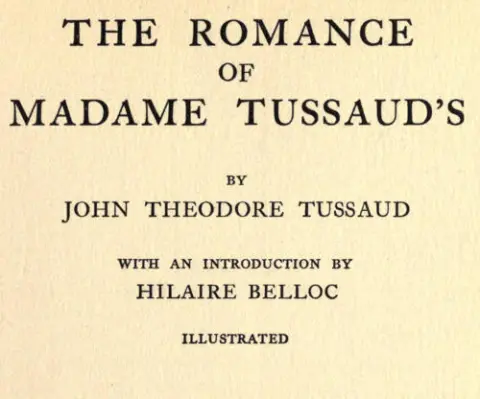
"The Romance of Madame Tussaud's" by John Theodore Tussaud is a historical account written in the early 20th century. This work chronicles the fascinating life and times of Madame Marie Tussaud, the founder of the famous wax museum in London, detailing her experiences from her childhood in Switzerland to her tumultuous life during the French Revolution. The narrative intertwines personal recollections of her family, particularly her uncle Christopher Curtius, a pioneering wax sculptor, inspiring readers to explore the depth of her character and the historical backdrop that shaped her legacy. At the start of the book, the author reflects on his childhood memories in his father's studio, revealing a lineage of wax modeling spanning generations. He recalls beginning his training under his father and notes the significance of figures from history that surrounded him, including Napoleon and Louis XVI. The narrative swiftly transitions to Madame Tussaud's origins in Berne, Switzerland, her eventual move to Paris with Curtius, and the artistic and political tumult of the time. The reader gains a glimpse of her early life, the formation of her identity as an artist, and the increasing involvement in the revolutionary climate of Paris, setting the stage for her future endeavors in the wax modeling industry.
Introduction adapted from the source catalogue; source summaries may be automatically generated.
Free to read · English · 82,147 words · No account needed
MAKE TIME FOR A GOOD BOOK
On by default. Untick to stop anonymous reading totals. Each page counts after 10 seconds in view. How this works.
Anonymous counting is on unless you have switched it off.
“‘Oh, it’s a part of his performance, ladies and gentleman. You see, Madame Tussaud is not satisfied with merely exhibiting the guillotine. She wishes to show you how it is actually worked.’
“This statement was greeted with general applause by everybody except the victim, who continued entreating to be released, whilst the impromptu lecturer calmly explained to the audience the practical working of the death-dealing machine.
“‘Bravo! How well he acts!’ was the verdict, as the prisoner appealed frantically in a language which none else but the attendant understood.
“Finally, on being at last released, he fainted. They brought him round with smelling-salts and cold water, and the first thing he did was to feel if his head was still safe. Satisfied on this point, he fled, without stopping to find his hat, and lost not an instant in starting at once for Paris.”
I come now, by a sudden transition, to write of three notable shrieval servants whose occupation, however indispensable, was unsavoury.
Calcraft, the first to be styled the “Yeoman of the Halter,” I had not the “pleasure” of knowing.
We have the original signboard he used to exhibit outside his house. It is a framed piece of wood, about three feet by two feet, and it bears in black letters the following notice:
J. CALCRAFT,
Boot and Shoe Maker. Executioner to Her Majesty.
His successor, Marwood, sat on several occasions for his model.
The executioner would sometimes visit the studios when his spirits were low, and a pipe and a glass of gin and water--his favourite beverage--were always at his service.
Then he would go down to the Chamber of Horrors to see some of his old acquaintances around whose necks he had so delicately adjusted the fatal noose. He would stop before each one with a grim look, while his lips moved tremulously.
“Put me there,” he once said after he had given a sitting.
It was like a man choosing the site of his grave.
His companion on these visits was a grizzled terrier. One day he came
alone.
“Your dog, Mr. Marwood--where is it?” he was asked.
The old man was sad.
“My poor old dog is dying--my dog that knew the business like a Christian and the inside of every prison in England; that has played with my ropes; that has caught rats in my business bags.”
“Dying by inches,” was the unfeeling rejoinder of a bystander, followed by the cruel suggestion, “Why don’t you hang him?”
Marwood gave him a reproachful glance.
“No, no. Hang a man, but my dear old dog--never!”
Your reading position is saved on this browser. Take it to another device with a library code. Reading pages adapt to text, rather than matching a printed edition.
BEHIND THE BOOK
This eBook is for the use of anyone anywhere in the United States and most other parts of the world at no cost and with almost no restrictions whatsoever. You may copy it, give it away or re-use it under the terms of the Project Gutenberg License included with this eBook or online at www.gutenberg.org. If you are not located in the United States, you will have to check the laws of the country where you are located before using this eBook. Read the source licence.
The original source file, including credits and licence, is retained by this library. Request an original-format copy at no charge. Please include the book title and Project Gutenberg identifier #54369.
KEEP YOUR CURIOSITY GOING
Cécile Tormay

Moritz Busch
John L. Ransom
Frances Wright
Cécile Tormay

Mabel Potter Daggett