
Last letters from the living dead man
David Patterson (Spirit) Hatch
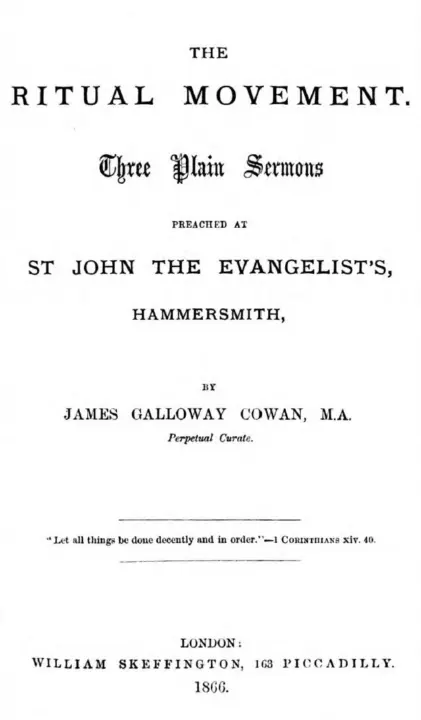
THE CLASSIC COLLECTION · 1866
"The Ritual Movement" by James Galloway Cowan is a compilation of three sermons preached in the Anglican Church during the mid-19th century. This work addresses the significant topic of church ritualism and the importance of maintaining decency and order in worship practices. Cowan emphasizes that the essence of worship is not merely internal but must also engage the body through ritualistic expressions, aiming to elevate and honor God. In these sermons, Cowan explores the historical context and theological implications of ritual practice within the Christian faith. He discusses the early Church's adherence to elaborate rituals as prescribed by God and argues for the importance of preserving those traditions to enhance worship experiences. Throughout his discourse, Cowan also confronts the tensions arising from the Reformation and the subsequent rituals' evolution, emphasizing the need for unity and decorum in worship while warning against the dangers of excessive ritualism that can lead to formalism and idolatry. Overall, the work advocates for a balanced approach to worship that honors both spiritual and physical expressions of faith.
Introduction adapted from the source catalogue; source summaries may be automatically generated.
Free to read · English · 9,674 words · No account needed
MAKE TIME FOR A GOOD BOOK
On by default. Untick to stop anonymous reading totals. Each page counts after 10 seconds in view. How this works.
Anonymous counting is on unless you have switched it off.
Let us speak with all charity and fair allowance of those earnest and holy men. Almost all the doctrines of the faith had been perverted or leavened with corruption; almost all the ordinances and ceremonies were associated with gross abuses. In the intensity of their awakened feeling against these things, it was natural that many among our own people, unable to distinguish between the truth and the corruption, the use and the abuse, should think that their rulers had not gone far enough in the way of change; while the foreign Protestants, left to act as individuals, driven to form communities of their own (as their Church would not reform itself) unguided by Catholic influence, directed by no intelligent principle (save that which would anyhow get rid of false traditions and gross abuses) in the construction of their creed and the ordering of their services, determined, as the easiest and most congenial course, to reject the whole system from which they had come out, and to make all things new for themselves.
What wonder that such men were dissatisfied with the First Prayer Book of Edward VI., that they regarded it as a base compromise with Rome, that they were horrified by the mention in it of “priests, altars and sacrifices,” that they scorned as “badges and rags of popery” the vestments which it prescribed; that they were loud and urgent in demanding its immediate revision! Not only had they no sympathy with, they had no comprehension, no idea of the principle on which its compilers had acted. Their notion was that the only true and pure religion was such an one as differed in toto from what they had repudiated. They had been misled by some traditions; therefore they would henceforth recognise no traditions. The word of God had hitherto been withheld from them: therefore now that they were able to possess it, they would handle it as freely as they pleased. The priests had domineered over them: henceforth they would have no priests. Sacrifices had been offered amiss; they therefore abhorred all sacrifices! Such were the feelings with which our Reformers had at once to deal. Should it be a matter of much surprise or reprehension that they dealt very indulgently with them, that they re-cast the service which was objected to as “so like the mass,” that they dealt expressions which were injuriously misunderstood, that individual Bishops ordered the removal of the altar lights, that the celebrant was required to wear a surplice only? Recollect: it was a time of violent re-action; moderation was interpreted as “compromise;” names, ceremonies, and vestments represented to Protestant minds not the things to which they really belonged, but the abuses which had so long been associated with them. In vain was it argued that the abuse does not take away the use. In vain was it protested that the Book of Common Prayer, as it stood, contained nothing that was contrary to the word of God or to the teaching of the primitive Church. In vain was it maintained that the Christian Church has and must have an altar, a priesthood, a continual sacrifice to offer; that, while it is most true that Christ’s one sacrifice was once offered for ever, and cannot be repeated, and that He is such a priest as knows no equal, no successor, no partner, as alone in fact answers to the name of priest; still, as the Jewish Church had its prophetic memorials of His sacrifice—in its slaying and offering of bulls, and goats, and lambs—and its priesthood representing in the various acts of its office what Christ would do—so have we, and by His own command, a historical memorial of His sacrifice: “This do in remembrance of me.” “As oft as ye eat this bread and drink this cup, ye do show forth the Lord’s death till He come”—and must have a so-called priesthood, performing sacerdotal acts as His representatives. In vain I say was all this urged. Doubtless many of the dissentients would have readily admitted much of it if they had calmly considered it, if they could have believed that a memorial sacrifice and a representative priesthood were what the Reformers claimed to retain. But they could not be persuaded to listen; they could not calm themselves sufficiently to listen; the spirit burned within them to root out and destroy popery; and every theological term, every religious ceremony, every ornament or vestment that had been used by papists, was regarded as of the very essence of popery itself! I believe that the reformers were justified in making temporary concession to this state of feeling, particularly in modifying ritual and ornament, which could only be useful so long as they were edifying, which were in fact doing harm to the Church’s cause and to individual souls while they were taken as representing and recommending the very things which had been repudiated. They doubtless justified themselves by considering that their second Prayer Book still contained the doctrines which the offending rites and vestments were meant to adorn; they hoped that men might come to understand and hold those doctrines when their prejudices were disarmed; at any rate they feared, lest, by a stubborn maintenance or violent enforcement at that critical time of anything not really essential, they should endanger the best interests of the Church; or even provoke and perpetuate among us a mere Protestant reformation. It seemed well then that they should make such concessions as the second Prayer Book of Edward VI contained. You know what followed; how within a year popery was established under Queen Mary, and how both Churchmen and Protestants had to flee the land and seek a home among German or Swiss reformers; or, if they remained, were savagely persecuted to the death. It might have been expected that the fact of Churchmen being treated as capital offenders against Rome would have disarmed the prejudices against them and their ritual which had hitherto existed, or at least that common misfortunes would have begotten common interests and sympathies and so have led to a truer appreciation of one another. This was not exactly what resulted. The Protestants retained and even strengthened their prejudices: the Churchmen who had lived in exile among them first of all fell in with their habits, their modes of worship, and their disuse of all vestments—or the substitution for them of a black gown—and presently they also contracted their prejudices. Accordingly when, soon after the accession of Queen Elizabeth, the old law about vestments was re-enacted, it remained except in a few solitary cases a dead letter; men either hated such things, or they were too indifferent to the way of performing divine service to trouble themselves to wear them; or, if they had right notions and right feelings about them, they were too poor to provide them for themselves; and their parishioners did not care, perhaps objected, to provide them. I cannot but believe that it was the knowledge of this fact—the adaptation of law to necessity—which led to the framing in 1603 of that Canon, (so often quoted of late) which requires parochial ministers to wear the surplice only in their ministrations, but directs that a cope shall be worn by the celebrant in cathedrals. The Convocation, it would seem to me, knowing how generally the vestments had been destroyed, or rapaciously seized for the sake of the gold and precious stones that adorned them, and how difficult it would be for the clergy generally to provide them afresh, appointed—what had long been the practice, and could in fact quote something like authority for itself in the Royal advertisements—that as a minimum of vestment in ordinary churches a surplice should be worn, but in cathedrals, whose endowments could provide it, the most costly and splendid of all vestments—the cope—should be retained. Surely it could never have been intended to insist that there should be a difference between the cathedrals and the parish churches of the same communion; far less to forbid as superstitious in the latter, what is positively enjoined in the former! But if it were so, the Canons, though in their spirit a rule to the Clergy and faithful laity, have no force by the law of this realm, and moreover they were almost immediately followed by a revised Prayer Book, which contains the rubric ordering all the ornaments which were in use in the second year of Edward VI. While at the very last revision of the Prayer Book, nearly sixty years afterwards, when our Church was only just lifting her head above the politico-religious revolution which had so nearly overwhelmed her, when so many reasons cogently pressed her to eliminate from her Book of Common Prayer all that was unnecessary, all that was questionable, all that she did not use or intend to use; when the Puritans put their finger on this very rubric, and required that it should be left out—for if it were retained it might bring back copes, albs and such like;—it was nevertheless deliberately determined that the rubric, made by verbal alteration more explicit than it had been before, should continue to be the written rule of our Church! And, brethren, it is still the written rule, confirmed by Convocation, enjoined by the Act of Uniformity.
Your reading position is saved on this browser. Take it to another device with a library code. Reading pages adapt to text, rather than matching a printed edition.
BEHIND THE BOOK
This eBook is for the use of anyone anywhere in the United States and most other parts of the world at no cost and with almost no restrictions whatsoever. You may copy it, give it away or re-use it under the terms of the Project Gutenberg License included with this eBook or online at www.gutenberg.org. If you are not located in the United States, you will have to check the laws of the country where you are located before using this eBook. Read the source licence.
The original source file, including credits and licence, is retained by this library. Request an original-format copy at no charge. Please include the book title and Project Gutenberg identifier #64741.
KEEP YOUR CURIOSITY GOING
David Patterson (Spirit) Hatch

David Patterson (Spirit) Hatch

David Patterson (Spirit) Hatch
Cécile Tormay

Moritz Busch
John L. Ransom