
The Wisdom of Fools
Margaret Wade Campbell Deland
THE CLASSIC COLLECTION · 1915
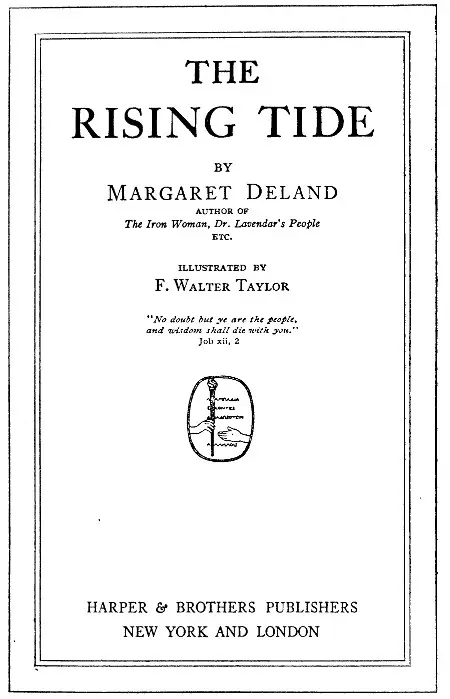
"The Rising Tide" by Margaret Wade Campbell Deland is a novel written in the early 20th century. The story appears to focus on the lives and struggles of the Payton family, particularly the contrasting viewpoints of the mother, Mrs. Payton, and her daughter, Frederica. The narrative explores themes of familial duty, societal expectations, and the evolving role of women, as Frederica seeks independence from traditional domesticity. The opening of the novel introduces the setting of Payton Street, a once-genteel area now in decline, mirroring the family's own struggles with change. Mrs. Payton is depicted as a devoted yet somewhat repressive mother, dealing with her son Mortimore's challenges and the rebellious spirit of her daughter, Frederica. As Frederica contemplates entering the workforce and rejecting traditional gender roles, tensions arise between her desire for freedom and her mother's expectations. A visit from a family friend sets off discussions about Frederica's recent behavior, signaling a brewing conflict within the Payton household regarding duty, affection, and autonomy.
Introduction adapted from the source catalogue; source summaries may be automatically generated.
Free to read · English · 72,982 words · No account needed
MAKE TIME FOR A GOOD BOOK
On by default. Untick to stop anonymous reading totals. Each page counts after 10 seconds in view. How this works.
Anonymous counting is on unless you have switched it off.
"She ought to be married," said Mrs. Holmes, clutching at the back of a gilt chair as she got on to her shaking old legs; "though I can't imagine any nice man wanting to marry a girl who talks as she does. Maria Spencer told me she heard that Fred said that men ought not to be allowed to marry unless they had a health certificate."
Mrs. Payton gasped with horror. "Mama! are you sure? I can't believe-- What are we coming to?"
"It mortified me to death," said Mrs. Holmes. ("Oh, do pick up that card-case for me!) I wish Arthur Weston would marry her, but I suppose he never got over that Morrison girl's behavior? No; the real trouble is, you insist on living in this out-of-the-way place! Oh, yes, I know; poor Mortimore. Still, the men won't come after her here, because it looks as if she had no money--that, and her queerness. Really, you ought to try to get her settled. You ought to move over to the Hill; but you love that poor, brainless creature up-stairs more than you do Fred!"
Mrs. Payton stiffened. "I love both my children just the same; and I can't discuss Mortimore, Mama, with anybody. As for being brainless, Doctor Davis always said, 'The intellect is there; but it is veiled.'" The tears brimmed over. "You don't understand a mother's feelings, Mama."
Mrs. Holmes shrugged her shoulders and brushed a powdered cheek against her daughter's worn face. "Good-by. Of course, you never take any advice--I'm used to that! If I wasn't the warmest-hearted creature in the world I should be very cross with you. I suppose you are terribly lonely without Freddy?"
"Oh, terribly," said Mrs. Payton.
When Mrs. Holmes had gone, teetering uncertainly down the front steps to her carriage, Freddy's mother, pausing a moment in the hall to make sure that Mr. Andrew Payton's silk hat had been dusted, went heavily up-stairs and sat down in her big cushioned chair. She wished that she had something to do. Of course, there was that new puzzle--but sometimes the thought of a puzzle gave her a qualm of repulsion, the sort of repulsion one feels at the sight of the drug that soothes and disgusts at the same moment. The household mending was a more wholesome anodyne; but there was very little of that; she had gone all through Freddy's stockings the day before, and found only one thin place. To-day there seemed nothing to do but sit in her soft chair and think of Freddy's shocking talk and how unkind Mrs. Holmes was about Mortimore. She knew, in the bottom of her heart, that her son's presence was painful to everybody except herself; she knew that Freddy didn't like to have people call, for fear they might see him, and that her reluctance dated back to her childhood. "But suppose she doesn't like it, what has that got to do with it?" Morty's mother thought, angrily; "it's a question of duty. Mama doesn't seem to remember that Freddy ought to do her duty!" It came over Mrs. Payton, with a thrill of pride, that she herself had always done her duty. Here, alone, with everything silent on the other side of the bolted door, she could allow herself to think how well she had done it! To Mortimore, first and foremost--she paused there, with a pang of annoyance at her mother's words: "I do not love him best!" she declared. She did her duty to Freddy, just as much as to Morty. When Fred had scarlet fever no mother could have been more devoted. She hadn't taken her clothes off for four days and nights! Her supreme dutifulness, however, a dutifulness of which she had always been acutely conscious, was in enduring Andrew's behavior. "Some women wouldn't have stood it," she thought, proudly. But what a good wife she had been! She had let him have his own way in everything. When he was cross, she had been silent. When he was drunk, she had wept--silently, of course. When he had done other things, of which anonymous letters had informed her, she had still been silent;--but she had been too angry to weep. She shivered involuntarily to think what would have happened if she had not been silent--if she had dared to remonstrate with him! For Andrew Payton's temper had been as celebrated as the brains which had once filled the now empty hat. "Some wives would have left him," she told herself; "but I always did my duty! Nobody ever supposed that I--knew." When Andrew died, and her friends were secretly rejoicing over her release, how careful she had been to wear the very deepest crape! "I didn't go out of the house, even to church, for three weeks, and I didn't use a plain white handkerchief for two years," she thought--then flushed, for, side by side with her satisfaction at her exemplary conduct was a rankling memory--a memory which made her constantly tell herself, and everybody else, that she "loved both her children just the same." The remorse--for it amounted to that--began a few weeks after Mr. Payton's death, when Freddy, listening to her mother's pride in the black-bordered handkerchief, had flung out: "If you told the truth, you'd use a flag for a handkerchief, and you'd go to church to return thanks!"
Your reading position is saved on this browser. Take it to another device with a library code. Reading pages adapt to text, rather than matching a printed edition.
Margaret Wade Campbell Deland
Margaret Wade Campbell Deland

Margaret Wade Campbell Deland

Margaret Wade Campbell Deland
BEHIND THE BOOK
This eBook is for the use of anyone anywhere in the United States and most other parts of the world at no cost and with almost no restrictions whatsoever. You may copy it, give it away or re-use it under the terms of the Project Gutenberg License included with this eBook or online at www.gutenberg.org. If you are not located in the United States, you will have to check the laws of the country where you are located before using this eBook. Read the source licence.
The original source file, including credits and licence, is retained by this library. Request an original-format copy at no charge. Please include the book title and Project Gutenberg identifier #54910.
KEEP YOUR CURIOSITY GOING
Coulson Kernahan

Maurice Baring
Frances Wright
Cécile Tormay

Frederic Jesup Stimson

W. H. P. (William Henry Pope) Jarvis