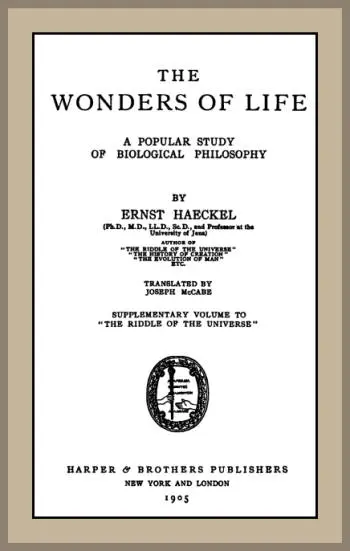
The Wonders of Life: A Popular Study of Biological Philosophy
Ernst Haeckel
THE CLASSIC COLLECTION · 1900
"The Riddle of the Universe at the Close of the Nineteenth Century" by Ernst Haeckel is a scientific publication written in the late 19th century. This work explores the intricate relationship between biology, philosophy, and the cosmos, presenting a comprehensive inquiry into the prevailing doubts and mysteries of existence as perceived in Haeckel's time. The book emphasizes the importance of empirical investigation and proposes a monistic philosophy that seeks to unify nature, science, and human understanding. The opening of the book unfolds with Haeckel's assertion of a significant transformation in knowledge and thought by the end of the 19th century. He portrays a duality in progress: while science has advanced tremendously, especially in revealing the workings of the universe and biological processes, societal, moral, and spiritual realms seem stagnant or regressive. Haeckel introduces the "world-riddles," a series of great enigmas regarding existence that challenge humanity’s understanding, and he outlines his philosophical stance that combines scientific observations with a monistic interpretation of nature. The reader is invited to contemplate elements like evolution, the nature of life, and humanity’s place within the broader context of the cosmos, framing the quest for answers as both a scientific and existential pursuit.
Introduction adapted from the source catalogue; source summaries may be automatically generated.
Free to read · English · 108,351 words · No account needed
MAKE TIME FOR A GOOD BOOK
On by default. Untick to stop anonymous reading totals. Each page counts after 10 seconds in view. How this works.
Anonymous counting is on unless you have switched it off.
The chain of our earlier invertebrate ancestors is much more difficult to investigate and much less safe than this tree of our vertebrate predecessors; we have no fossilized relics of their soft, boneless structures, so palæontology can give us no assistance in this case. The evidence of comparative anatomy and ontogeny, therefore, becomes all the more important. Since the human embryo passes through the same chordula-stage as the germs of all other vertebrates, since it evolves, similarly, out of two germinal layers of a gastrula, we infer, in virtue of the biogenetic law, the early existence of corresponding ancestral forms--vermalia, gastræada, etc. Most important of all is the fact that the human embryo, like that of all other animals, arises originally from a single cell; for this "stem-cell" (cytula)--the impregnated egg cell--points indubitably to a corresponding unicellular ancestor, a primitive, Laurentian protozoon.
For the purpose of our monistic philosophy, however, it is a matter of comparative indifference how the succession of our animal predecessors may be confirmed in detail. Sufficient for us, as an incontestable historical fact, is the important thesis that man descends immediately from the ape, and secondarily from a long series of lower vertebrates. I have laid stress on the logical proof of this "pithecometra-thesis" in the seventh book of the General Morphology: "The thesis that man has been evolved from lower vertebrates, and immediately from the simiae, is a special inference which results with absolute necessity from the general inductive law of the theory of descent."
For the definitive proof and establishment of this fundamental pithecometra-thesis the palæontological discoveries of the last thirty years are of the greatest importance; in particular, the astonishing discoveries of a number of extinct mammals of the Tertiary period have enabled us to draw up clearly in its main outlines the evolutionary history of this most important class of animals, from the lowest oviparous monotremes up to man. The four chief groups of the placentals, the heterogeneous legions of the carnassia, the rodentia, the ungulata, and the primates, seem to be separated by profound gulfs, when we confine our attention to their representatives of to-day. But these gulfs are completely bridged, and the sharp distinctions of the four legions are entirely lost, when we compare their extinct predecessors of the Tertiary period, and when we go back into the Eocene twilight of history, in the oldest part of the Tertiary period--at least three million years ago. There we find the great sub-class of the placentals, which to-day comprises more than two thousand five hundred species, represented by only a small number of little, insignificant "proplacentals"; and in these prochoriata the characters of the four divergent legions are so intermingled and toned down that we cannot in reason do other than consider them as the precursors of those features. The oldest carnassia (the ictopsales), the oldest rodentia (the esthonychales), the oldest ungulata (the condylarthrales) and the oldest primates (the lemuravales), all have the same fundamental skeletal structure, and the same typical dentition of the primitive placentals, consisting of forty-four teeth (three incisors, one canine, four premolars, and three molars in each half of the jaw); all are characterized by the small size and the imperfect structure of the brain (especially of its chief part, the cortex, which does not become a true "organ of thought" until later on in the Miocene and Pliocene representatives); they have all short legs and five-toed, flat-soled feet (plantigrada). In many cases among these oldest placentals of the Eocene period it was very difficult to say at first whether they should be classed with the carnassia, rodentia, ungulata, or primates; so very closely, even to confusion, do these four groups of the placentals, which diverge so widely afterwards, approach each other at that time. Their common origin from a single ancestral group follows incontestably. These prochoriata lived in the preceding Cretaceous period (more than three million years ago), and were probably developed in the Jurassic period from a group of insectivorous marsupials (amphitheria) by the formation of a primitive placenta diffusa, a placenta of the simplest type.
Your reading position is saved on this browser. Take it to another device with a library code. Reading pages adapt to text, rather than matching a printed edition.
BEHIND THE BOOK
This eBook is for the use of anyone anywhere in the United States and most other parts of the world at no cost and with almost no restrictions whatsoever. You may copy it, give it away or re-use it under the terms of the Project Gutenberg License included with this eBook or online at www.gutenberg.org. If you are not located in the United States, you will have to check the laws of the country where you are located before using this eBook. Read the source licence.
The original source file, including credits and licence, is retained by this library. Request an original-format copy at no charge. Please include the book title and Project Gutenberg identifier #42968.
KEEP YOUR CURIOSITY GOING

David Patterson (Spirit) Hatch

David Patterson (Spirit) Hatch

David Patterson (Spirit) Hatch
Coulson Kernahan

Ralph Waldo Emerson
Frances Wright