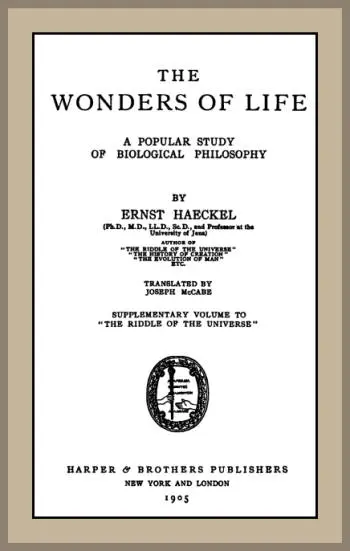
The Wonders of Life: A Popular Study of Biological Philosophy
Ernst Haeckel
THE CLASSIC COLLECTION · 1900
"The Riddle of the Universe at the Close of the Nineteenth Century" by Ernst Haeckel is a scientific publication written in the late 19th century. This work explores the intricate relationship between biology, philosophy, and the cosmos, presenting a comprehensive inquiry into the prevailing doubts and mysteries of existence as perceived in Haeckel's time. The book emphasizes the importance of empirical investigation and proposes a monistic philosophy that seeks to unify nature, science, and human understanding. The opening of the book unfolds with Haeckel's assertion of a significant transformation in knowledge and thought by the end of the 19th century. He portrays a duality in progress: while science has advanced tremendously, especially in revealing the workings of the universe and biological processes, societal, moral, and spiritual realms seem stagnant or regressive. Haeckel introduces the "world-riddles," a series of great enigmas regarding existence that challenge humanity’s understanding, and he outlines his philosophical stance that combines scientific observations with a monistic interpretation of nature. The reader is invited to contemplate elements like evolution, the nature of life, and humanity’s place within the broader context of the cosmos, framing the quest for answers as both a scientific and existential pursuit.
Introduction adapted from the source catalogue; source summaries may be automatically generated.
Free to read · English · 108,351 words · No account needed
MAKE TIME FOR A GOOD BOOK
On by default. Untick to stop anonymous reading totals. Each page counts after 10 seconds in view. How this works.
Anonymous counting is on unless you have switched it off.
Cenobitic soul, 155.
Cenogenesis, 82.
of the psyche, 144.
Chance, 274.
Chemicotropism, 64, 136.
Chordula, 64.
Chorion, 68.
Christ, father of, 327.
Christian art, 339.
civilization, 356.
contempt of the body, 354.
animals, 355.
nature, 355.
self, 353.
the family, 357.
woman, 358.
ethics, 352.
Christianity, 347.
Church and school, 362.
state, 361.
Cnidaria, 161.
Conception, 64.
Concubinage of the clergy, 358.
Confession of faith, 302.
Consciousness, 170.
animal, 176.
atomistic, 178.
biological, 176.
cellular, 177.
development of, 185.
dualistic, 182.
human, 173.
monistic, 182.
neurological, 174.
ontogeny of, 186.
pathology of, 182.
physiological, 180.
transcendental, 180.
Constancy of energy, 212, 231.
matter, 212.
Constantine the Great, 316.
Constellations of substance, 218.
Conventional lies, 323.
Copernicus, 24, 320, 367.
Cosmic immortality, 191.
Cosmogonies, 234.
Cosmological dualism, 257.
creationism, 235.
law, 211.
perspective, 14.
Cosmos, the, 229.
Creation, 73, 79, 234.
cosmological, 235.
dualistic, 236.
heptameral, 237.
individual, 237.
myths of, 236.
periodic, 237.
trialistic, 237.
Cultur-kampf, 334.
Cuvier, 74.
Cyclostomata, 167.
Cynopitheci, 46.
Cytology, 26, etc.
Cytopsyche, 151.
Cytula, 64.
Darwin (Charles), 78, etc.
Decidua, 69.
Deduction, 16.
Demonism, 276.
Descartes, 99, 355.
Descent of the ape, 85, etc.
of man, 87.
theory of, 77.
Design, 264, 266.
in nature, 260.
in organisms, 266.
in selection, 261.
Destruction of heavenly bodies, 243.
Determinists, 130.
Diaphragm, 31.
Division of labor in matter, 229.
Draper, 309, 333.
Dualism, 20, etc.
Du Bois-Reymond, 15 180, 235.
Du Prel (Carl), 305.
Duty, feeling of, 350.
Dynamodes, 216.
Dysteleology, 260.
Echinodermata, 62.
Ectoderm, 160.
sense-cells in the, 293.
Egoism, 350.
Elements, chemical, 222.
system of the, 222.
Embryo, human, 64.
Embryology, 54.
Embryonic psychogeny, 144.
sleep, 146.
Empedocles, 23, 224.
Encyclica (of Pius IX.), 323.
End of the world, 247.
Energy, kinetic, 231.
potential, 231.
principle of, 230.
specific, 294.
Entelecheia, 268.
Entoderm, 160.
Entropy of the universe, 247.
Epigenesis, 56, 133.
Ergonomy of matter, 229.
Eternity of the world, 242.
Ether, 225.
Etheric souls, 199.
Ethics, fundamental law of, 350.
Evolution, theory of, 54, 239, 243.
chief element in, 267.
Experience, 16.
Extra-mundane God, 288.
Faith, confession of, 303.
of our fathers, 304.
Family, the, and Christianity, 357.
Fate, 272.
Fechner, 97, etc.
Fecundation, 63.
Fetishism, 276.
Feuerbach (Ludwig), 295.
Flechsig, 183.
Foetal membranes, 66.
Folk-psychology, 103.
Forces, conversion of, 231.
Frederick the Great, 194, 315.
Galen, 23, 40.
Gaseous souls, 199.
vertebrates, 288.
Gastræa, 160.
theory of the, 60.
Gastræads, 159.
Gastrula, 61.
Gegenbaur, 25, 30.
Generation, theory of, 55.
Genus, 73.
Geology, periods of, 270.
progress of, 373.
Germinal disk, 57.
Gills, 65.
God, 275.
the father, 277.
the son, 277, 328.
Goethe, 20, etc.
Goethe's monism, 331.
Golden Rule, the, 351.
Gospels, 312.
Gravitation, theory of, 217.
Gut-layer, 159.
Haller, 42.
Harvey, 42.
Helmholtz (Hermann), 213, 230.
Heredity, psychic, 138.
Hertz (Heinrich), 225.
Hippocrates, 23.
Histology, 26.
Histopsyche, 156.
Hoff (Carl), 250.
Holbach (Paul), 193.
Holy Ghost, 277, 326.
Humboldt (Alexander), 343.
Hydra, 161.
Hylozoism, 289.
Hypothesis, 299.
Iatrochemicists, 45.
Iatromechanicists, 45.
Ideal of beauty, 338.
of truth, 337.
of virtue, 339.
Ignorabimus, 180.
Immaculate conception, 326.
Immaterial substance, 221.
Immortality of animals, 201.
of the human soul, 188.
of unicellular organisms, 190.
personal, 192.
Imperfection of nature, 264.
Imponderable matter, 225.
Impregnation, 64.
Indeterminists, 130.
Induction, 16.
Indulgences, 359.
Infallibility of the pope, 324.
Instinct, 105, 123.
Intellect, 125, etc.
Intramundane God, 288.
Introspective psychology, 95.
Islam, 284.
Janssen (Johannes), 316.
Jehovah, 283.
Journeys on foot, 364.
Kant, 258, etc.
Kant's metamorphosis, 92, etc.
Kinetic energy, 231.
theory of substance, 216.
Kölliker, 26, 48.
Lamarck, 76, etc.
Lamettrie, 194.
Landscape-painting, 343.
Language, 126.
study of, 363.
Last judgment, 209.
Lavoisier, 212.
Leap of the gospels, miraculous, 312.
Leydig, 27.
Life, definition of, 39.
Limits of our knowledge, 182.
Love, 357.
of animals, 355.
of neighbor, 350.
of self, 350.
Lucretius Carus, 290.
Lunarism, 281.
Luther, 320.
Lyell, 77, 250.
Madonna, cult of the, 284, 327.
Malphigi, 54.
Mammals, 30, etc.
Mammary glands, 31.
Man, ancestors of, 82.
Marsupials, 32, 86.
Mass, 222.
Materialism, 20.
Mayer (Robert), 213, 377.
Mechanical causality, 366.
explanation, 259.
theory of heat, 247.
Mechanicism, 259.
Mediterranean religions, the, 282.
Memory, cellular, 12O.
conscious, 121.
histionic, 121.
unconscious, 121.
Mephistopheles, 279.
Metabolism, 232.
Metamorphoses of the cosmos, 372.
of philosophers, 92.
Metaphyta, 156.
Metasitism, 153.
Metazoa, 60, 157.
Middle Ages, 315, 358.
Mixotheism, 286.
Mohammedanism, 284.
Mohr (Friedrich), 213.
Monera, 257, 369.
Your reading position is saved on this browser. Take it to another device with a library code. Reading pages adapt to text, rather than matching a printed edition.
BEHIND THE BOOK
This eBook is for the use of anyone anywhere in the United States and most other parts of the world at no cost and with almost no restrictions whatsoever. You may copy it, give it away or re-use it under the terms of the Project Gutenberg License included with this eBook or online at www.gutenberg.org. If you are not located in the United States, you will have to check the laws of the country where you are located before using this eBook. Read the source licence.
The original source file, including credits and licence, is retained by this library. Request an original-format copy at no charge. Please include the book title and Project Gutenberg identifier #42968.
KEEP YOUR CURIOSITY GOING

David Patterson (Spirit) Hatch

David Patterson (Spirit) Hatch

David Patterson (Spirit) Hatch
Coulson Kernahan

Ralph Waldo Emerson
Frances Wright