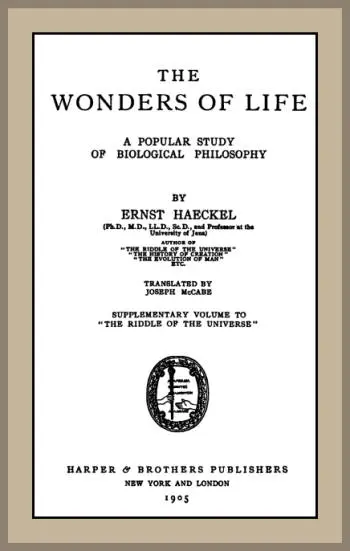
The Wonders of Life: A Popular Study of Biological Philosophy
Ernst Haeckel
THE CLASSIC COLLECTION · 1900
"The Riddle of the Universe at the Close of the Nineteenth Century" by Ernst Haeckel is a scientific publication written in the late 19th century. This work explores the intricate relationship between biology, philosophy, and the cosmos, presenting a comprehensive inquiry into the prevailing doubts and mysteries of existence as perceived in Haeckel's time. The book emphasizes the importance of empirical investigation and proposes a monistic philosophy that seeks to unify nature, science, and human understanding. The opening of the book unfolds with Haeckel's assertion of a significant transformation in knowledge and thought by the end of the 19th century. He portrays a duality in progress: while science has advanced tremendously, especially in revealing the workings of the universe and biological processes, societal, moral, and spiritual realms seem stagnant or regressive. Haeckel introduces the "world-riddles," a series of great enigmas regarding existence that challenge humanity’s understanding, and he outlines his philosophical stance that combines scientific observations with a monistic interpretation of nature. The reader is invited to contemplate elements like evolution, the nature of life, and humanity’s place within the broader context of the cosmos, framing the quest for answers as both a scientific and existential pursuit.
Introduction adapted from the source catalogue; source summaries may be automatically generated.
Free to read · English · 108,351 words · No account needed
MAKE TIME FOR A GOOD BOOK
On by default. Untick to stop anonymous reading totals. Each page counts after 10 seconds in view. How this works.
Anonymous counting is on unless you have switched it off.
The triumph of Christianity and its mystic theories meant retrogression to anatomy, as it did to all the other sciences. The popes were resolved above all things to detain humanity in ignorance; they rightly deemed a knowledge of the human organism to be a dangerous source of enlightenment as to our true nature. During the long period of thirteen centuries the writings of Galen were almost the only source of human anatomy, just as the works of Aristotle were for the whole of natural history. It was not until the sixteenth century, when the spiritual tyranny of the papacy was broken by the Reformation, and the geocentric theory, so intimately connected with papal doctrine, was destroyed by the new cosmic system of Copernicus, that the knowledge of the human frame entered upon a new period of progress. The great anatomists, Vesalius (of Brussels), and Eustachius and Fallopius (of Modena), advanced the knowledge of our bodily structure so much by their own thorough investigations that little remained for their numerous followers to do, with regard to the more obvious phenomena, except the substantiation of details. Andreas Vesalius, as courageous as he was talented and indefatigable, was the pioneer of the movement; he completed in his twenty-eighth year (1543) that great and systematic work De humani corporis fabrica; he gave to the whole of human anatomy a new and independent scope and a more solid foundation. On that account he was, at a later date, at Madrid--where he was physician to Charles V. and Philip II.--condemned to death by the Inquisition as a magician. He only escaped by undertaking a pilgrimage to Jerusalem; in returning he suffered shipwreck on the Isle of Zante, and died there in misery and destitution.
The great merit of the nineteenth century, as far as our knowledge of the human frame is concerned, lies in the founding of two new lines of research of immense importance--comparative anatomy and histology, or microscopic anatomy. The former was intimately associated with human anatomy from the very beginning; indeed, it had to supply the place of the latter so long because the dissection of human corpses was a crime visited with capital punishment--that was the case even in the fifteenth century! But the many anatomists of the next three centuries devoted themselves mainly to a more accurate study of the human organism. The elaborate science which we now call comparative anatomy was born in the year 1803, when the great French zoologist Georges Cuvier (a native of Mömpelgard, in Alsace) published his profound Leçons sur l'anatomie comparée, and endeavored to formulate, for the first time, definite laws as to the organism of man and the beasts. While his predecessors--among whom was Goethe in 1790--had mainly contented themselves with comparing the skeleton of man with those of other animals, Cuvier's broader vision took in the whole of the animal organization. He distinguished therein four great and mutually independent types: Vertebrata, Articulata, Mollusca, and Radiata. This advance was of extreme consequence for our "question of all questions," since it clearly brought out the fact that man belonged to the vertebral type, and differed fundamentally from all the other types. It is true that the keen-sighted Linné had already, in his Systema Natuae, made a great step in advance by assigning man a definite place in the class of mammals; he had even drawn up the three groups of half-apes, apes, and men (Lemur, simia, and homo) in the order of primates. But his keen, systematic mind was not furnished with that profound empirical foundation, supplied by comparative anatomy, which Cuvier was the first to attain. Further developments were added by the great comparative anatomists of our own century--Friedrich Meckel (Halle), Johannes Müller (Berlin), Richard Owen, T. Huxley, and Karl Gegenbaur (Jena, subsequently Heidelberg). The last-named, in applying the evolutionary theory, which Darwin had just established, to comparative anatomy, raised his science to the front rank of biological studies. The numerous comparative anatomical works of Gegenbaur are, like his well-known Manual of Human Anatomy, equally distinguished by a thorough empirical acquaintance with their immense multitudes of facts, and by a comprehensive control of his material, and its philosophic appreciation in the evolutionary sense. His recent Comparative Anatomy of the Vertebrata establishes the solid foundation on which our conviction of the vertebral character of man in every aspect is chiefly based.
Your reading position is saved on this browser. Take it to another device with a library code. Reading pages adapt to text, rather than matching a printed edition.
BEHIND THE BOOK
This eBook is for the use of anyone anywhere in the United States and most other parts of the world at no cost and with almost no restrictions whatsoever. You may copy it, give it away or re-use it under the terms of the Project Gutenberg License included with this eBook or online at www.gutenberg.org. If you are not located in the United States, you will have to check the laws of the country where you are located before using this eBook. Read the source licence.
The original source file, including credits and licence, is retained by this library. Request an original-format copy at no charge. Please include the book title and Project Gutenberg identifier #42968.
KEEP YOUR CURIOSITY GOING

David Patterson (Spirit) Hatch

David Patterson (Spirit) Hatch

David Patterson (Spirit) Hatch
Coulson Kernahan

Ralph Waldo Emerson
Frances Wright