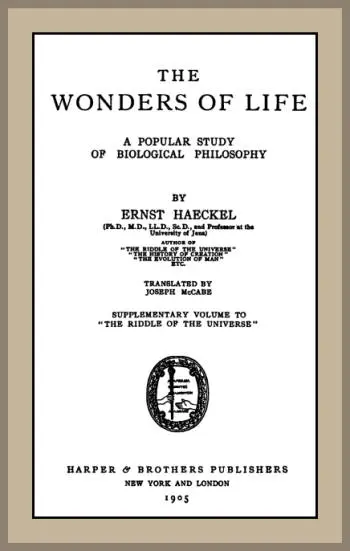
The Wonders of Life: A Popular Study of Biological Philosophy
Ernst Haeckel
THE CLASSIC COLLECTION · 1900
"The Riddle of the Universe at the Close of the Nineteenth Century" by Ernst Haeckel is a scientific publication written in the late 19th century. This work explores the intricate relationship between biology, philosophy, and the cosmos, presenting a comprehensive inquiry into the prevailing doubts and mysteries of existence as perceived in Haeckel's time. The book emphasizes the importance of empirical investigation and proposes a monistic philosophy that seeks to unify nature, science, and human understanding. The opening of the book unfolds with Haeckel's assertion of a significant transformation in knowledge and thought by the end of the 19th century. He portrays a duality in progress: while science has advanced tremendously, especially in revealing the workings of the universe and biological processes, societal, moral, and spiritual realms seem stagnant or regressive. Haeckel introduces the "world-riddles," a series of great enigmas regarding existence that challenge humanity’s understanding, and he outlines his philosophical stance that combines scientific observations with a monistic interpretation of nature. The reader is invited to contemplate elements like evolution, the nature of life, and humanity’s place within the broader context of the cosmos, framing the quest for answers as both a scientific and existential pursuit.
Introduction adapted from the source catalogue; source summaries may be automatically generated.
Free to read · English · 108,351 words · No account needed
MAKE TIME FOR A GOOD BOOK
On by default. Untick to stop anonymous reading totals. Each page counts after 10 seconds in view. How this works.
Anonymous counting is on unless you have switched it off.
Since Newton (1682) formulated the law of gravitation, and Kant (1755) established "the constitution and mechanical origin of the entire fabric of the world on Newtonian laws," and Laplace (1796) provided a mathematical foundation for this law of cosmic mechanicism, the whole of the inorganic sciences have become purely mechanical, and at the same time purely atheistic. Astronomy, cosmogony, geology, meteorology, and inorganic physics and chemistry are now absolutely ruled by mechanical laws on a mathematical foundation. The idea of "design" has wholly disappeared from this vast province of science. At the close of the nineteenth century, now that this monistic view has fought its way to general recognition, no scientist ever asks seriously of the "purpose" of any single phenomenon in the whole of this great field. Is any astronomer likely to inquire seriously to-day into the purpose of planetary motion, or a mineralogist to seek design in the structure of a crystal? Does the physicist investigate the purpose of electric force, or the chemist that of atomic weight? We may confidently answer in the negative--certainly not, in the sense that God, or a purposive natural force, had at some time created these fundamental laws of the mechanism of the universe with a definite design, and causes them to work daily in accordance with his rational will. The anthropomorphic notion of a deliberate architect and ruler of the world has gone forever from this field; the "eternal, iron laws of nature" have taken his place.
But the idea of design has a very great significance and application in the organic world. We do undeniably perceive a purpose in the structure and in the life of an organism. The plant and the animal seem to be controlled by a definite design in the combination of their several parts, just as clearly as we see in the machines which man invents and constructs; as long as life continues the functions of the several organs are directed to definite ends, just as is the operation of the various parts of a machine. Hence it was quite natural that the older naïve study of nature, in explaining the origin and activity of the living being, should postulate a creator who had "arranged all things with wisdom and understanding," and had constructed each plant and animal according to the special purpose of its life. The conception of this "almighty creator of heaven and earth" was usually quite anthropomorphic; he created "everything after its kind." As long as the creator seemed to man to be of human shape, to think with his brain, see with his eyes, and fashion with his hands, it was possible to form a definite picture of this "divine engineer" and his artistic work in the great workshop of creation. This was not so easy when the idea of God became refined, and man saw in his "invisible God" a creator without organs--a gaseous being. Still more unintelligible did these anthropomorphic ideas become when physiology substituted for the conscious, divine architect an unconscious, creative "vital force"--a mysterious, purposive, natural force, which differed from the familiar forces of physics and chemistry, and only took these in part, during life, into its service. This vitalism prevailed until about the middle of the nineteenth century. Johannes Müller, the great Berlin physiologist, was the first to menace it with a destructive dose of facts. It is true that the distinguished biologist had himself (like all others in the first half of the century) been educated in a belief in this vital force, and deemed it indispensable for an elucidation of the ultimate sources of life; nevertheless, in his classical and still unrivalled Manual of Physiology (1833) he gave a demonstrative proof that there is really nothing to be said for this vital force. Müller himself, in a long series of remarkable observations and experiments, showed that most of the vital processes in the human organism (and in the other animals) take place according to physical and chemical laws, and that many of them are capable of mathematical determination. That was no less true of the animal functions of the muscles and nerves, and of both the higher and the lower sense-organs, than of the vegetal functions of digestion, assimilation, and circulation. Only two branches of the life of the organism, mental action and reproduction, retained any element of mystery, and seemed inexplicable without assuming a vital force. But immediately after Müller's death such important discoveries and advances were made in these two branches that the uneasy "phantom of vital force" was driven from its last refuge. By a very remarkable coincidence Johannes Müller died in the year 1858, which saw the publication of Darwin's first communication concerning his famous theory. The theory of selection solved the great problem that had mastered Müller--the question of the origin of orderly arrangements from purely mechanical causes.
Your reading position is saved on this browser. Take it to another device with a library code. Reading pages adapt to text, rather than matching a printed edition.
BEHIND THE BOOK
This eBook is for the use of anyone anywhere in the United States and most other parts of the world at no cost and with almost no restrictions whatsoever. You may copy it, give it away or re-use it under the terms of the Project Gutenberg License included with this eBook or online at www.gutenberg.org. If you are not located in the United States, you will have to check the laws of the country where you are located before using this eBook. Read the source licence.
The original source file, including credits and licence, is retained by this library. Request an original-format copy at no charge. Please include the book title and Project Gutenberg identifier #42968.
KEEP YOUR CURIOSITY GOING

David Patterson (Spirit) Hatch

David Patterson (Spirit) Hatch

David Patterson (Spirit) Hatch
Coulson Kernahan

Ralph Waldo Emerson
Frances Wright