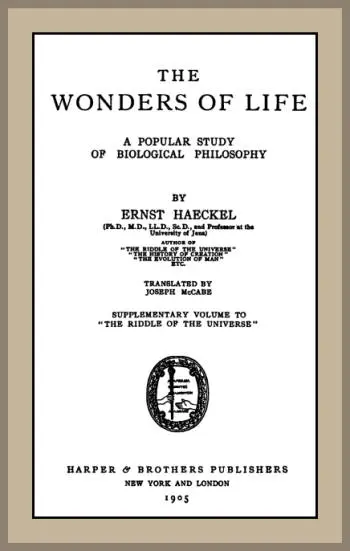
The Wonders of Life: A Popular Study of Biological Philosophy
Ernst Haeckel
THE CLASSIC COLLECTION · 1900
"The Riddle of the Universe at the Close of the Nineteenth Century" by Ernst Haeckel is a scientific publication written in the late 19th century. This work explores the intricate relationship between biology, philosophy, and the cosmos, presenting a comprehensive inquiry into the prevailing doubts and mysteries of existence as perceived in Haeckel's time. The book emphasizes the importance of empirical investigation and proposes a monistic philosophy that seeks to unify nature, science, and human understanding. The opening of the book unfolds with Haeckel's assertion of a significant transformation in knowledge and thought by the end of the 19th century. He portrays a duality in progress: while science has advanced tremendously, especially in revealing the workings of the universe and biological processes, societal, moral, and spiritual realms seem stagnant or regressive. Haeckel introduces the "world-riddles," a series of great enigmas regarding existence that challenge humanity’s understanding, and he outlines his philosophical stance that combines scientific observations with a monistic interpretation of nature. The reader is invited to contemplate elements like evolution, the nature of life, and humanity’s place within the broader context of the cosmos, framing the quest for answers as both a scientific and existential pursuit.
Introduction adapted from the source catalogue; source summaries may be automatically generated.
Free to read · English · 108,351 words · No account needed
MAKE TIME FOR A GOOD BOOK
On by default. Untick to stop anonymous reading totals. Each page counts after 10 seconds in view. How this works.
Anonymous counting is on unless you have switched it off.
The first thinker to introduce the purely monistic conception of substance into science and appreciate its profound importance was the great philosopher Baruch Spinoza; his chief work appeared shortly after his premature death in 1677, just one hundred years before Lavoisier gave empirical proof of the constancy of matter by means of the chemist's principal instrument, the balance. In his stately pantheistic system the notion of the world (the universe, or the cosmos) is identical with the all-pervading notion of God; it is at one and the same time the purest and most rational monism and the clearest and most abstract monotheism. This universal substance, this "divine nature of the world," shows us two different aspects of its being, or two fundamental attributes--matter (infinitely extended substance) and spirit (the all-embracing energy of thought). All the changes which have since come over the idea of substance are reduced, on a logical analysis, to this supreme thought of Spinoza's; with Goethe I take it to be the loftiest, profoundest, and truest thought of all ages. Every single object in the world which comes within the sphere of our cognizance, all individual forms of existence, are but special transitory forms--accidents or modes--of substance. These modes are material things when we regard them under the attribute of extension (or "occupation of space"), but forces or ideas when we consider them under the attribute of thought (or "energy"). To this profound thought of Spinoza our purified monism returns after a lapse of two hundred years; for us, too, matter (space-filling substance) and energy (moving force) are but two inseparable attributes of the one underlying substance.
Among the various modifications which the fundamental idea of substance has undergone in modern physics, in association with the prevalent atomism, we shall select only two of the most divergent theories for a brief discussion, the kinetic and the pyknotic. Both theories agree that we have succeeded in reducing all the different forces of nature to one common original force; gravity and chemical action, electricity and magnetism, light and heat, etc., are only different manifestations, forms, or dynamodes, of a single primitive force (prodynamis). This fundamental force is generally conceived as a vibratory motion of the smallest particles of matter--a vibration of atoms. The atoms themselves, according to the usual "kinetic theory of substance," are dead, separate particles of matter, which dance to and fro in empty space and act at a distance. The real founder and most distinguished representative of the kinetic theory is Newton, the famous discoverer of the law of gravitation. In his great work, the Philosophiae Naturalis Principia Mathematica (1687), he showed that throughout the universe the same law of attraction controls the unvarying constancy of gravitation; the attraction of two particles being in direct proportion to their mass and in inverse proportion to the square of their distance. This universal force of gravity is at work in the fall of an apple and the tidal wave no less than in the course of the planets round the sun and the movements of all the heavenly bodies. Newton had the immortal merit of establishing the law of gravitation and embodying it in an indisputable mathematical formula. Yet this dead mathematical formula, on which most scientists lay great stress, as so frequently happens, gives us merely the quantitative demonstration of the theory; it gives us no insight whatever into the qualitative nature of the phenomena. The action at a distance without a medium, which Newton deduced from his law of gravitation, and which became one of the most serious and most dangerous dogmas of later physics, does not afford the slightest explanation of the real causes of attraction; indeed, it long obstructed our way to the real discovery of them. I cannot but suspect that his speculations on this mysterious action at a distance contributed not a little to the leading of the great English mathematician into the obscure labyrinth of mystic dreams and theistic superstition in which he passed the last thirty-four years of his life; we find him, at the end, giving metaphysical hypotheses on the predictions of Daniel and on the paradoxical fantasies of St. John.
Your reading position is saved on this browser. Take it to another device with a library code. Reading pages adapt to text, rather than matching a printed edition.
BEHIND THE BOOK
This eBook is for the use of anyone anywhere in the United States and most other parts of the world at no cost and with almost no restrictions whatsoever. You may copy it, give it away or re-use it under the terms of the Project Gutenberg License included with this eBook or online at www.gutenberg.org. If you are not located in the United States, you will have to check the laws of the country where you are located before using this eBook. Read the source licence.
The original source file, including credits and licence, is retained by this library. Request an original-format copy at no charge. Please include the book title and Project Gutenberg identifier #42968.
KEEP YOUR CURIOSITY GOING

David Patterson (Spirit) Hatch

David Patterson (Spirit) Hatch

David Patterson (Spirit) Hatch
Coulson Kernahan

Ralph Waldo Emerson
Frances Wright