
The justice of Gideon
Eleanor Gates
THE CLASSIC COLLECTION · 1922
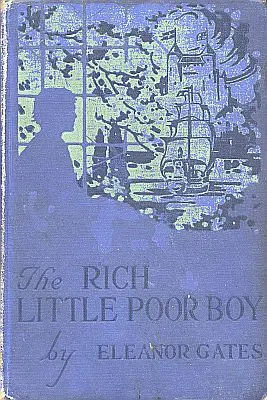
"The Rich Little Poor Boy" by Eleanor Gates is a novel written in the early 20th century. The story centers around a ten-year-old boy named Johnnie Smith, who lives in a tenement and is under the care of harsh foster father Big Tom Barber. As Johnnie navigates the challenges of his difficult home life, he uses his imagination to escape into a world where he dreams of adventure and a brighter future. At the start of the book, the reader is introduced to Johnnie's grim reality, marked by his oversized, tattered clothes and the oppressive presence of Big Tom, who issues commands and instills fear. Despite these conditions, Johnnie possesses a vibrant imagination, vividly visualizing a life of nobility and freedom. He shares a bond with his step-sister Cis, who provides some comfort as they communicate using a secret system due to Barber’s harsh nature. The opening sections establish Johnnie's character, his struggles, and his escapist tendencies, setting the stage for a tale about resilience, dreams, and the quest for kindness amidst adversity.
Introduction adapted from the source catalogue; source summaries may be automatically generated.
Free to read · English · 124,863 words · No account needed
MAKE TIME FOR A GOOD BOOK
On by default. Untick to stop anonymous reading totals. Each page counts after 10 seconds in view. How this works.
Anonymous counting is on unless you have switched it off.
While he was waiting for silence, Barber fell to examining the scout uniform, article by article--the hat, the coat, the trousers, the leggings, the shoes, his look full of disgust, and fairly withering. When he was done, he sank leisurely into the morris chair, a big hand on each knee, and the flat back of his head rested against the old soiled cushion. And now he concentrated on Johnnie's countenance. "So Mister One-Eye fitted y' out," he resumed, and his mouth lifted at one corner, showing a brown, fanglike tooth worn by his pipe stem.
"Y--yes, sir," replied Johnnie.
"Oh, be sure to sir him!" mocked Cis. "He deserves politeness!"
Big Tom showed all of his teeth. But not at what Cis had been saying; it was evident that some new and pleasant thought had occurred to him. He nodded his head over it. "I thought maybe it was that dude again," he remarked cheerfully. "But it was One-Eye fitted y' out! Hm! And when I'm off at work, instead o' doin' what y' ought t', y' fix y'rself up, don't y'?--soldier boy stuff!"
"I--I do my work in these," pleaded Johnnie. "I do! Honest! See how nice the place is! I don't shirk nothin'! 'Cause y' see, a scout, he----"
Big Tom let him get no further. "Take them rags off!" he commanded. The last trace of that smile was gone. The bulging eyes looked out through slits. That underlip was thrust forward wrathfully.
"Take your suit off, Johnnie," counseled Cis. "Don't you see he hates to
have you look nice?"
"My--my scout suit!" faltered the boy. The light in those peering, bloodshot eyes told him that the longshoreman would mistreat that beloved uniform; and Johnnie wanted to gain time. Something, or some one, might interrupt, and thus stave off--what?
Barber straightened. "Take--it--off," he said quietly, but with heat; and added, "Before I tear it off."
Johnnie proceeded to carry out the order. He put the beautiful olive-drab hat on the table. Next he unfastened the neat, webbed belt, and unlaced the soldierly leggings. The emblemed coat came off carefully. The khaki shirt followed. Last of all, having slipped his feet out of the wonderful shoes, he pulled off the trousers, and stood, a pathetic little figure, in an old undershirt of Grandpa's, the sleeves of which he had shortened, and a pair of Grandpa's underdrawers, similarly cut--to knee length.
Barber stared at the underclothes. "Who said y' could wear my old man's
things?" he asked.
"N--nobody."
"They're too small for Grandpa," declared Cis, stoutly. "Johnnie might as well wear them. If he didn't, I'd throw them away, or use them for dishcloths."
Your reading position is saved on this browser. Take it to another device with a library code. Reading pages adapt to text, rather than matching a printed edition.
Eleanor Gates

Eleanor Gates

Eleanor Gates

Eleanor Gates
BEHIND THE BOOK
This eBook is for the use of anyone anywhere in the United States and most other parts of the world at no cost and with almost no restrictions whatsoever. You may copy it, give it away or re-use it under the terms of the Project Gutenberg License included with this eBook or online at www.gutenberg.org. If you are not located in the United States, you will have to check the laws of the country where you are located before using this eBook. Read the source licence.
The original source file, including credits and licence, is retained by this library. Request an original-format copy at no charge. Please include the book title and Project Gutenberg identifier #24663.
KEEP YOUR CURIOSITY GOING
Coulson Kernahan

Maurice Baring
Frances Wright
Cécile Tormay

Frederic Jesup Stimson

W. H. P. (William Henry Pope) Jarvis