
The justice of Gideon
Eleanor Gates
THE CLASSIC COLLECTION · 1922
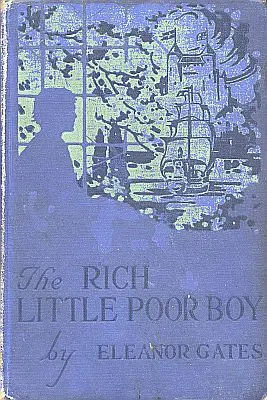
"The Rich Little Poor Boy" by Eleanor Gates is a novel written in the early 20th century. The story centers around a ten-year-old boy named Johnnie Smith, who lives in a tenement and is under the care of harsh foster father Big Tom Barber. As Johnnie navigates the challenges of his difficult home life, he uses his imagination to escape into a world where he dreams of adventure and a brighter future. At the start of the book, the reader is introduced to Johnnie's grim reality, marked by his oversized, tattered clothes and the oppressive presence of Big Tom, who issues commands and instills fear. Despite these conditions, Johnnie possesses a vibrant imagination, vividly visualizing a life of nobility and freedom. He shares a bond with his step-sister Cis, who provides some comfort as they communicate using a secret system due to Barber’s harsh nature. The opening sections establish Johnnie's character, his struggles, and his escapist tendencies, setting the stage for a tale about resilience, dreams, and the quest for kindness amidst adversity.
Introduction adapted from the source catalogue; source summaries may be automatically generated.
Free to read · English · 124,863 words · No account needed
MAKE TIME FOR A GOOD BOOK
On by default. Untick to stop anonymous reading totals. Each page counts after 10 seconds in view. How this works.
Anonymous counting is on unless you have switched it off.
It was then they heard the stairs creak, and a heavy step in the hall. And thought of Big Tom for the first time--having been too enthralled by the roses, until now, to remember anything else. "Oh, quick!" Johnnie was between Cis and the door of her room. He moved aside to let her pass. "Oh!"--but, being panic-stricken, she stepped in the same direction, so that she stumbled against him. Finding himself again blocking her path, "Hurry!" he urged, and dodged the other way. She also dodged that way. Thus they did a kind of frightened side-to-side dance there in the middle of the kitchen floor--as the door opened and Barber appeared, his coat on his arm.
Face to face, with the roses between them, Cis and Johnnie stayed where they were, as if stricken into helplessness by the sight of the longshoreman, toward him turning their beseeching, anxious look. Each reached blindly to touch the other, for strength and sympathy. And the roses, lifted to the level of their lips, swayed to their hard breathing.
Barber lumbered closer. "What y' got there?" he demanded. He flung his coat from him, to light upon the table, where it covered those other flowers which were of cotton.
"R--roses," faltered Cis, her voice scarcely audible.
Now the longshoreman came to loom over them. "Where 'd y' git 'em?" he asked next, staring at the bouquet almost wildly. ("He'll jerk it," thought Johnnie.)
"You--you remember the--the Mr. Perkins?" Cis began, not taking her eyes
from Big Tom's face.
Barber did not "jerk" the roses. Instead, he pointed one of those long arms toward the window. "Walk over there," he commanded, "and pitch 'em out!" His arm stayed outstretched.
Cis tried to speak, made as if to plead, but could only swallow. As for Johnnie, he was petrified, mesmerized, and remained in her path, watching those eyes which were bulging so furiously, while that white flash in the left one darted into sight and disappeared, then came and went again.
"Out!" repeated Barber.
Cis lowered her look to her roses, as if she were seeing them for the last time. Even in the dusk of the kitchen their bright color was reflected upon her face, which, but for the flowers, would have been a ghastly white. A quick catching of the breath, like a sob. Then, her chin sunk among the blossoms, she half-circled Johnnie, and slowly started windowward.
"Git a move on!" Barber spoke low.
At that, she turned, holding the roses toward him. "Oh, Mr. Barber!" she begged. "Don't make me! Don't! The first roses I've ever had! The first! Oh, don't hurt 'em!"
Your reading position is saved on this browser. Take it to another device with a library code. Reading pages adapt to text, rather than matching a printed edition.
Eleanor Gates

Eleanor Gates

Eleanor Gates

Eleanor Gates
BEHIND THE BOOK
This eBook is for the use of anyone anywhere in the United States and most other parts of the world at no cost and with almost no restrictions whatsoever. You may copy it, give it away or re-use it under the terms of the Project Gutenberg License included with this eBook or online at www.gutenberg.org. If you are not located in the United States, you will have to check the laws of the country where you are located before using this eBook. Read the source licence.
The original source file, including credits and licence, is retained by this library. Request an original-format copy at no charge. Please include the book title and Project Gutenberg identifier #24663.
KEEP YOUR CURIOSITY GOING
Coulson Kernahan

Maurice Baring
Frances Wright
Cécile Tormay

Frederic Jesup Stimson

W. H. P. (William Henry Pope) Jarvis