
The justice of Gideon
Eleanor Gates
THE CLASSIC COLLECTION · 1922
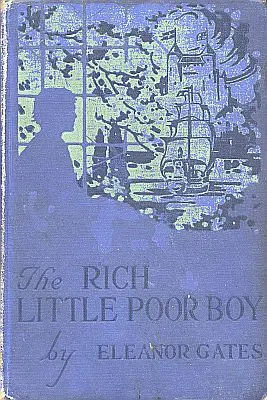
"The Rich Little Poor Boy" by Eleanor Gates is a novel written in the early 20th century. The story centers around a ten-year-old boy named Johnnie Smith, who lives in a tenement and is under the care of harsh foster father Big Tom Barber. As Johnnie navigates the challenges of his difficult home life, he uses his imagination to escape into a world where he dreams of adventure and a brighter future. At the start of the book, the reader is introduced to Johnnie's grim reality, marked by his oversized, tattered clothes and the oppressive presence of Big Tom, who issues commands and instills fear. Despite these conditions, Johnnie possesses a vibrant imagination, vividly visualizing a life of nobility and freedom. He shares a bond with his step-sister Cis, who provides some comfort as they communicate using a secret system due to Barber’s harsh nature. The opening sections establish Johnnie's character, his struggles, and his escapist tendencies, setting the stage for a tale about resilience, dreams, and the quest for kindness amidst adversity.
Introduction adapted from the source catalogue; source summaries may be automatically generated.
Free to read · English · 124,863 words · No account needed
MAKE TIME FOR A GOOD BOOK
On by default. Untick to stop anonymous reading totals. Each page counts after 10 seconds in view. How this works.
Anonymous counting is on unless you have switched it off.
"Any high-falutin' stuff would be wasted 'round here," went on Barber. "We're just plain, hard-workin', decent people.--And now we'll git down to brass tacks." He passed in front of Mr. Perkins and settled himself heavily in the morris chair.
The scoutmaster faced about, found the kitchen chair, and sat. "I'm listening," he said. He was businesslike, even cordial.
"You seem t' hang 'round here about two-thirds of your time," commented Big Tom, hunting his pipe.
"No," contradicted Mr. Perkins, easily. "Lately, I've been coming here
one hour a day."
"And just what's the idear?" The big fingers plucked blindly at the strings of a tobacco-bag, for Big Tom did not take his eyes from the younger man.
"I've been giving the boy setting-up exercises," explained Mr. Perkins.
"Y' have!"--sarcastically. "Ain't that sweet of y'!" Then with an impatient gesture that scattered tobacco upon the floor, "Exercises!" Big Tom cried wrathfully. "Exercises! As if he can't git all the exercises he needs by doin' his work! I have t' feed that kid, and feed costs money. He knows that. And he earns. Because he ain't no grafter."
In sheer amazement, Johnnie's look strayed to Mr. Perkins. He had expected mistreatment and insult for himself, and here he was receiving praise!
"There's a difference in exercising," said Mr. Perkins. "Johnnie gets one kind while he's doing his work. But his work is all inside work, out of the fresh air that every boy needs. And certain of his muscles are not developed. I've been correcting that undevelopment by giving him the regular setting-up that we give all boy scouts."
"Shucks, your boy scouts!" sneered Big Tom. "We got no time for 'em. We're poor, and we're busy, and we got a' old, sick man on our hands. That's scoutin' enough!"
"Many men who have boys think as you do," acknowledged Mr. Perkins, serenely. "That is, at first."
"I think it first and second," returned Big Tom, raising his voice. "And
also I know it."
"I promise you that it won't hurt Johnnie," urged the scoutmaster.
"Yeh? But I know what would hurt Johnnie, and that's growin' up t'
look like you!"
At that, Mr. Perkins burst out in a laugh. It was both good-natured and amused. "Well, my looks suit me," he declared.
"Which is more'n I can say of 'em," retorted Barber. "They don't suit
me a little bit!"
Mr. Perkins laughed again. "Sorry," he said, but his tone entirely
contradicted his assertion.
Barber kept on: "Your looks don't suit me, and neither does your talk. You're altogether too slick, too pink-and-whity, too eye-glassy, and purple-shirty, and cute-socky, and girl-glovy."
"I see."
Your reading position is saved on this browser. Take it to another device with a library code. Reading pages adapt to text, rather than matching a printed edition.
Eleanor Gates

Eleanor Gates

Eleanor Gates

Eleanor Gates
BEHIND THE BOOK
This eBook is for the use of anyone anywhere in the United States and most other parts of the world at no cost and with almost no restrictions whatsoever. You may copy it, give it away or re-use it under the terms of the Project Gutenberg License included with this eBook or online at www.gutenberg.org. If you are not located in the United States, you will have to check the laws of the country where you are located before using this eBook. Read the source licence.
The original source file, including credits and licence, is retained by this library. Request an original-format copy at no charge. Please include the book title and Project Gutenberg identifier #24663.
KEEP YOUR CURIOSITY GOING
Coulson Kernahan

Maurice Baring
Frances Wright
Cécile Tormay

Frederic Jesup Stimson

W. H. P. (William Henry Pope) Jarvis