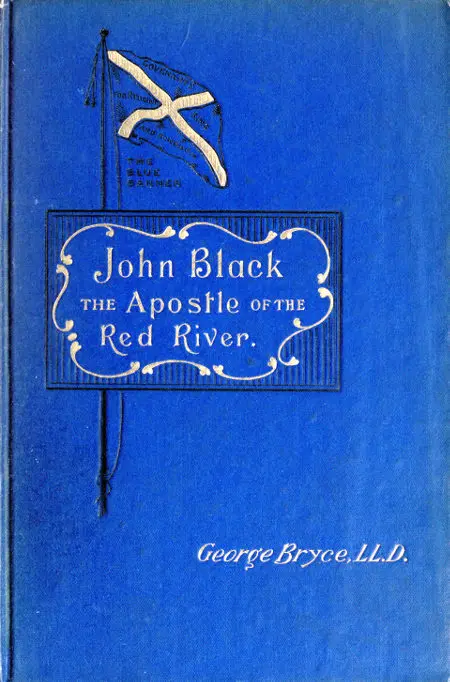
John Black, the Apostle of the Red River Or, How the Blue Banner Was Unfurled on Manitoba Prairies
George Bryce
THE CLASSIC COLLECTION · 1900
"The Remarkable History of the Hudson's Bay Company" by George Bryce is a historical account written in the early 20th century. This work meticulously chronicles the extensive legacy and influence of the Hudson's Bay Company over its long history, emphasizing its critical role in trade, exploration, and the governance of vast territories in North America. The narrative takes the reader through the company's foundational years, its key figures, and its interactions with rival trading entities, particularly the French traders and other companies, thus painting a detailed picture of the fur trade era. The opening of the book introduces the rich history surrounding the establishment of the Hudson's Bay Company, highlighting its adventurous beginnings with explorers Pierre Esprit Radisson and Médard Chouart des Groseilliers, who first sought to harness trade in the region. As they navigated personal and political challenges, the narrative lays the groundwork for how these early ventures and royal interventions led to the formation of a company that would eventually control vast expanses of land. Through various challenges and detailed accounts of expeditions, Bryce sets the stage for understanding the larger impact the Hudson's Bay Company had on Canada's development and its complex relationships with Indigenous peoples and competing traders.
Introduction adapted from the source catalogue; source summaries may be automatically generated.
Free to read · English · 177,637 words · No account needed
MAKE TIME FOR A GOOD BOOK
On by default. Untick to stop anonymous reading totals. Each page counts after 10 seconds in view. How this works.
Anonymous counting is on unless you have switched it off.
"Faintly as tolls the evening chime,
Our voices keep tune and our oars keep time."
Certainly the refrain has more of the spirit of the boatman's song:--
"Row, brothers, row; the stream runs fast,
The rapids are near and the daylight's past."
The true colouring of the scene is reflected in
"We'll sing at Ste. Anne;"
and--
"Ottawa's tide, this trembling moon,
Shall see us float over thy surges soon."
Ste. Anne really had a high distinction among all the resting-places on the fur trader's route. It was the last point in the departure from Montreal Island. Religion and sentiment for a hundred years had consecrated it, and a short distance above it, on an eminence overlooking the narrows--the real mouth of the Ottawa--was a venerable ruin, now overgrown with ivy and young trees, "Château brillant," a castle speaking of border foray and Indian warfare generations ago.
If the party was a distinguished one there was often a priest included, and he, as soon as the brigade was fairly off and the party had settled down to the motion, reverently removing his hat, sounded forth a loud invocation to the Deity and to a long train of male and female saints, in a loud and full voice, while all the men at the end of each versicle made response, "Qu'il me bénisse." This done, he called for a song. None of the many songs of France would be more likely at this stage than the favourite and most beloved of all French Canadian songs, "A la Claire Fontaine."
The leader in solo would ring out the verse--
"A la claire fontaine,
M'en allent promener,
J'ai trouvé l'eau si belle,
Que je m'y sois baigné."
("Unto the crystal fountain,
For pleasure did I stray;
So fair I found the waters,
My limbs in them I lay.")
Then in full chorus all would unite, followed verse by verse. Most touching of all would be the address to the nightingale--
"Chantez, rossignol, chantez,
Toi qui as le coeur gai;
Tu as le coeur à rire,
Moi, je l'ai à pleurer."
("Sing, nightingale, keep singing,
Thou hast a heart so gay;
Thou hast a heart so merry,
While mine is sorrow's prey.")
The most beautiful of all, the chorus, is again repeated, and is, as
translated by Lighthall:--
"Long is it I have loved thee,
Thee shall I love alway,
My dearest;
Long is it I have loved thee,
Thee shall I love alway."
Your reading position is saved on this browser. Take it to another device with a library code. Reading pages adapt to text, rather than matching a printed edition.
George Bryce

George Bryce
George Bryce
George Bryce
BEHIND THE BOOK
This eBook is for the use of anyone anywhere in the United States and most other parts of the world at no cost and with almost no restrictions whatsoever. You may copy it, give it away or re-use it under the terms of the Project Gutenberg License included with this eBook or online at www.gutenberg.org. If you are not located in the United States, you will have to check the laws of the country where you are located before using this eBook. Read the source licence.
The original source file, including credits and licence, is retained by this library. Request an original-format copy at no charge. Please include the book title and Project Gutenberg identifier #44312.
KEEP YOUR CURIOSITY GOING
Cécile Tormay

Moritz Busch
John L. Ransom
Frances Wright
Cécile Tormay

Mabel Potter Daggett