
Bonnie Scotland and what we owe her
William Elliot Griffis
THE CLASSIC COLLECTION · 1895
"The Religions of Japan, from the Dawn of History to the Era of Méiji" by William Elliot Griffis is a historical account written in the late 19th century. The work explores the evolution of religious practices in Japan, providing insights into how Japan's unique spiritual landscape developed from its earliest days through the Meiji era. The book draws attention to the diverse religious influences, particularly focusing on Shintō, Confucianism, and Buddhism, along with the underlying animistic beliefs and practices that shaped the Japanese people's spiritual lives. The opening portion of the text sets the stage for an in-depth examination of Japan's religious history, as the author outlines his background and the purpose of the book. Griffis reflects on his time spent in Japan and his interactions with various facets of Japanese culture, emphasizing the importance of understanding the interplay between different religious traditions. He characterizes Japan as a relatively young nation with a complex blend of indigenous and foreign religious elements, stressing that an authentic portrayal of Japanese religion should account for this amalgamation. The text makes a strong case for the significance of comparative religion, advocating for a comprehensive understanding of the beliefs and practices that have evolved throughout Japan’s history.
Introduction adapted from the source catalogue; source summaries may be automatically generated.
Free to read · English · 121,556 words · No account needed
MAKE TIME FOR A GOOD BOOK
On by default. Untick to stop anonymous reading totals. Each page counts after 10 seconds in view. How this works.
Anonymous counting is on unless you have switched it off.
"The wise make our halls illustrious, and their monuments endure for
ages."
"What permanency is there to the glory of the world? It goes from the sight like hoar-frost in the sun."
"If men wish to enter the joys of heavenly light, Let them smell the fragrance of the law of Buddha."
"Whoever wishes to have his merit reach even to the abode of demons, let him, with us, and all living, become perfect in the doctrine."]
[Footnote 36: Rev. C.B. Hawarth in the New York Independent, January
18, 1894.]
[Footnote 37: In 781 the Buddhist monk Kéi-shun dedicated a chapel to Jizo, on whom he conferred the epithet of Sho-gun or general, to suit the warlike tastes of the Japanese people.--S. and H., p. 384. So also Hachiman became the god of war because adopted as the patron deity of the Genji warriors.--S. and H., p. 70.]
[Footnote 38: Corea, the Hermit Nation, p. 90.]
[Footnote 39: Dixon's Japan, p. 41; S. and H., Japan, passim; Rein's Japan; Story of the Nations, Japan, by David Murray, p. 201, note; Dening's life of Toyotomi Hidéyoshi; M.E., Chapters XV., XVI., XX., XXIII., XXIV.; Gazetteer of Echizen; Shiga's History of Nations, Tōkiō, 1888, pp. 115, 118; T.A.S.J., Vol. VIII., pp. 94, 134, 143.]
[Footnote 40: T.A.S.J., Vol. VIII., Hidéyoshi and the Satsuma Clan in the Sixteenth Century, by J.H. Gubbins; The Times of Taikō, by R. Brinkley, in The Japan Times.]
[Footnote 41: The Copy of the Buddhist Tripitaka, or Northern Collection, made by order of the Emperor, Wan-Li, in the sixteenth century, when the Chinese capital (King) was changed from the South (Nan) to the North (Pe), was reproduced in Japan in 1679 and again in 1681-83, and in over two thousand volumes, making a pile a hundred feet high, was presented by the Japanese Government, through the Junior Prime Minister, Mr. Tomomi Iwakura, to the Library of the India Office. See Samuel Beal's The Buddhist Tripitaka, as it is known in China and Japan, A Catalogue and Compendious Report, London, 1876. The library has been rearranged by Mr. Bunyin Nanjio, who has published the result of his labors, with Sanskrit equivalents of the titles and with notes of the highest value.]
[Footnote 42: "Neither country (China or Japan) has had the independence and mental force to produce a literature of its own, and to add anything but a chapter of decay to the history of this religion."--Professor William D. Whitney, in review of Anecdota Oxoniensia, Buddhist Texts from Japan, in The Nation, No. 875.]
Your reading position is saved on this browser. Take it to another device with a library code. Reading pages adapt to text, rather than matching a printed edition.
William Elliot Griffis
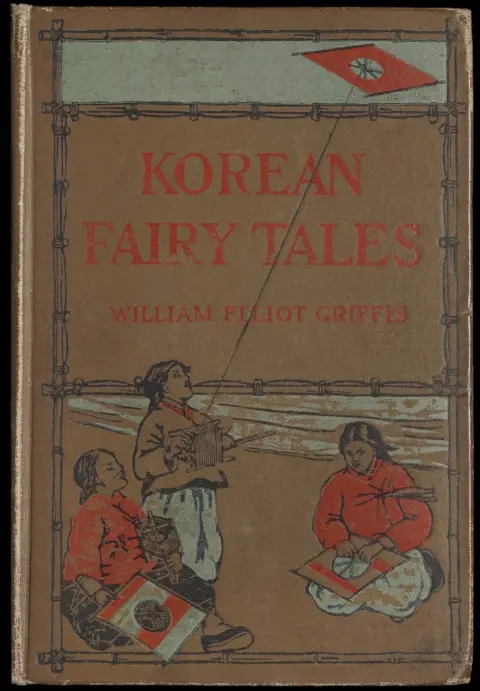
William Elliot Griffis
William Elliot Griffis

William Elliot Griffis
BEHIND THE BOOK
This eBook is for the use of anyone anywhere in the United States and most other parts of the world at no cost and with almost no restrictions whatsoever. You may copy it, give it away or re-use it under the terms of the Project Gutenberg License included with this eBook or online at www.gutenberg.org. If you are not located in the United States, you will have to check the laws of the country where you are located before using this eBook. Read the source licence.
The original source file, including credits and licence, is retained by this library. Request an original-format copy at no charge. Please include the book title and Project Gutenberg identifier #15516.
KEEP YOUR CURIOSITY GOING

David Patterson (Spirit) Hatch

David Patterson (Spirit) Hatch

David Patterson (Spirit) Hatch
Cécile Tormay

Moritz Busch
John L. Ransom