
Bonnie Scotland and what we owe her
William Elliot Griffis
THE CLASSIC COLLECTION · 1895
"The Religions of Japan, from the Dawn of History to the Era of Méiji" by William Elliot Griffis is a historical account written in the late 19th century. The work explores the evolution of religious practices in Japan, providing insights into how Japan's unique spiritual landscape developed from its earliest days through the Meiji era. The book draws attention to the diverse religious influences, particularly focusing on Shintō, Confucianism, and Buddhism, along with the underlying animistic beliefs and practices that shaped the Japanese people's spiritual lives. The opening portion of the text sets the stage for an in-depth examination of Japan's religious history, as the author outlines his background and the purpose of the book. Griffis reflects on his time spent in Japan and his interactions with various facets of Japanese culture, emphasizing the importance of understanding the interplay between different religious traditions. He characterizes Japan as a relatively young nation with a complex blend of indigenous and foreign religious elements, stressing that an authentic portrayal of Japanese religion should account for this amalgamation. The text makes a strong case for the significance of comparative religion, advocating for a comprehensive understanding of the beliefs and practices that have evolved throughout Japan’s history.
Introduction adapted from the source catalogue; source summaries may be automatically generated.
Free to read · English · 121,556 words · No account needed
MAKE TIME FOR A GOOD BOOK
On by default. Untick to stop anonymous reading totals. Each page counts after 10 seconds in view. How this works.
Anonymous counting is on unless you have switched it off.
[Footnote 19: It was for lifting with his walking-stick the curtain hanging before the shrine of this Kami that Arinori Mori, formerly H.I.J.M. Minister at Washington and London, was assassinated by a Shintō fanatic, February 11, 1889; T. J., p. 229; see Percival Lowell's paper in the Atlantic Monthly.]
[Footnote 20: See Mr. P. Lowell's Esoteric Shintō, T.A.S.J., Vol. XXI, pp. 165-167, and his "Occult Japan."]
[Footnote 21: S. and H., Japan, p. 83.]
[Footnote 22: See the Author's Introduction to the Arabian Nights' Entertainments, Boston, 1891.]
[Footnote 23: B.N., Index and pp. 78-103; Edkins's Chinese Buddhism, p.
169.]
[Footnote 24: Satow's or Chamberlain's Guide-books furnish hundreds of other instances, and describe temples in which the renamed kami are worshipped.]
[Footnote 25: S. and H., p. 70.]
[Footnote 26: M.E., pp. 187, 188; S. and H., pp. 11, 12.]
[Footnote 27: San Kai Ri (Mountain, Sea, and Land). This work, recommended to me by a learned Buddhist priest in Fukui, I had translated and read to me by a Buddhist of the Shin Shu sect. In like manner, even Christian writers in Japan have occasionally endeavored to rationalize the legends of Shintō, see Kojiki, p. liii., where Mr. T. Goro's Shintō Shin-ron is referred to. I have to thank my friend Mr. C. Watanabé, of Cornell University, for reading to me Mr. Takahashi's interesting but unconvincing monographs on Shintō and Buddhism.]
[Footnote 28: T.J., p. 402; Some Chinese Ghosts, by Lafcadio Hearn, p.
129.]
[Footnote 29: S. and H., Japan, p. 397; Classical Poetry of the
Japanese, p. 201, note.]
[Footnote 30: The Japanese word Ryō means both, and is applied to the eyes, ears, feet, things correspondent or in pairs, etc.; bu is a term for a set, kind, group, etc.]
[Footnote 31: Rein, p. 432; T.A.S.J., Vol. XXI., pp. 241-270; T.J., p.
339.]
[Footnote 32: The Chrysanthemum, Vol. I., p. 401.]
[Footnote 33: Even the Takétori Monogatari (The Bamboo Cutter's Daughter), the oldest and the best of the Japanese classic romances is (at least in the text and form now extant) a warp of native ideas with a woof of Buddhist notions.]
[Footnote 34: Mr. Percival Lowell argues, in Esoteric Shintō, T.A.S.J., Vol. XXI., that besides the habit of pilgrimages, fire-walking, and god-possession, other practices supposed to be Buddhistic are of Shintō origin.]
Your reading position is saved on this browser. Take it to another device with a library code. Reading pages adapt to text, rather than matching a printed edition.
William Elliot Griffis
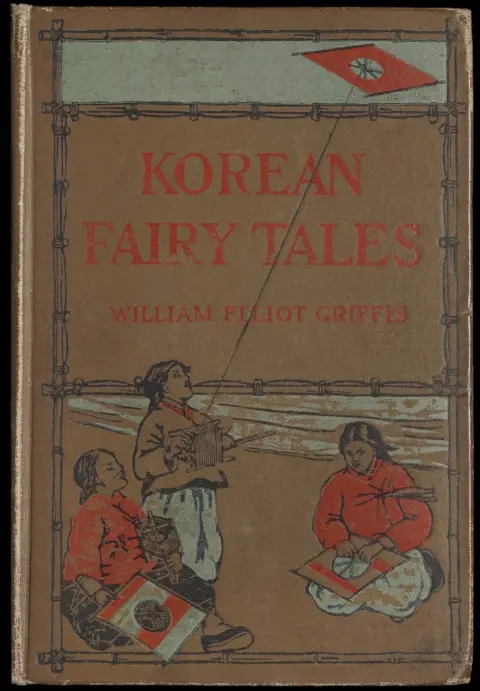
William Elliot Griffis
William Elliot Griffis

William Elliot Griffis
BEHIND THE BOOK
This eBook is for the use of anyone anywhere in the United States and most other parts of the world at no cost and with almost no restrictions whatsoever. You may copy it, give it away or re-use it under the terms of the Project Gutenberg License included with this eBook or online at www.gutenberg.org. If you are not located in the United States, you will have to check the laws of the country where you are located before using this eBook. Read the source licence.
The original source file, including credits and licence, is retained by this library. Request an original-format copy at no charge. Please include the book title and Project Gutenberg identifier #15516.
KEEP YOUR CURIOSITY GOING

David Patterson (Spirit) Hatch

David Patterson (Spirit) Hatch

David Patterson (Spirit) Hatch
Cécile Tormay

Moritz Busch
John L. Ransom