
Bonnie Scotland and what we owe her
William Elliot Griffis
THE CLASSIC COLLECTION · 1895
"The Religions of Japan, from the Dawn of History to the Era of Méiji" by William Elliot Griffis is a historical account written in the late 19th century. The work explores the evolution of religious practices in Japan, providing insights into how Japan's unique spiritual landscape developed from its earliest days through the Meiji era. The book draws attention to the diverse religious influences, particularly focusing on Shintō, Confucianism, and Buddhism, along with the underlying animistic beliefs and practices that shaped the Japanese people's spiritual lives. The opening portion of the text sets the stage for an in-depth examination of Japan's religious history, as the author outlines his background and the purpose of the book. Griffis reflects on his time spent in Japan and his interactions with various facets of Japanese culture, emphasizing the importance of understanding the interplay between different religious traditions. He characterizes Japan as a relatively young nation with a complex blend of indigenous and foreign religious elements, stressing that an authentic portrayal of Japanese religion should account for this amalgamation. The text makes a strong case for the significance of comparative religion, advocating for a comprehensive understanding of the beliefs and practices that have evolved throughout Japan’s history.
Introduction adapted from the source catalogue; source summaries may be automatically generated.
Free to read · English · 121,556 words · No account needed
MAKE TIME FOR A GOOD BOOK
On by default. Untick to stop anonymous reading totals. Each page counts after 10 seconds in view. How this works.
Anonymous counting is on unless you have switched it off.
[Footnote 8: "The frog in the well knows not the great ocean." This proverb, so freely quoted throughout Chinese Asia, and in recent years so much applied to themselves by the Japanese, is of Hindu origin and is found in the Sanskrit.]
[Footnote 9: This is shown with literary skill and power in a modern popular work, the title of which, Dai Nippon Kai-biyaku Yurai-iki, which, very freely indeed, may be translated Instances of Divine Interposition in Behalf of Great Japan. A copy of this work was presented to the writer by the late daimiō of Echizen, and was read with interest as containing the common people's ideas about their country and history. It was published in Yedo in 1856, while Japan was still excited over the visits of the American and European fleets. On the basis of the information furnished in this work General Le Gendre wrote his influential book, Progressive Japan, in which a number of quotations from the Kai-biyaku may be read.]
[Footnote 10: In the Kojiki, pp. 101-104, we have the poetical account of the abdication of the lord of Idzumo in favor of the Yamato conqueror, on condition that the latter should build a temple and have him honored among the gods. One of the rituals contains the congratulatory address of the chieftains of Idzumo, on their surrender to "the first Mikado, Jimmu Tennō." See also T.J., p. 206.]
[Footnote 11: "The praying for Harvest, or Toshigoi no Matsuri, was celebrated on the 4th day of the 2d month of each year, at the capital in the Jin-Gi-Kuan or office for the Worship of the Shintō gods, and in the provinces by the chiefs of the local administrations. At the Jin-Gi-Kuan there were assembled the ministers of state, the functionaries of that office, the priests and priestesses of 573 temples, containing 737 shrines, which were kept up at the expense of the Mikado's treasury, while the governors of the provinces superintended in the districts under their administration the performance of rites in honor of 2,395 other shrines. It would not be easy to state the exact number of deities to whom these 3,132 shrines were dedicated. A glance over the list in the 9th and 10th books of the Yengishiki shows at once that there were many gods who were worshipped in more than half-a-dozen different localities at the same time; but exact calculation is impossible, because in many cases only the names of the temples are given, and we are left quite in the dark as to the individuality of the gods to whom they were sacred. Besides these 3,132 shrines, which are distinguished as Shikidai, that is contained in the catalogue of the Yengishiki, there were a large number of enumerated shrines in temples scattered all over the country, in every village or hamlet, of which it was impossible to take any account, just as at the present day there are temples of Hachiman, Kompira, Tenjin sama, San-no sama and Sengen sama, as they are popularly called, wherever twenty or thirty houses are collected together. The shrines are classed as great and small, the respective numbers being 492 and 2,640, the distinction being twofold, firstly in the proportionately larger quantity of offerings made at the great shrines, and secondly that the offerings in the one case were arranged upon tables or altars, while in the other they were placed on mats spread upon the earth. In the Yengishiki the amounts and nature of the offerings are stated with great minuteness, but it will be sufficient if the kinds of articles offered are alone mentioned here. It will be seen, by comparison with the text of the norito, that they had varied somewhat since the date when the ritual was composed. The offerings to a greater shrine consisted of coarse woven silk (ashiginu), thin silk of five different colors, a kind of stuff called shidori or shidzu, which is supposed by some to have been a striped silk, cloth of broussonetia bark or hemp, and a small quantity of the raw materials of which the cloth was made, models of swords, a pair of tables or altars (called yo-kura-oki and ya-kura-oki), a shield or mantlet, a spear-head, a bow, a quiver, a pair of stag's horns, a hoe, a few measures of saké or rice-beer, some haliotis and bonito, two measures of kituli (supposed to be salt roe), various kinds of edible seaweed, a measure of salt, a saké jar, and a few feet of matting for packing. To each of the temples of Watarai in Isé was presented in addition a horse; to the temple of the Harvest god Mitoshi no kami, a white horse, cock, and pig, and a horse to each of nineteen others.
Your reading position is saved on this browser. Take it to another device with a library code. Reading pages adapt to text, rather than matching a printed edition.
William Elliot Griffis
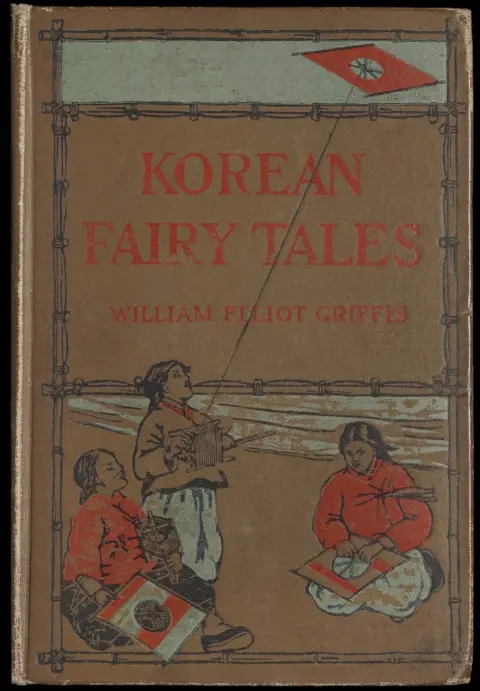
William Elliot Griffis
William Elliot Griffis

William Elliot Griffis
BEHIND THE BOOK
This eBook is for the use of anyone anywhere in the United States and most other parts of the world at no cost and with almost no restrictions whatsoever. You may copy it, give it away or re-use it under the terms of the Project Gutenberg License included with this eBook or online at www.gutenberg.org. If you are not located in the United States, you will have to check the laws of the country where you are located before using this eBook. Read the source licence.
The original source file, including credits and licence, is retained by this library. Request an original-format copy at no charge. Please include the book title and Project Gutenberg identifier #15516.
KEEP YOUR CURIOSITY GOING

David Patterson (Spirit) Hatch

David Patterson (Spirit) Hatch

David Patterson (Spirit) Hatch
Cécile Tormay

Moritz Busch
John L. Ransom