
Last letters from the living dead man
David Patterson (Spirit) Hatch
THE CLASSIC COLLECTION · 1922
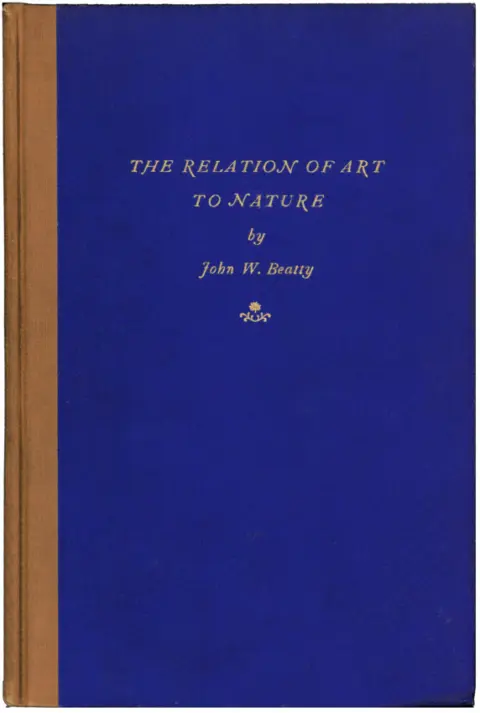
"The Relation of Art to Nature" by John W. Beatty is a philosophical treatise on the interconnection between art and the natural world, written in the early 20th century. As a prominent painter and Director of Fine Arts at the Carnegie Institute, Beatty draws on his extensive experience and the perspectives of other distinguished artists and philosophers. The book explores the fundamental assertion that art serves to imitate and reveal the beauty and character inherent in nature, challenging the prevailing notion that art is purely a creative endeavor. In this work, Beatty argues that the true purpose of art lies in its ability to faithfully reproduce the qualities of nature, thereby capturing its essence. He supports his thesis with insights from renowned artists such as Michelangelo, Dürer, and Whistler, who extoll the virtues of representing nature with accuracy and depth. The text also examines historical views on art, the necessity of aesthetic beauty, and the role of structures like symmetry within artistic endeavors. By emphasizing the significance of observation and truthful representation, Beatty ultimately calls for a deeper appreciation of the artist's relationship with nature, suggesting that this bond is essential for the creation of enduring masterpieces.
Introduction adapted from the source catalogue; source summaries may be automatically generated.
Free to read · English · 15,909 words · No account needed
MAKE TIME FOR A GOOD BOOK
On by default. Untick to stop anonymous reading totals. Each page counts after 10 seconds in view. How this works.
Anonymous counting is on unless you have switched it off.
Text enclosed by underscores is in italics (italics).
Sidenotes are identified as: [SN: text of sidenote].
Additional Transcriber’s Notes are at the end.
The Relation of Art to Nature
by John W. Beatty
New York
William Edwin Rudge
1922
Copyright, 1922
by JOHN W. BEATTY
To my gentle wife this little volume
is affectionately dedicated.
Contents
ARGUMENT Page 1
Authorities Quoted
Kuo Hsi 11th Century
Leonardo da Vinci 1452-1519
Albrecht Dürer 1471-1528
Michelangelo Buonarotti 1475-1564
William Hogarth 1697-1764
Sir Joshua Reynolds 1723-1792
Gilbert Stuart 1755-1828
Sir Thomas Lawrence 1769-1830
John Constable 1776-1837
Jean-Baptiste Camille Corot 1796-1875
Jean François Millet 1814-1875
James Abbott McNeill Whistler 1834-1903
John La Farge 1835-1910
Winslow Homer 1836-1910
Anton Mauve 1838-1888
Auguste Rodin 1840-1915
Abbott Handerson Thayer 1849-1921
Henry Ward Ranger 1858-1916
Giovanni Segantini 1858-1899
Socrates 470-399 B. C.
Plato 427-347 B. C.
Aristotle 384-322 B. C.
Baron Gottfried Wilhelm von Leibnitz 1646-1716
Alexander Gottlieb Baumgarten 1714-1762
Immanuel Kant 1724-1804
Georg Wilhelm Friedrich Hegel 1770-1831
Arthur Schopenhauer 1788-1860
John Stuart Blackie 1809-1895
James Anthony Froude 1818-1894
Jean Henri Fabre 1823-1915
Hippolyte Adolphe Taine 1828-1893
William Angus Knight 1836-1916
Lord James Bryce 1838-1922
Lafcadio Hearn 1850-1904
Maurice Maeterlinck 1862-
Sei-ichi Taki
Introduction
In his very convincing and lucid treatise on the fundamental principles of art, John W. Beatty gives us a most absorbing theme to follow--the relation of art to nature, as expressed in their own words by artists themselves, of different times and creeds; with, too, the opinions of philosophers and men of letters.
Himself a well-known painter, Mr. Beatty has been for almost thirty years the enlightened Director of Fine Arts of the Carnegie Institute, where, alone in our whole country, are held annually International Exhibitions of Art. Much of his life has thus been spent in intimate association with the very best painters and sculptors of our generation, and his and their opinions and observations are here to be read with much pleasure and profit by every one interested in art.
Mr. Beatty is quite right when he says, “Not many able artists have recorded their opinions.” In conversation, or on the impulse of the moment they may often speak with great beauty and clarity of expression, but nearly always tersely and to the point. On the other hand, the man of letters is more given to analysis and finds more words, and more beautiful ones, to express his meaning.
Your reading position is saved on this browser. Take it to another device with a library code. Reading pages adapt to text, rather than matching a printed edition.
BEHIND THE BOOK
This eBook is for the use of anyone anywhere in the United States and most other parts of the world at no cost and with almost no restrictions whatsoever. You may copy it, give it away or re-use it under the terms of the Project Gutenberg License included with this eBook or online at www.gutenberg.org. If you are not located in the United States, you will have to check the laws of the country where you are located before using this eBook. Read the source licence.
The original source file, including credits and licence, is retained by this library. Request an original-format copy at no charge. Please include the book title and Project Gutenberg identifier #53477.
KEEP YOUR CURIOSITY GOING
David Patterson (Spirit) Hatch
Coulson Kernahan

Ralph Waldo Emerson
Frances Wright

Edwin Abbott Abbott

Joseph Droz