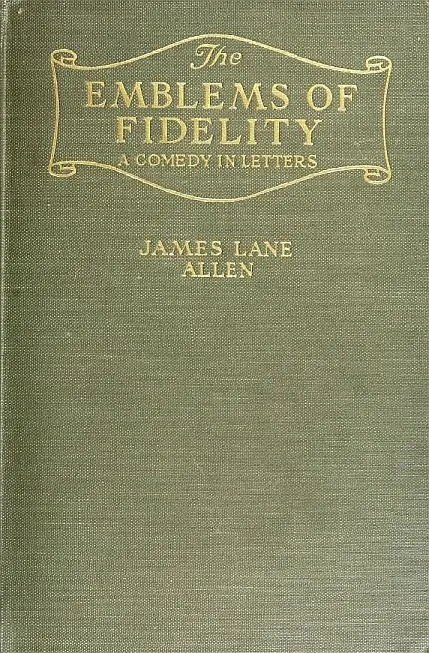
The Emblems of Fidelity: A Comedy in Letters
James Lane Allen
THE CLASSIC COLLECTION · 1900
"The Reign of Law; a tale of the Kentucky hemp fields" by James Lane Allen is a novel written during the late 19th century. It explores the life of Kentucky farmers in the context of hemp cultivation, intertwining agricultural practices with themes of personal and societal struggle. The story begins by highlighting the historical significance of hemp in Kentucky and delves into the lives of its people, with a focus on the impact of this crop on their livelihoods and relationships. The opening of the novel paints a vivid picture of the rich landscape of Kentucky, detailing the cultivation of hemp and the labor involved in its production. It introduces a pioneer community defined by their hard work and the changes brought about by the cultivation of hemp, as it shifts from being a necessity for basic needs to a lucrative cash crop. During this backdrop of agricultural life, the narrative sets the stage for the struggles and aspirations of its characters, including a deacon expelled from a church for his open-mindedness, and a young man, David, who dreams of attending a new university. This opening portion establishes a complex interplay between the characters' personal desires and the cultural and economic forces shaping their lives amidst the natural world.
Introduction adapted from the source catalogue; source summaries may be automatically generated.
Free to read · English · 64,433 words · No account needed
MAKE TIME FOR A GOOD BOOK
On by default. Untick to stop anonymous reading totals. Each page counts after 10 seconds in view. How this works.
Anonymous counting is on unless you have switched it off.
The lad's face was overspread with ghastly pallor; he had lost control
of himself.
"I have not been sick. I am perfectly well," he said at length, looking from one to the other with forlorn, remorseful affection. They had drawn a chair close, one on each side of him. "How are you, mother? How are you, father?"
The change in HIM!--that was all they saw. As soon as he spoke, they knew he was in good health. Then the trouble was something else, more terrible. The mother took refuge in silence as a woman instinctively does at such times; the father sought relief in speech.
"What is the matter? What happened?"
After a moment of horrible silence, David spoke:--
"Ah, father! How can I ever tell you!"
"How can you ever tell me?"
The rising anger mingled with distrust and fear in those words! How
many a father knows!
"Oh, what is it!" cried his mother, wringing her hands, and bursting into tears. She rose and went to her seat under the mantelpiece.
"What have you done?" said his father, also rising and going back to
his seat.
There was a new sternness in his voice; but the look which returned suddenly to his eyes was the old life-long look.
The lad sat watching his father, dazed by the tragedy he was facing.
"It is my duty to tell you as soon as possible--I suppose I ought to
tell you now."
"Then speak--why do you sit there--"
The words choked him.
"Oh! oh!--"
"Mother, don't!--"
"What is it?"
"Father, I have been put out of college and expelled from the church."
How loud sounded the minute noises of the fire--the clocks--the blows of an axe at the woodpile--the lowing of a cow at the barn.
The question was put at length in a voice flat and dead. It summed up a lifetime of failure and admitted it. After an interval it was put again:--
"I do not believe the Bible any longer. I do not believe in
Christianity."
"Oh, don't do THAT!"
The cry proceeded from David's mother, who crossed quickly and sat
beside her husband, holding his hand, perhaps not knowing her own
motive.
This, then, was the end of hope and pride, the reward of years of self-denial, the insult to all this poverty. For the time, even the awful nature of his avowal made no impression.
After a long silence, the father asked feebly:--
Suddenly he rose, and striding across to his son, struck him one blow
with his mind:--
Your reading position is saved on this browser. Take it to another device with a library code. Reading pages adapt to text, rather than matching a printed edition.
James Lane Allen
James Lane Allen
James Lane Allen
James Lane Allen
BEHIND THE BOOK
This eBook is for the use of anyone anywhere in the United States and most other parts of the world at no cost and with almost no restrictions whatsoever. You may copy it, give it away or re-use it under the terms of the Project Gutenberg License included with this eBook or online at www.gutenberg.org. If you are not located in the United States, you will have to check the laws of the country where you are located before using this eBook. Read the source licence.
The original source file, including credits and licence, is retained by this library. Request an original-format copy at no charge. Please include the book title and Project Gutenberg identifier #3791.
KEEP YOUR CURIOSITY GOING
Coulson Kernahan

Maurice Baring
Frances Wright
Cécile Tormay

Frederic Jesup Stimson

W. H. P. (William Henry Pope) Jarvis