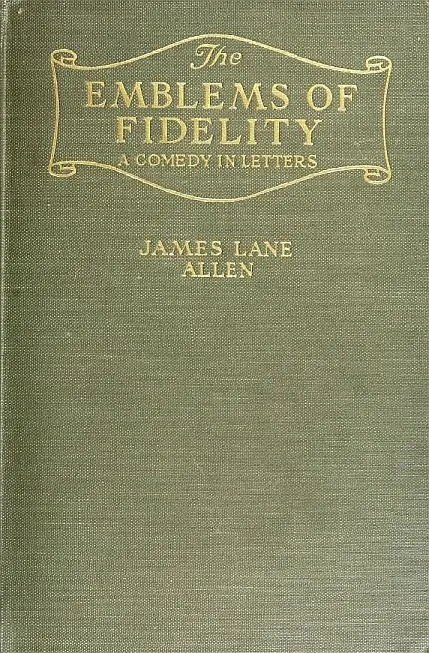
The Emblems of Fidelity: A Comedy in Letters
James Lane Allen
THE CLASSIC COLLECTION · 1900
"The Reign of Law; a tale of the Kentucky hemp fields" by James Lane Allen is a novel written during the late 19th century. It explores the life of Kentucky farmers in the context of hemp cultivation, intertwining agricultural practices with themes of personal and societal struggle. The story begins by highlighting the historical significance of hemp in Kentucky and delves into the lives of its people, with a focus on the impact of this crop on their livelihoods and relationships. The opening of the novel paints a vivid picture of the rich landscape of Kentucky, detailing the cultivation of hemp and the labor involved in its production. It introduces a pioneer community defined by their hard work and the changes brought about by the cultivation of hemp, as it shifts from being a necessity for basic needs to a lucrative cash crop. During this backdrop of agricultural life, the narrative sets the stage for the struggles and aspirations of its characters, including a deacon expelled from a church for his open-mindedness, and a young man, David, who dreams of attending a new university. This opening portion establishes a complex interplay between the characters' personal desires and the cultural and economic forces shaping their lives amidst the natural world.
Introduction adapted from the source catalogue; source summaries may be automatically generated.
Free to read · English · 64,433 words · No account needed
MAKE TIME FOR A GOOD BOOK
On by default. Untick to stop anonymous reading totals. Each page counts after 10 seconds in view. How this works.
Anonymous counting is on unless you have switched it off.
"In the smoke-house," she said with a ripple of laughter. Gabriella, when she was merry, made one, think of some lovely green April hill, snow-capped.
David shook his head slowly. His eyes grew soft and mysterious.
"It was the first time I ever saw YOU," she protested.
He continued to shake his head, and she looked puzzled.
"You saw me once before that, and smiled at me."
Gabriella seemed incredulous and not well pleased.
After a little while David began in the manner of one who sets out to tell a story he is secretly fond of.
"Do you remember standing on the steps of a church the Friday evening before Christmas--a little after dark?"
Gabriella's eyes began to express remembrance. "A wagon-load of cedar had just been thrown out on the sidewalk, the sexton was carrying it into the church, some children were helping, you were making a wreath: do you remember?"
She knew every word of this.
"A young man--a Bible student--passed, or tried to pass. You smiled at his difficulty. Not unkindly," he added, smiling not unkindly himself.
"And that was you? This explains why I have always believed I had seen you before. But it was only for a moment, your face was in the dark; how should I remember?"
After she said this, she looked grave: his face that night had been far
from a happy one.
"That day," continued David, quickly grave also, "that day I saw my professors and pastor for the last time; it ended me as a Bible student. I had left the University and the scene of my trial only a little while before."
He rose as he concluded and took a turn across the room. Then he faced her, smiling a little sadly.
"Once I might have thought all that Providential. I mean, seeing the faces of my professors--my judges--last, as the end of my old life; then seeing your face next--the beginning of the new."
He had long used frankness like this, making no secret of himself, of her influence over him. It was embarrassing; it declared so much, assumed so much, that had never been declared or assumed in any other way. But her stripped and beaten young Samaritan was no labyrinthine courtier, bescented and bedraped and bedyed with worldliness and conventions: he came ever in her presence naked of soul. It was this that empowered her to take the measure of his feeling for her: it had its effect.
David returned to his chair and looked across with a mixture of
hesitancy and determination.
"I have never spoken to you about my expulsion--my unbelief."
After a painful pause she answered.
Your reading position is saved on this browser. Take it to another device with a library code. Reading pages adapt to text, rather than matching a printed edition.
James Lane Allen
James Lane Allen
James Lane Allen
James Lane Allen
BEHIND THE BOOK
This eBook is for the use of anyone anywhere in the United States and most other parts of the world at no cost and with almost no restrictions whatsoever. You may copy it, give it away or re-use it under the terms of the Project Gutenberg License included with this eBook or online at www.gutenberg.org. If you are not located in the United States, you will have to check the laws of the country where you are located before using this eBook. Read the source licence.
The original source file, including credits and licence, is retained by this library. Request an original-format copy at no charge. Please include the book title and Project Gutenberg identifier #3791.
KEEP YOUR CURIOSITY GOING
Coulson Kernahan

Maurice Baring
Frances Wright
Cécile Tormay

Frederic Jesup Stimson

W. H. P. (William Henry Pope) Jarvis