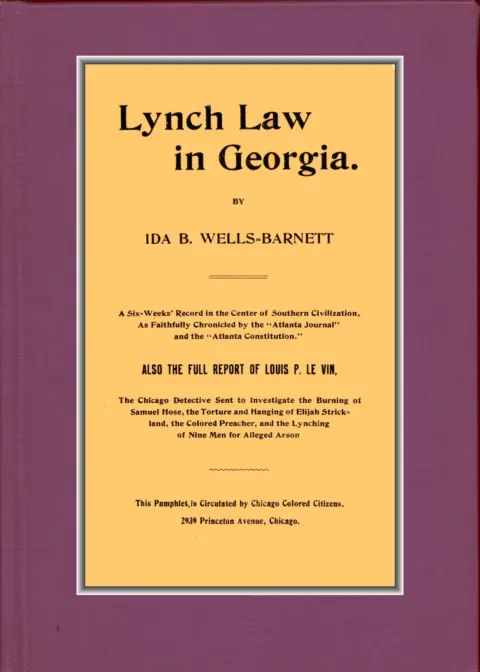
Lynch Law in Georgia
Ida B. Wells-Barnett
THE CLASSIC COLLECTION · 1895
“The Red Record” by Ida B. Wells-Barnett is a historical account written in the late 19th century. This work serves as a powerful and harrowing examination of lynching in the United States, particularly focusing on its impact on African Americans in the South. The text collects and analyzes statistics regarding lynching incidents, scrutinizing the justification of such acts and providing commentary on the societal implications and underlying racial biases of that era. The opening of the pamphlet establishes the context for Wells-Barnett's investigation, addressing the severe moral indifference of American society towards lynchings that had become alarmingly commonplace by 1894. In her preface, letters from notable figures, such as Frederick Douglass, emphasize the need for her work to expose the grave injustices faced by Black individuals, given the overwhelming statistics of murders without judicial process. The beginning chapters outline various excuses historically employed by white southerners to justify such brutal acts, probing into the concepts of racial violence, societal complicity, and the deeply entrenched systems of oppression that not only allowed for but effectively encouraged such lawlessness.
Introduction adapted from the source catalogue; source summaries may be automatically generated.
Free to read · English · 33,699 words · No account needed
MAKE TIME FOR A GOOD BOOK
On by default. Untick to stop anonymous reading totals. Each page counts after 10 seconds in view. How this works.
Anonymous counting is on unless you have switched it off.
April 5, Negro, near Selma, Ala.; April 5, Negro, near Selma, Ala.
May 17, Samuel Wood, Gates City, Va.
April 22, Thomas Black, Tuscumbia, Ala.; April 22, John Williams, Tuscumbia, Ala.; April 22, Toney Johnson, Tuscumbia, Ala.; July 14, William Bell, Dixon, Tenn.; Sept. 1, Daniel Hawkins, Millington, Tenn.; Sept. 1, Robert Haynes, Millington, Tenn.; Sept. 1, Warner Williams, Millington, Tenn.; Sept. 1, Edward Hall, Millington, Tenn.; Sept. 1, John Haynes, Millington, Tenn.; Sept. 1, Graham White, Millington, Tenn.
May 23, William Brooks, Galesline, Ark.
Suspected arson, 2; stealing, 1; political causes, 1; murder, 45; rape, 29; desperado, 1; suspected incendiarism, 1; train wrecking, 1; enticing servant away, 1; kidnapping, 1; unknown offense, 6; larceny, 1; barn burning, 10; writing letters to a white woman, 1; without cause, 1; burglary, 1; asking white woman to marry, 1; conspiracy, 1; attempted murder, 1; horse stealing, 3; highway robbery, 1; alleged rape, 1; attempted rape, 11; race prejudice, 2; introducing smallpox, 1; giving information, 1; conjuring, 1; incendiarism, 2; arson, 1; assault, 1; no offense, 1; alleged murder, 2; total (colored), 134.
Mississippi, 15; Arkansas, 8; Virginia, 5; Tennessee, 15; Alabama, 12; Kentucky, 12; Texas, 9; Georgia, 19; South Carolina, 5; Florida, 7; Louisiana, 15; Missouri, 4; Ohio, 2; Maryland, 1; West Virginia, 2; Indiana, 1; Kansas, 1; Pennsylvania, 1.
January, 11; February, 17; March, 8; April, 36; May, 16; June, 31; July, 21; August, 4; September, 17; October, 7; November, 9; December, 20; total colored and white, 197.
July 24, unknown woman, race prejudice, Sampson County, Miss.; March 6, unknown, woman, unknown offense, Marche, Ark.; Dec. 5, Mrs. Teddy Arthur, unknown cause, Lincoln County, W. Va.
It is a well-established principle of law that every wrong has a remedy. Herein rests our respect for law. The Negro does not claim that all of the one thousand black men, women and children, who have been hanged, shot and burned alive during the past ten years, were innocent of the charges made against them. We have associated too long with the white man not to have copied his vices as well as his virtues. But we do insist that the punishment is not the same for both classes of criminals. In lynching, opportunity is not given the Negro to defend himself against the unsupported accusations of white men and women. The word of the accuser is held to be true and the excited bloodthirsty mob demands that the rule of law be reversed and instead of proving the accused to be guilty, the victim of their hate and revenge must prove himself innocent. No evidence he can offer will satisfy the mob; he is bound hand and foot and swung into eternity. Then to excuse its infamy, the mob almost invariably reports the monstrous falsehood that its victim made a full confession before he was hanged.
Your reading position is saved on this browser. Take it to another device with a library code. Reading pages adapt to text, rather than matching a printed edition.
Ida B. Wells-Barnett
Ida B. Wells-Barnett
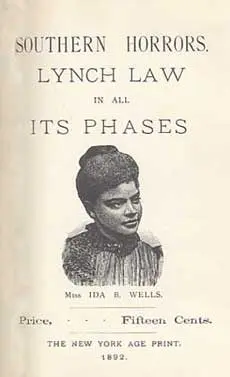
Ida B. Wells-Barnett
BEHIND THE BOOK
This eBook is for the use of anyone anywhere in the United States and most other parts of the world at no cost and with almost no restrictions whatsoever. You may copy it, give it away or re-use it under the terms of the Project Gutenberg License included with this eBook or online at www.gutenberg.org. If you are not located in the United States, you will have to check the laws of the country where you are located before using this eBook. Read the source licence.
The original source file, including credits and licence, is retained by this library. Request an original-format copy at no charge. Please include the book title and Project Gutenberg identifier #14977.
KEEP YOUR CURIOSITY GOING
Cécile Tormay

Moritz Busch
Coulson Kernahan
John L. Ransom

Maurice Baring
Frances Wright