
Last letters from the living dead man
David Patterson (Spirit) Hatch
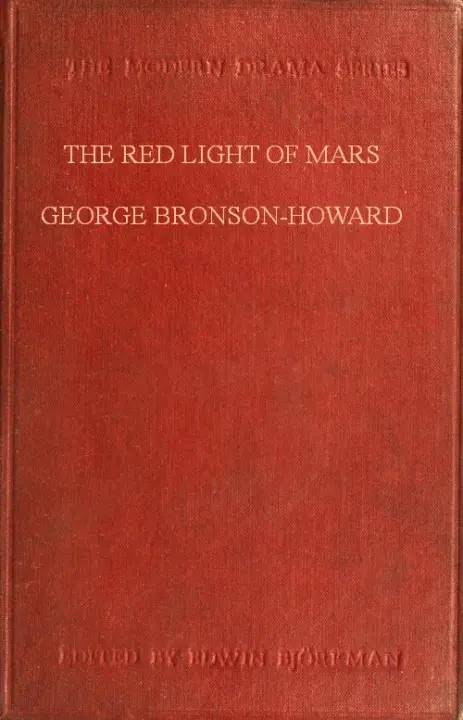
THE CLASSIC COLLECTION · 1913
"The Red Light of Mars; or, A Day in the Life of the Devil" by George Bronson-Howard is a philosophical comedy written in the early 20th century. The work explores profound themes through sharp dialogue and character interactions, likely following the lives of scientific and social figures as they navigate ambition, love, and morality. The lead character, Thomas Vanillity, is introduced as a college professor, setting the stage for an exploration of the clash between scientific discovery and societal expectations. The opening of the play establishes a sunny winter morning in the study of Dr. Addington Agnus, an ambitious scientist on the brink of a significant discovery. As characters such as Judge Hippolyte Critty and Professor Vanillity enter, the narrative builds around Agnus's forthcoming meeting with potential corporate benefactors, John Magnus and William Tromper, who intend to lure him away from his true scientific pursuits for financial gain. The conversation reveals tensions surrounding the temptation of wealth and the sacrifices of personal principles, highlighting the overarching conflict between material ambition and the pursuit of genuine knowledge or love as Fanny, the daughter of Mrs. Felix, enters bearing her own aspirations intertwined with those of Agnus. This tension is further intensified as Agnus grapples with the implications of accepting the offer that threatens to derail his quest for immortality through scientific exploration.
Introduction adapted from the source catalogue; source summaries may be automatically generated.
Free to read · English · 29,727 words · No account needed
MAKE TIME FOR A GOOD BOOK
On by default. Untick to stop anonymous reading totals. Each page counts after 10 seconds in view. How this works.
Anonymous counting is on unless you have switched it off.
John, that’s petty! That’s small, John. I never knew you to be petty or
small before.
SCHWARTZENHOPFEL (to Mrs. Felix)
Wait! (To Tromper) Saving? How?
TROMPER (stuttering)
Why, the Churchstead strike alone—
SCHWARTZENHOPFEL (militantly)
Strike! Ha! Go on! What did you do?
TROMPER (miserably)
You know well enough what I did, sir—
Tell me anyhow—
I locked ’em out, the bums!
What did they want? Just union rates, union hours; white men’s pay, white men’s hours; not nigger slaves—?
MRS. FELIX (admiringly)
Bravo, John! You ’re shaping up!
[The light moves closer, as if listening intently.
SCHWARTZENHOPFEL (nodding)
I told you to wait! (To Tromper) You beat them, didn’t you?
And a tough job! Strike-breakers weren’t enough—
SCHWARTZENHOPFEL (to Mrs. Felix)
New York thugs, gunmen—with brass knuckles, hand spikes, and automatics—licensed to bruise, maim and kill—
Weren’t the strikers breaking windows and burning fences? Didn’t they threaten to burn the works?
Fighting for their children and their homes, they were—for the right to have more than cattle or pigs—more than a place to sleep—and enough food to keep them working. Food! Ha! Like gasoline put into a motor-car—
I was fighting to save you money—
Against the men you used to work with, side by side, your own
blood-brothers—
No brothers of mine, those sweating, smelly ignorant dogs! I might have been born one. That wasn’t my fault. But I didn’t stay one.
No, and I’ll bet I know why. Because you spied on them, carried tales, for little foreman jobs, and sweated more work out of them.
TROMPER (bitterly)
Always saving you money—
MRS. FELIX (to Schwartzenhopfel)
You see, John: all crime, bloodshed, murder finally comes back to yourself. He said it: “Always saving you money.”
I’m going to change all that. Consequently I don’t need his sort any
more.
MRS. FELIX (delightedly)
You are? (Suspiciously) But so suddenly—what’s changed you?
SCHWARTZENHOPFEL (points toward the laboratory) The—(corrects himself) D—Doctor. (Enthusiastically) The trouble about us human beings is that we don’t know nothing about nothing—
Can’t you be moral and retain your grammar?
SCHWARTZENHOPFEL (disregarding her, enthusiastically) Then he comes along (pointing toward laboratory) and shows us that millionaires on one hand—anarchists on the other—are one part right, ninety-nine parts wrong—
FANNY (bursts into wild tears again)
And I’ve lost him! I’ve lost him!
[Mrs. Felix comforts her.
SCHWARTZENHOPFEL (to Tromper)
How much have you saved? Not for me—for yourself?
TROMPER (haughtily)
I don’t save; I invest.
Your reading position is saved on this browser. Take it to another device with a library code. Reading pages adapt to text, rather than matching a printed edition.
BEHIND THE BOOK
This eBook is for the use of anyone anywhere in the United States and most other parts of the world at no cost and with almost no restrictions whatsoever. You may copy it, give it away or re-use it under the terms of the Project Gutenberg License included with this eBook or online at www.gutenberg.org. If you are not located in the United States, you will have to check the laws of the country where you are located before using this eBook. Read the source licence.
The original source file, including credits and licence, is retained by this library. Request an original-format copy at no charge. Please include the book title and Project Gutenberg identifier #57598.
KEEP YOUR CURIOSITY GOING
David Patterson (Spirit) Hatch
Coulson Kernahan

Ralph Waldo Emerson
Frances Wright

Edwin Abbott Abbott

Joseph Droz