
Last letters from the living dead man
David Patterson (Spirit) Hatch
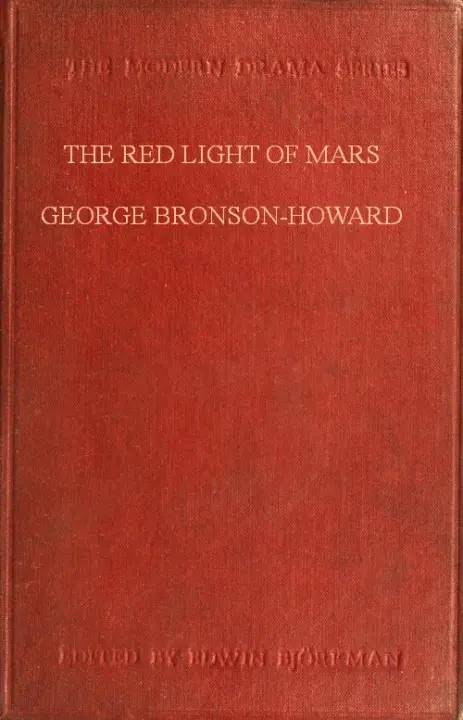
THE CLASSIC COLLECTION · 1913
"The Red Light of Mars; or, A Day in the Life of the Devil" by George Bronson-Howard is a philosophical comedy written in the early 20th century. The work explores profound themes through sharp dialogue and character interactions, likely following the lives of scientific and social figures as they navigate ambition, love, and morality. The lead character, Thomas Vanillity, is introduced as a college professor, setting the stage for an exploration of the clash between scientific discovery and societal expectations. The opening of the play establishes a sunny winter morning in the study of Dr. Addington Agnus, an ambitious scientist on the brink of a significant discovery. As characters such as Judge Hippolyte Critty and Professor Vanillity enter, the narrative builds around Agnus's forthcoming meeting with potential corporate benefactors, John Magnus and William Tromper, who intend to lure him away from his true scientific pursuits for financial gain. The conversation reveals tensions surrounding the temptation of wealth and the sacrifices of personal principles, highlighting the overarching conflict between material ambition and the pursuit of genuine knowledge or love as Fanny, the daughter of Mrs. Felix, enters bearing her own aspirations intertwined with those of Agnus. This tension is further intensified as Agnus grapples with the implications of accepting the offer that threatens to derail his quest for immortality through scientific exploration.
Introduction adapted from the source catalogue; source summaries may be automatically generated.
Free to read · English · 29,727 words · No account needed
MAKE TIME FOR A GOOD BOOK
On by default. Untick to stop anonymous reading totals. Each page counts after 10 seconds in view. How this works.
Anonymous counting is on unless you have switched it off.
PEATTIE (to the Detectives)
What’s gone wrong, pardners? Why don’t you handcuff that there
dynamiter?
LIEUTENANT (roughly)
What dynamiter?
PEATTIE (points to Agnus)
Fellow you’ve been hunting for all day—
LIEUTENANT (taking out his note-book)
Will you swear he’s a dynamiter?
I ain’t never heard of him before. How’ll I swear?
LIEUTENANT (trying to make his tone official by speaking sternly, as if determined to get at evidence)
You’ve seen him about the village every day?
Sure—but—
Just answer my questions: how has he behaved?
I see him going into Pete Mellish’s and into Gus Hobbs’s—
LIEUTENANT (with heavy constabulary levity)
And—did he try to dynamite—er—Pete Jellyfish—or Corn Cob’s—whatever
their names are?
Hush, man! Pete’s our grocer. Gus’s our butcher. Prisoner’s human, ain’t he? He’s got to eat—
LIEUTENANT (making note)
Bought groceries and meat daily. (Relieved) Well, that ain’t criminal.
PEATTIE (sulkily)
I never see him dynamite nobody, if that’s what you’re trying to get at. Allus bin civil enough to me. Gi’me a cigar once.
LIEUTENANT (poising pencil with same heavy police humor) Ah! Cigar!
Loaded?
PEATTIE (annoyed)
No, ’twarn’t. ’Twas as good as any two fer a nickel I ever bought myself.
SCHWARTZENHOPFEL (scandalized as he remembers the episode and the price) Two for a nickel! It was a—(Pulls himself up sharply)
LIEUTENANT (explaining apologetically, supposing the outbreak to be due to a millionaire’s ignorance of such cheap matters) An expression, Mr. Magnus—“twofera nickel” is two cigars for five cents. Rubes smoke ’em.
PEATTIE (angry)
Rubes, eh? Well, thank Joshyouway, I ain’t a New Yorker, mister—where every next fella’s a Harp or a Ginny, a Kike or a Polack; where haff of ’em don’t even talk Amurrican. (Turning to The Devil, who has been listening with approval) Doctor Agnus, be ashamed of yourself! I’m older’n you: old enough to be Sheriff here when your daddy was Senator. And your dad, young gentleman, he told me to arrest old Commodore Vanderbilt. Yes, sir—the Commodore—driving his hosses too fast ‘long Main Street, endangerin’ lives and limbs of old women and children. Your dad, he sez: “St. Elmo, no matter who he is, any big man that breaks laws is little.” Little, yes, sir; and why? “Because,” says your dad, the Honnible Maxwell Agnus, “because, Sheriff, people who don’t know no better is goin’to say: ‘If the biggest man in the country breaks laws then them laws ’es no good’—and so,” sez your dad, “ignorant people start breakin’ ’em too—” and, sez he, “the law’s like a brick barn, Sheriff; taking one brick out makes the walls git weak and, pritty soon, the whole blamed thing starts tumbling down.”
Your reading position is saved on this browser. Take it to another device with a library code. Reading pages adapt to text, rather than matching a printed edition.
BEHIND THE BOOK
This eBook is for the use of anyone anywhere in the United States and most other parts of the world at no cost and with almost no restrictions whatsoever. You may copy it, give it away or re-use it under the terms of the Project Gutenberg License included with this eBook or online at www.gutenberg.org. If you are not located in the United States, you will have to check the laws of the country where you are located before using this eBook. Read the source licence.
The original source file, including credits and licence, is retained by this library. Request an original-format copy at no charge. Please include the book title and Project Gutenberg identifier #57598.
KEEP YOUR CURIOSITY GOING
David Patterson (Spirit) Hatch
Coulson Kernahan

Ralph Waldo Emerson
Frances Wright

Edwin Abbott Abbott

Joseph Droz