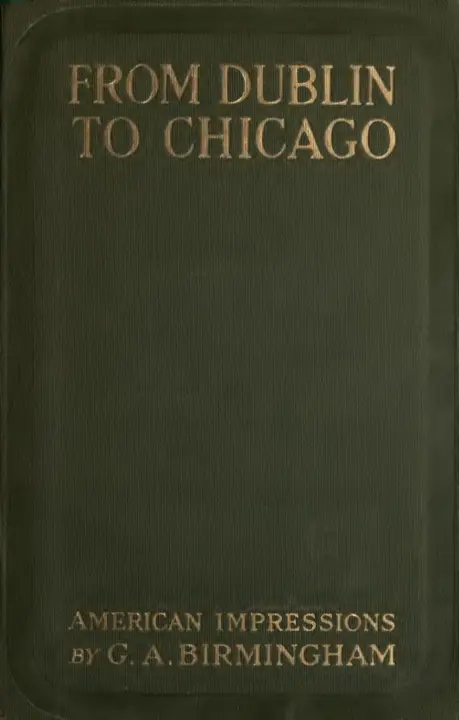
From Dublin to Chicago: Some Notes on a Tour in America
George A. Birmingham
THE CLASSIC COLLECTION · 1912
"The Red Hand of Ulster" by George A. Birmingham is a historical novel written in the early 20th century. The story delves into the complex political tensions in Ireland surrounding the Home Rule debate and features characters such as Joseph Peterson Conroy, a wealthy American, and Bob Power, his adventurous Irish secretary, as they become embroiled in revolutionary political schemes. The narrative weaves through their ambitions and the social dynamics of English society and Irish nationalism. The opening portion of the narrative introduces Conroy, who, having recently made a fortune, becomes disillusioned with London society and the emptiness of his extravagant lifestyle. He seeks something more thrilling and, through his discussions with Bob, contemplates stirring unrest in Ireland, suggesting financing a rebellion in the face of British authority. Meanwhile, Bob Power's perspective on the politics of Ireland reveals a mix of skepticism and loyalty, as he navigates their growing ambitions. Their conversations hint at a looming conflict between the Irish nationalists and loyalists, framing the exciting premise for the developing plot.
Introduction adapted from the source catalogue; source summaries may be automatically generated.
Free to read · English · 74,043 words · No account needed
MAKE TIME FOR A GOOD BOOK
On by default. Untick to stop anonymous reading totals. Each page counts after 10 seconds in view. How this works.
Anonymous counting is on unless you have switched it off.
"They gave him quite a fair trial," said Bland, "and had just
condemned him when--"
"That fellow Crossan in particular," said Godfrey.
"The Colonel ran round to tell you," said Bland. "I rather fancy they wanted to get off carrying out the sentence if they could."
"A lot of fellows," said Godfrey sulkily, "who ought to be wheeling barrows! But it's very largely your fault, Excellency. You always encouraged that class. If you'd kept them in their proper places--"
"What on earth brought you to Belfast?" I said. "Why didn't you stay at home? Nobody wants you here. Why did you come?"
Godfrey looked uneasily at Bland. He evidently did not want to make his reason for coming to Belfast public property. Godfrey is usually quite shameless. I could only imagine that he had done something of a peculiarly repulsive kind.
"Well," I said, "why did you come?"
He looked at Bland again, and then nodded sideways at me.
"I suppose," I said, "that you thought there might be some assessment made by the Government of the amount of damage done in the town, and that if you started valuing things at once on your own hook, you might possibly get a job out of it."
"But is there?" said Godfrey eagerly; "for if there is--"
"So far as I know there isn't," I said.
"Anyhow it wasn't that which brought me to Belfast. The fact is, Excellency, I couldn't very well stay at home. You remember,"--here his voice sunk to a whisper--"what I told you about the Pringles."
"Your bank account?"
"No. Not that. The girl, I mean. Tottie Pringle."
"Oh yes, I remember."
"Well, old Pringle began to get offensive. He seemed to think that I
ought to--you know."
"Marry her? I expect you ought."
"Excellency?" said Godfrey in genuine horror and amazement.
"By the way," said Bland, "I forgot to mention that I promised the court martial to get your nephew out of Belfast before to-morrow morning. I hope you don't mind. They wouldn't let him go on any other condition."
"Quite right," I said. "Godfrey shall start to-night."
"I don't see why I should," said Godfrey. "I don't think it's at all nice of you, Excellency, to--"
"And while we're at it," I said, "we may as well ship off Clithering. Godfrey let me introduce you to--"
I looked round and discovered that Clithering was not in the room.
"I hope to goodness," I said, "that he's not gone out to get himself hanged. He rather wanted to a few minutes ago."
"It's all right," said Bland. "I saw him going upstairs. I expect he's
looking for his clothes."
Your reading position is saved on this browser. Take it to another device with a library code. Reading pages adapt to text, rather than matching a printed edition.
George A. Birmingham
George A. Birmingham
George A. Birmingham
George A. Birmingham
BEHIND THE BOOK
This eBook is for the use of anyone anywhere in the United States and most other parts of the world at no cost and with almost no restrictions whatsoever. You may copy it, give it away or re-use it under the terms of the Project Gutenberg License included with this eBook or online at www.gutenberg.org. If you are not located in the United States, you will have to check the laws of the country where you are located before using this eBook. Read the source licence.
The original source file, including credits and licence, is retained by this library. Request an original-format copy at no charge. Please include the book title and Project Gutenberg identifier #29533.
KEEP YOUR CURIOSITY GOING
Cécile Tormay

Moritz Busch
Coulson Kernahan
John L. Ransom

Maurice Baring
Frances Wright