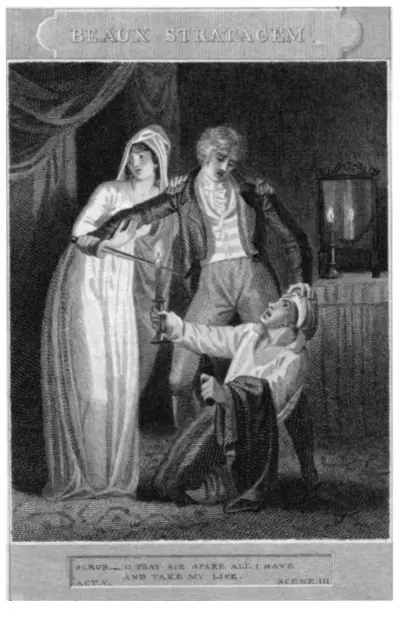
The Beaux-Stratagem: A comedy in five acts
George Farquhar
THE CLASSIC COLLECTION · 1706
"The Recruiting Officer" by George Farquhar is a play written in 1706. It follows two English Army officers—the womanizing Captain Plume and the cowardly Captain Brazen—as they recruit soldiers in Shrewsbury. Their military mission becomes entangled with romantic pursuits and social schemes. Sylvia disguises herself as a male recruit to be near Plume, while Worthy attempts to win back the now-wealthy Melinda. Through mistaken identities, dubious recruiting tactics, and romantic rivalries, the play weaves together the complications of love and ambition in this Restoration comedy.
Introduction adapted from the source catalogue; source summaries may be automatically generated.
Free to read · English · 21,284 words · No account needed
MAKE TIME FOR A GOOD BOOK
On by default. Untick to stop anonymous reading totals. Each page counts after 10 seconds in view. How this works.
Anonymous counting is on unless you have switched it off.
Kite. This man is but one man, the country may spare him, and the army wants him; besides, he's cut out by nature for a grenadier; he's five feet ten inches high; he shall box, wrestle, or dance the Cheshire round with any man in the country; he gets drunk every Sabbath-day, and he beats his wife.
Wife. You lie, sirrah, you lie; an please your worship, he's the best natured pains-taking'st man in the parish, witness my five poor children.
Scrup. A wife and five children? you constable, you rogue, how durst you impress a man that has a wife and five children?
Scale. Discharge him, discharge him.
Bal. Hold, gentlemen. Harkye, friend, how do you maintain your wife
and five children?
Plume. They live upon wild-fowl and venison, sir; the husband keeps a gun, and kills all the hares and partridges within five miles round.
Bal. A gun! nay if he be so good at gunning, he shall have enough
on't. He may be of use against the French, for he shoots flying to be
sure.
Scrup. But his wife and children, Mr. Balance?
Wife. Ay, ay, that's the reason you would send him away; you know I have a child every year, and you are afraid that they should come upon the parish at last.
Plume. Lookye there, gentlemen; the honest woman has spoke it at once; the parish had better maintain five children this year, than six or seven the next. That fellow, upon this high feeding, may get you two or three beggars at a birth.
Wife. Lookye, Mr. Captain, the parish shall get nothing by sending him away, for I won't lose my teeming-time, if there be a man left in the parish.
Bal. Send that woman to the house of correction,----and the man----
Kite. I'll take care of him, if you please. [Takes him down.
Scale. Here, you constable, the next. Set up that black-faced fellow, he has a gunpowder look; what can you say against this man, constable?
Const. Nothing, but that he's a very honest man.
Plume. Pray, gentlemen, let me have one honest man in my company, for
the novelty's sake.
Bal. What are you, friend?
Mob. A collier; I work in the coal-pits.
Scrup. Lookye, gentlemen, this fellow has a trade, and the act of parliament here expresses, that we are to impress no man that has any visible means of a livelihood.
Kite. May it please your worship, this man has no visible means of a livelihood, for he works underground.
Plume. Well said, Kite; besides, the army wants miners.
Your reading position is saved on this browser. Take it to another device with a library code. Reading pages adapt to text, rather than matching a printed edition.
BEHIND THE BOOK
This eBook is for the use of anyone anywhere in the United States and most other parts of the world at no cost and with almost no restrictions whatsoever. You may copy it, give it away or re-use it under the terms of the Project Gutenberg License included with this eBook or online at www.gutenberg.org. If you are not located in the United States, you will have to check the laws of the country where you are located before using this eBook. Read the source licence.
The original source file, including credits and licence, is retained by this library. Request an original-format copy at no charge. Please include the book title and Project Gutenberg identifier #37012.
KEEP YOUR CURIOSITY GOING
Maurice Baring
W. B. (William Butler) Yeats
Edward Martyn

John Brougham & Charlotte Brontë
Marguerite Merington
Leonid Andreyev